Last weekend I took a trip to Washington DC to meet up with an old friend as he passed through the East Coast (and, I might add, a newer friend who now lives there). Being Brits, two of us did all the quintessential tourist stuff that one does – wandered past the official residence of the leader of the free world, took an elevator to the top of the world’s tallest stone structure, reminded ourselves that freedom isn’t free and paid our respects to fallen soldiers, got spaced out (awesome flight simulators) at the World’s largest museum complex, debated the Wall Street Bail Out on the hill, saw some pretty pictures, and drank several of world’s best beers*.
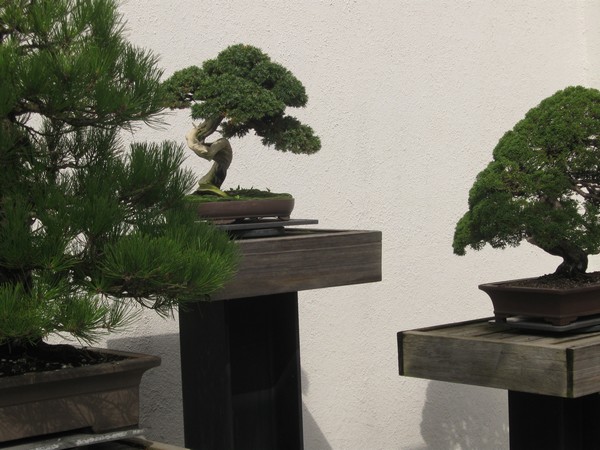
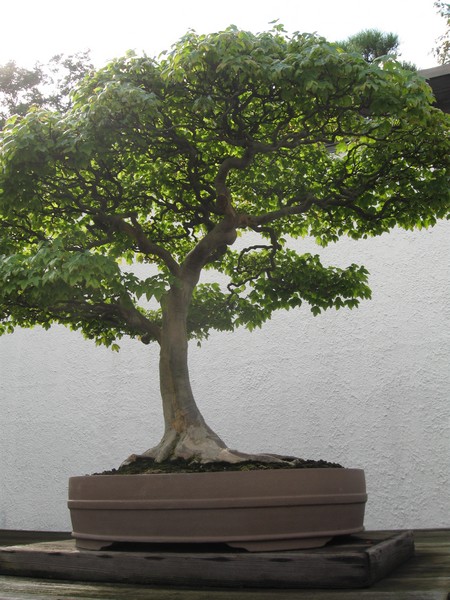
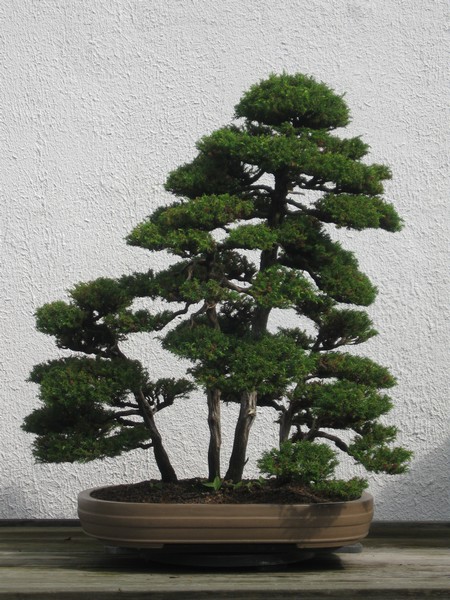
However, despite all that (and all that was very good fun) one of the things that really took my attention was the National Bonsai and Penjing Museum at the National Arboretum. Whilst vaguely aware of Bonsai I don’t think I had ever actually seen a Bonsai tree (or ‘forest’ for that matter) outside of a book. I think I assumed they were just small trees in pots, like potted plants. I certainly have never really appreciated them until now.

Bonsai is the art of cultivating miniature trees through shaping, watering, and repotting. The goal is to produce a tree that is aesthetically pleasing and realises the the principle of ‘heaven and earth in one container’. To some, all the wiring that is required and the stunting of growth may seem un-natural (or even cruel), but the results (when done right, of course) are miniature forms of arboreal beauty, expressing how the past, the present, humanity, the elements, and change itself, are all fundamentally intertwined. Bonsai are not deformed caricatures – if they were we would be unable to associate them with the nature they reflect and as a consequence they would be infinitely less beautiful or intriguing.

If I have have encountered Bonsai infrequently before, I’m sure I have never been aware of the Chinese precursor, <a href="
http://www.manlungpenjing.org/” class=”regular” target=”_blank”>Penjing. Penjing is not limited to the miniaturisation of trees but extends to the culture of idealised landscapes and scenery. Whereas Bonsai is an expression of Zen Buddhism, Penjing is philosophically influenced by Taoism and the concept of a universe containing inherently opposite but complementary forces (Yin and Yang). Penjing may juxtapose organic with mineral (for example using the root-over-rock style of tree culture) or include characters and figures to highlight contrasts in scale.

Initially, I saw Bonsai as idealisations of the untamed, full-size trees they share their genes with. And Penjing seemed to be an attempt to recreate reality on a reduced scale. But I was thinking about them as if they were models – abstract, intentionally objective, representations of reality like the ones we scientists often like to use to better understand the material world. But the more one considers them, observing the trees and the forms produced, and the more one reads and thinks about the philosophies underlying them, the more apparent it is that they are artistic creations that reflect their philosophies. They take the laws of biology and manipulate them to meet our human aesthetic intuitions. There is no claim of objectivity – this is art.
So, there are certainly plenty of venerable museums, monuments, institutions, and buildings in Washington DC. As expected I got to see and appreciate many of them. But I didn’t expect to come away with a greater appreciation and interest in an ancient art form (other than brewing, of course).
*According to the labels on the bottles.

 Direction not Destination