Landscape Ecology paper In Press

We were informed this week that the paper I have been working on with Raul Romero Calcerrada and other colleagues at Universidad Rey Juan Carlos has been accepted by Landscape Ecology. I’ve copied the abstract below. It should be out later in 2008, but email me if you want a pre-print.

Currently I’m working on two paper with colleagues describing the construction and initial results of the model I constructed during my PhD research. We’re also submitting abstracts to the European Geophysics Union General Assembly 2008 on this and work related to the Landscape Ecology paper.

The abstract submitted with colleagues at CSIS has been accepted for poster presentation at the US-IALE meeting in Madison in April. Should be a good meeting. Also, the doi for Perry and Millington (2008) in PPEES now works.

Tomorrow I’m heading back to Europe for a couple of weeks. I have my PhD graduation ceremony next week (maybe I’ll post some photos of me looking scholarly/awkward in my academic dress/get-up), a couple days snowboarding in the Swiss Alps, and a couple of days working with Bruce Malamud at King’s following up on the work we published on US wildfire regimes in PNAS. Should be a fun couple of weeks!

GIS analysis of spatial patterns of wildfire human-caused ignition risk in the SW of Madrid (Central Spain) (In Press) Landscape Ecology

Raul Romero Calcerrada; Carlos J. Novillo Camacho; James DA Millington; Inmaculada Gomez-Jimenez

Abstract: The majority of wildfires in Spain are caused by human activities. However, much wildfire research has focused on the biological and physical aspects of wildfire, with comparatively less attention given to the importance of socio-economic factors. With recent changes in human activity and settlement patterns in many parts of Spain, potentially contributing to the increases in wildfire occurrence recently observed, the need to consider human activity in models of wildfire risk for this region are apparent. Here we use a method from Bayesian statistics, the Weights of Evidence (WofE) model, to examine the causal factors of wildfires in the south west of the Madrid region for two differently defined wildfire seasons. We also produce predictive maps of wildfire risk. Our results show that spatial patterns of wildfire ignition are strongly associated with human access to the natural landscape, with proximity to urban areas and roads found to be the most important causal factors. We suggest these characteristics and recent socio-economic trends in Spain may be producing landscapes and wildfire ignition risk characteristics that are increasingly similar to Mediterranean regions with historically stronger economies, such as California, where the urban-wildland interface is large and recreation in forested areas is high. We also find that the WofE model is useful for estimating future wildfire risk. We suggest the methods presented here will be useful to optimize time,
human resources and fire management funds in areas where urbanization is increasing the urban-forest interface and where human activity is an important cause of wildfire ignition.

Update 06/02/08: This paper is now online here and here.

IALE-IUFRO WG Website


A while back the ‘new’ IALE-IUFRO Working Group website launched, so I thought I’d highlight it here. During the IALE World Congress 2007 in Wageningen, a new IALE-IUFRO working group was approved and sanctioned by both IALE (International Association of Landscape Ecology) and IUFRO (International Union of Forestry Research Organizations):

Forestry was the first major field to recognize the importance of landscape ecology, and today foresters widely know, use, and even develop landscape ecology principles based on experience and science. Landscape ecology is an exciting field for researchers and managers together. In this sense, landscape ecology is viewed as the nexus of ecology, resource management, and land use planning. It is within this framework of synergy and integration that we envisaged this formal link between the two groups.

Thus, the IALE-IUFRO WG aims to collate landscape ecologists with an interest in forest science and ecology including studies and methods for monitoring, planning, designing, and managing forest ecosystems and landscapes. Through the website, members of IALE-IUFRO WG will be able to exchange experiences and share common needs and interests to build up on the strength of the network. This group can serve as an international platform for advocating and updating research and management on forest landscapes.

Tom Veldkamp: Advances in Land Models

As I mentioned before, the Global Land Project website is experimenting with the use of webcasts to enable the wider network to “participate” and use the GLP webpage as a resource. For example, several presentations are available for viewing from the Third Land System Science (LaSyS) Workshop entitled ‘Handling complex series of natural and socio-economic processes’ and held in Denmark in October of 2007. One that caught my attention was by Tom Veldkamp, mainly because of its succinct title: Advances in Land Models [webcast works best in IE].


Presented in the context of other CHANS research, Veldkamp used an example from the south of Spain to discuss recent modelling approaches to examine the effects of human decisions on environmental processes and the feedbacks between human and natural systems. The Spanish example examined the interaction of human land-use decision making and soil erosion. A multi-scale erosion model, LAPSUS, represented the interactive natural and human processes occurring olive groves on steep hillslopes; gullying caused by extreme rainfall events and attempts to preserve soils and remove gullies by ploughing. Monte Carlo simulations were used to explore uncertainties in model results and highlighted the importance of path dependencies. As such, another example of the historical dimension of ‘open’ systems and the difficulties it presents for environmental modellers.

The LAPSUS model was coupled with the well known land use/cover change CLUE model to examine feedbacks between human land use and erosion. The coupled model was used to examine the potential implications of farmers adopting land use practices as a response to erosion. Interestingly, the model suggested that human adaptation strategy modelled would not lead to reduced erosion.

Veldkamp also discusses the issue of validating simulation models of self-organising processes, and suggests that ensemble and scenario approaches such as those used in global climate modelling are necessary for this class of models. However, rather than simply using ‘static’ scenarios that specify model boundary conditions, such as the IPCC SRES scenarios, scenarios that represent some form of feedback with the model itself will be more useful. Again, this comes back to his point about the importance of representing feedbacks in coupled human and natural systems.

For example, Veldkamp suggests the use of “Fuzzy Cognitive Maps” to generate ‘dynamic’ scenarios. Essentially, these fuzzy cognitive maps are produced by asking local stakeholders in the systems under study to quantify the effects of the different factors driving change. First, the appropriate components of the system are identified. Next, the feedbacks between these components are identified. Finally, the stakeholders are asked to estimate how strong these feedbacks are (on a scale of zero to one). This results in a semi-quantitative systems model that can be run for several iterations to examine the consequences of the feedbacks within the system. This method is still in development and Veldkamp highlighted several pros and cons:

Pros:

  • it is relatively easy and quick to do
  • it forces the stakeholders to be explicit
  • the emphasis is placed on the feedbacks within the system

Cons:

  • it is a semi-quantitative approach
  • often feedbacks are of incomparable units of measurement
  • time is ill defined
  • stakeholders are often more concerned with the exact values they put on an interaction rather than the relative importance of the feedbacks

I agree when Veldkamp suggests this ‘fuzzy cognitive mapping’ is a promising approach to scenario development and incorporation into simulation modelling. Indeed, during my PhD research I explored the use of an agent-based model of land use decision-making to provide scenarios of land use/cover change for a model of forest succession-disturbance dynamics (and which I am currently writing up for publication). ‘Dynamic’ model scenario approaches show real promise for representing feedbacks in coupled human natural systems. As Veldkamp concludes, these feedbacks, along with the non-linearities in system behaviour they produce, need to be explicitly represented and explored to improve our understanding of the interactions between humans and their environment.

Jared Diamond: What’s Your Consumption Factor?

“We Americans may think of China’s growing consumption as a problem. But the Chinese are only reaching for the consumption rate we already have. To tell them not to try would be futile.The only approach that China and other developing countries will accept is to aim to make consumption rates and living standards more equal around the world. But the world doesn’t have enough resources to allow for raising China’s consumption rates, let alone those of the rest of the world, to our levels. Does this mean we’re headed for disaster?No, we could have a stable outcome in which all countries converge on consumption rates considerably below the current highest levels…”

read more | digg story

Global Land Project

The Global Land Project is a proposed joint research project for land systems for the International Geosphere-Biosphere Programme (IGBP) and the International Human Dimensions Programme (IHDP). It plans to build upon previous work and the research network developed during the Global Change and Terrestrial Ecosystems (GCTE) and Land Use/Cover Change (LUCC) projects. The GLP website states:

The Global Land Project Science Plan represents the research framework for the coming decade for land systems. This development of a research strategy is designed to better integrate the understanding of the coupled human-environment system. These integrated science perspectives reflect the recognition of the fundamental nature of how human activities on land are affecting feedbacks to the earth system and the response of the human-environment system to global change.

The GLP will evidently be an important component of CHANS research in the coming years. Of the three research ‘Nodal Offices’ around the world, one is located in Aberdeen, Scotland and will be essentially run by the folks at the Macaulay Institute. They have several workshop coming up in 2008, the titles which seem to suggest discussion of the sort of work that I often insist on espousing on this blog. In late February 2008 Workshop 1. will examine The design of integrative models of natural and social systems in land change science, and 2 later in the year Workshop will discuss Data and model integration for coupled models of land use change. As I write it looks like those interested in such matters can still apply to attend. Future workshops will examine:

  • Integration of the economic and spatial modelling of land use change
  • Representation of land systems in the modelling of ecosystem services
  • Economic, social and environmental valuation of land use systems

Also on the GLP website are a series of webcasts from previous workshops for all those that missed out on attending (like me). There are some pretty interesting presentation on there, and in a couple of days I think I’ll post about the recent Advances in Land Models as presented by Tom Veldkamp.

To Catch a Panda


One of the main research foci of CSIS is the interaction of policies, people, and Giant Panda habitat in China. Recently, Vanessa Hull, one of the CSIS PhD students, set off for the mountains of Sichuan province with the aim of catching and radio-collaring four Giant Pandas. Once collared, she’ll be tracking the movements of the Panda so that we might learn more about these endangered animal’s habitat preferences.

The MSU Newsroom have picked up on her current fieldwork and have set up a website detailing her work. Tracking and capturing individuals from this elusive species is easier said than done though. So that we can keep track of how successful (or otherwise) she is, Vanessa is posting excerpts from her journal online. A contemporary account of conservation research in the field, it promises to be interesting…

Three New NetLogo Releases

The Center for Connected Learning and Computer-Based Modeling at Northwestern University had announced three new NetLogo releases:

4.0.2 and 3.1.5 are both bugfix releases, addressing various issues found in 4.0 and 3.1.4.

NetLogo 3D Preview 5 brings the NetLogo 3D series up to date with NetLogo 4.0.2. It includes the majority of NetLogo 4.0’s features and all of 4.0.2’s fixes.

Download these latest versions from the NetLogo homepage

A DNA-Driven World – Craig Venter Lecture

Gene pioneer Dr. J. Craig Venter gives the 32nd Richard Dimbleby Lecture. One of the principal scientists who decoded the human genome is about to create the first artificial life form on Earth. He outlines his vision for the future of genetic engineering and its implications for health care and our global energy supply. This is an important lecture, whether you agree or disagree with what he says. Watch it or read it.

read more | digg story

Sustainability Science: An Emerging Interdisciplinary Frontier

Sustainability. Integration. Interdisciplinary. These are the three words that stood out from Prof William C. Clark’s Rachel Carson Distinguished Lecture at MSU on Thursday and reflect the research we do at the the Center for Systems Integration and Sustainability.

Prof Clark discussed the recent emergence of ‘Sustainability Science’ as a field that is use-inspired (like health science or agricultural science), that is defined by the practical problems it addresses, that is focused on the scientific understanding of coupled human and natural systems (CHANS), and that integrates knowledge and research from multiple disciplines.

The definition of ‘sustainability’ has always been a tricky one – in part Clark suggested because it is a concept that is as broad as concepts such as ‘freedom’, ‘good’ and ‘bad’. What sustainability means depends on who is using the word and the context of the problem in which it is being used. Because sustainability science is use-inspired, what is to be sustained is defined by the the problem or issue being addressed. In one situation the objective might be examine how best to sustain a community’s cultural and social well-being, in another it might be the continuation of the life-supporting functions of an ecosystem, and in yet another it might the continued growth of the economy and the material well-being that affords. An idealist might argue that the objective should be to sustain all three examples, but in reality priorities will often need to be drawn up.

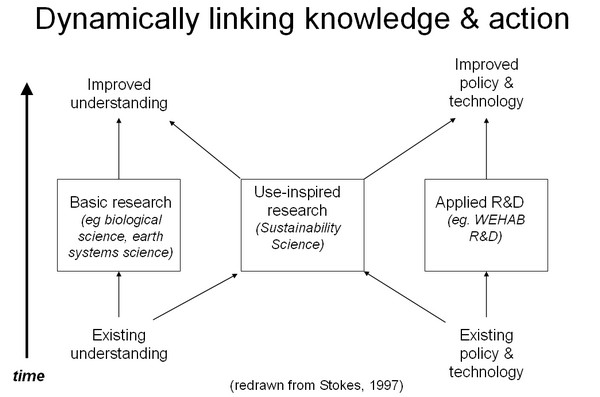
Clark used Stoke’s (1997) presentation of the four quadrants of the reasons to undertake research, highlighting that sustainability science falls into Pasteur’s Quadrant. Research in sustainability science is driven by both a quest for fundamental understanding and the consideration of the use to which the research will be put in the real world. Research with the goal of the former alone might be termed ‘Basic Research’ (e.g. physics – Bohr’s Quadrant), whereas the latter might be termed ‘Applied Research’ (e.g. engineering – Edison’s Quadrant). Through time, research in Pasteur’s Quadrant often results in a dialogue between the basic and the applied sciences, as demonstrated below.


The characterisation of sustainability science highlights that the domain of sustainability science is geo-historical. Place and history are important in defining both the problem to be examined and the solutions we might suggest. Prof Clark highlighted this, noting that a good knowledge of the environmental history of the location under study is important, and that such a history can be used in some ways as a laboratory provides data. But equally we need to remember that this history can be framed or contextualised itself – the narrative of an environmental history is unlikely to provide data that is as ‘objective’ as would be produced in a biology lab say.

Furthermore, the nature of geo-historical systems highlights the problems associated with a science that tries to be both applied and basic. How do we take use the knowledge gained from a given study to inform wider policy and decision making? Critics can argue that ‘it only happens in this particular place’, whereas advocates can argue that ‘it happens like this everywhere’. A balance between these stances will need to be struck. Multiple examples of processes, treatments, and outcomes in different places might be one way to approach this balance. Given that real-world systems are context-dependent, and that the problems sustainability science will study are value-laden, a certain level of subjectivity probably isn’t such a big deal anyway. The development of nomothetic generalizations in the same vein as the hard sciences may not be possible. However this situation, which implies uncertainty, will need to be acknowledged and understood by decision-makers.

Clark also discussed the ‘lessons for designing university-based knowledge systems for sustainability’. An article in the current issue of Futures highlights the issues faced by university departments and researchers wishing to perform sustainability science:

“The art of problem-based interdisciplinarity lies in the choice of problems that will be both academically and socially fruitful. Too heavy emphasis on the former leads to research that may successfully address problems within a particular field of study and make a contribution to the literature but that are of limited value or interest beyond the academy. Too much emphasis on the latter leads to work that is indistinguishable from consulting or pure advocacy work. Being problem-driven means starting from a problem or concern in society, but, in order to create the hybrid activity described above, this problem must be translated into a form that is amenable to issue-driven interdisciplinary research. Such translation is an indispensable prerequisite to obtaining funding from academic funding agencies and buy-in from academic collaborators, who have to be able to undertake research that will lead to publications in the outlets in which they need to publish in order to further their career prospects.”


To develop successfully Prof Clark suggested that the academy will need to maintain and engage strength in the foundation disciplines, support focused programs of ‘use-inspired basic research’ on core questions of sustainability science, build collaborative problem-solving programs, and create recognition and reward systems for those who develop and participate in such programs. The ‘publish or perish’ mantra also demands that there be suitable outlets for sustainability science research – the creation of the Sustainability Science section in PNAS is an indication that the importance, and uniqueness, of this emerging interdisciplinary field of study is becoming increasingly recognised.

There was so much more said and discussed during Prof Clark’s visit to MSU but that’s enough here for now. A copy of the powerpoint presentation used during the lecture can be downloaded from the CSIS website.