What’s your model?

In their feature Formulae for the 21st Century, Edge ask ‘What is your formula? Your equation?’ Scientists, Philosophers, Artists and Writers have replied. Some gave their favourite, or what they thought to be the most important, formulas from their fields.

But many gave their models of the world. I think that’s why I like these so much – they’re models, simplifications, abstractions, essences of an aspect of life or thought. From Happiness (Danny Kahneman, Jonathan Haidt) and Creativity (Geoffrey Miller, Richard Foreman), through Cognition (Steven Pinker, Ernst Poppel), Economics (Matt Ridley), Society (Doug Rushkoff, John Horgan), Science (Richard Dawkins, Neil Shubin), Life (Alison Gopnik, Tor Nørretranders) and the Universe (Michael Shermer, Dimitar D. Sasselov) all the way (full circle maybe) to Metaphysics (Paul Bloom).

My favourites are the most simple – model parsimony, Occam’s Razor and all that. Here are a couple (click for larger images).

This got me thinking about why I like quotes so much too – because they’re models. Take the essence of an idea and express it as elegantly as possible. That’s what scientists and mathematicians do, but equally it’s what writers and artists do. Take it far enough, and being a bit of critical realist, I would say that all human perception is a model. But these elegant models are more useful than our sensory apparatus alone (which, along with our subconscious does plenty of filtering already) – they observe whilst simultaneously interpreting and synthesizing.

So what’s my model? I’m not sure – it would have to involve change. My personal models are continually changing, vacillating. Sometimes I believe time has an arrow, sometimes it doesn’t. Sometimes the world is equations and energy, sometimes it’s story and sentiment. Sometimes life is light, sometimes life is heavy. Even when my model is relatively stable it’s usually paradoxical (or should that be hypocritical?) and ironic. I’ll try to parse it down to it’s most parsimonious state and then find some words and symbols to express it elegantly. Then I’ll post it here. I can’t guarantee that will be any time soon mind you…

In the meantime, what’s your model?

Private Science & Environmental Governance at the AAG

James Porter, a friend of mine from Geography at King’s College London, is co-convening a session at the 2008 Association of American Geographers Annual Meeting to address the issue of the increasing contribution of ‘private science’ to environmental decision-making and knowledge about the world around us. Sounds like it will be an interesting session – if I actually make it to the AAG next year I’ll have to swing by.

Submissions for the session are open until October 21st 2007. Abstracts and PIN numbers (obtained by registering your abstract online) should be sent to James Porter (james.porter at kcl.ac.uk) and Leigh Johnson (leighjohnson at berkeley.edu) Conference information here. Submit your abstract and get your PIN here.

Here’s the session details and call for papers in full:

Private Science, Environmental Governance & the Management of Knowledge
Association of American Geographers Annual Meeting, April 15-19, 2008
Boston, MA

In the US and UK, new forms of market-based, commercially driven, and politically relevant demands are restructuring the context of scientific research and the social norms and values therein. No longer can academic institutions expect the same levels of public support immortalized by Vannevar Bush; in recent decades we have seen the rapid ascent of private science or science for hire to fill the void. Science is now routinely contracted-out to the private sector to produce a range of products from Climate Forecast Predictions, flood modeling outputs, risk assessments, chemical tests, life-style drugs and myriad other products that find their way into public policy and regulatory decision-making. The appeal of this new form of scientific research is its cost-effectiveness, its embrace of strategic ignorance, and its flexibility in allowing clients to guide the design and outcome of the work produced.

Yet, environmental governance is shaped extensively by the use of scientific knowledge. In the context of governing citizens, regulating private enterprise, and guiding development, what happens when nature and science are conceptualized in terms of their commercial potential? Geographers are uniquely positioned to provide theoretical depth and empirical evidence to answer these questions. We seek papers addressing (though not limited to) the following questions:

  • How are commercial science, modeling, and assessments done in practice? What is lost and equally gained in this process? What is ignored in these new knowledge productions?
  • These questions open up room to consider the contested practice of translation: who chooses what is to be translated? Who does the translation? Does the quality of translation impact the nature of knowledge, and if so, how? How might unlikely allies become enrolled in the project?
  • Can we discern a particular set of preferred methodologies or instruments that are consistently deployed in the performance of private science? Are these characteristic of a particular neoliberal mode of governance?
  • If private science has come to dominate fact-making about nature, does this entail a transformation from the rule of (bureaucratic) experts? How do these new forms of knowledge gain authoritative status, if at all?
  • What are the implications for the subjects of governance?

An Integrated Fire Research Framework

Integrated, multi- and inter-disciplinary studies are becoming increasingly demanded and required to understand the consequences of human activity on the natural environment. In a recent paper, Sandra Lavorel and colleagues highlight the importance of considering the feedbacks and interactions between several systems when examining landscape vulnerabilities to fire. They present a framework for integrated fire research that considers the fire regime as the central subsystem (FR in the figure below) and two feedback loops, the first with consequences for atmospheric and biochemical systems (F1) and the second that represents ecosystems services and human activity (F2). It is this second feedback loop in their framework that my research focuses.


To adequately quantify the fire-related vulnerability of different regions of the world the authors suggest that a better understanding of the relative contributions of climate, vegetation and human activity to the fire regime is required. For example, they suggest that an examination of the statistical relationships between spatio-temporal patterns evident in wildfire regimes and data on ecosystem structure, land use and other socio-economic factors. We made a very similar point in our PNAS paper and hope to continue to use the exponent (Beta) of the power-law frequency-area relationship that is evident in many model and empirical wildfire regimes to examine these interactions. One statistical relationship that might be investigated is between Beta and the level of forest fragmentations, thought to be a factor confounding research on the effects of fire suppression of wildfire regimes.

But the effects of landscape fragmentation can also be examined in a more mechanistic fashion using dynamic simulation models. Lavorel et al. mention the impacts of agricultural abandonment on the connectivity of fuels in Mediterranean landscapes which are attributed, in conjunction with a drier than average climate, to the exceptionally large fires that burned there during the 1990s. My PhD research examined the impacts of agricultural land abandonment on wildfire regimes in central Spain. I’m currently working on writing this work up for publication, but I plan on continuing to develop the model to more explicitly represent the F2 feedbacks loop shown in the figure above.

The potential socio-economic consequences of changing fire regimes are an area with a lot of room to improve our understanding. For example, some regions of the world, such as the Canadian boreal forest, are transitioning from a net sink for carbon to a net source (due to emission during burning). If carbon sinks are considered in future emission trading systems, regions such as are losing a potential future economic commodity. Lavorel et al. also discuss the interesting subject of potential land conflict due to mismatches in the time scales between land planning and fire occurrence. In Indonesia for example, years which burn large areas force re-allocation of land development plans by local government. Often however the processes of developing these plans is not fast enough to forestall the exploitation by local residents of the new land available for occupation and use.

The need for increased research in this area is highlighted by the case studies for Alaskan and African savannah ecosystems presented by Lavorel et al. Whilst discussion of the wildfire regime and atmospheric/biochemical feedbacks can be discussed in detail, poor understanding of the ecosystem services/human activity feedbacks prevents such detailed discussion.

The framework Lavorel et al. present is a very useful way to conceptualise and plan for future research in this field. They suggest (p.47-48) that “Assessments of vulnerability of land systems to fire demand regional studies that use a systemic approach that focuses on the feedback loops described here” and “… will require engaging a collection of multiscale and interdisciplinary regional studies”. In many respects, I expect my future work to contribute to this framework, particularly with regards the human activity (F2) feedback loop.

alan greenspan on the future

I just listened to an interview with Alan Greenspan, former Chairman of the Board of Governors of the U.S. Federal Reserve, on BBC Radio Four (available to listen again online here). I just want to point out some quotes that interested me, the first regarding societal decisions that seem to echo some of Jared Diamond’s writing, and the second regarding our (in)ability to predict the future

“I think fundamentally societies have to make choices as to whether they want more material well being or more tranquillity. Regrettably I think we cannot have both. … That’s what I believe the evidence very conclusively indicates.”

“All you can basically know is whether probabilities are increasing or decreasing. We have no capability of looking into to the future and knowing for certain that certain things are going to happen.”

CHANS and the Risks of Modelling

In their recent review of Coupled Human and Natural Systems (CHANS), Liu et al highlight several facets of the integrated study of these systems;

  • Reciprocal Effects and Feedback Loops
  • Nonlinearity and Thresholds
  • Surprises
  • Legacy Effects and Time Lags
  • Resilience

Whilst the emphasis of the paper is on the emergence of complex patterns and processes not evident when human and natural systems are studied independently by social or natural scientists, for me the issue that should be highlighted is the importance of surprises and legacy effects when studying these systems. This goes back to what I have written before about the open, middle-numbered nature of these systems. In these systems history matters and events that occur outside the bounds of the system being studied can have an influence on system dynamics.

With this in mind, when I was recently asked where the risks lie in ecological-economic modelling (modelling that specifically considers the interactions of ecological and economic systems) I suggested we might consider three areas of risk:

  1. The production of a integrated model that is not accepted or valued by those we hope it would (whether that be other scientists, decision-makers or members of the society we are modelling). For example, the nature of producing a model that lies somewhere between ecology and economics and/or between science and management has the potential to be accepted by neither party in these dichotomies (as it is not perceived by others to be ‘real ecology’ or ‘real science’ for example). However, this can be avoided by ensuring continued collaboration between economists and ecologists, and between scientists and managers, throughout the modelling process to ensure understanding or model structure.
  2. The production of a model that is not fully integrated but is rather an ecological model used to examine various economic scenarios. In this case, the study remains integrated (examining the interactions between economic and ecological systems) but the model is not (as feedbacks back from the ecological systems into the economic system, for example in terms of prices and costs, are not fully accounted for). Alternatively, if the modelling process is understood to be iterative, then this initial reduced version of the model may simply be a single step in the complete ecological-economic modeling process.
  3. Because of legacy effects, surprises etc, a misplaced confidence in what the model can accurately predict may arise. This is also related to the question of the limited capacity to validate models of complex ecological systems given limited empirical data. Again, this may be prevented by continued collaboration between scientist and manager to ensure the structure and limitations of a model are understood, and if a range of model results are predicted for different scenarios (in order to demonstrate the variability in potential outcomes).

The study of CHANS will become increasingly important in the future. But if political decisions are to be made based on the outcome of the knowledge gained, the risks present in the study (and specifically the modelling) of these systems must be minimized and accounted for.

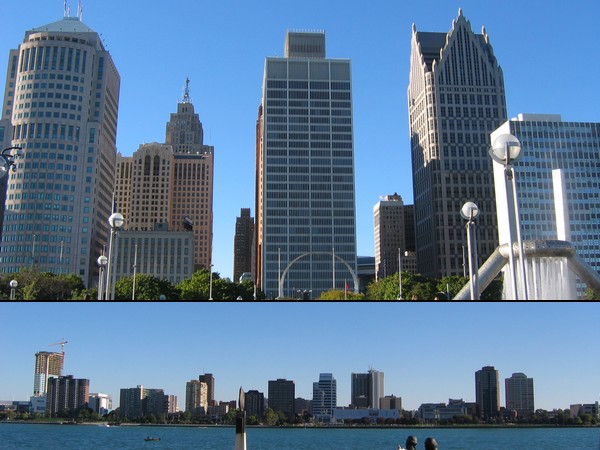
detroit river vs the thames

I’ve been busy recently. Those comments on the CHANS Science paper will follow soon, promise.

For now here is a grossly unfair, and probably invalid, comparison (but this is how it felt just looking whilst stood there). On one side of Detroit River is its namesake, Detroit, Michigan (top). On the other side lies Windsor, Ontario (bottom).


Looking across the river, whilst stood on the US side after walking through the large office blocks built when the city was at the centre of the automotive world, it felt a little like looking out at Rotherhithe from the Isle of Dogs. But Detroit and GM aren’t doing quite as well as Canary Wharf and I doubt whether the Windsor-Rotherhithe comparison is fair either. Anyway…

More vaguely interesting pics on the pictures page soon.

CHANS Science Paper

In this week’s issue of Science Jack Liu, Director of CSIS (and my boss), and colleagues present a review of recent research on Coupled Human And Natural Systems (CHANS). Using six case studies from around the world the paper discusses these coupled systems with regards spatial, temporal and organisational units, nonlinear dynamics and feedback loops between systems, the importance of history within these sytems, and aspects of their resilience and heterogeneity. We’ll be discussing the paper within the center next week so maybe I’ll have some more insightful comments then. For now, here’s the abstract:

Integrated studies of coupled human and natural systems reveal new and complex patterns and processes not evident when studied by social or natural scientists separately. Synthesis of six case studies from around the world shows that couplings between human and natural systems vary across space, time, and organizational units. They also exhibit nonlinear dynamics with thresholds, reciprocal feedback loops, time lags, resilience, heterogeneity, and surprises. Furthermore, past couplings have legacy effects on present conditions and future possibilities.

Complexity of Coupled Human and Natural Systems
Jianguo Liu , Thomas Dietz, Stephen R. Carpenter, Marina Alberti, Carl Folke, Emilio Moran, Alice N. Pell, Peter Deadman, Timothy Kratz, Jane Lubchenco, Elinor Ostrom, Zhiyun Ouyang, William Provencher, Charles L. Redman, Stephen H. Schneider, William W. Taylor
Science 14 September 2007
Vol. 317. no. 5844, pp. 1513 – 1516
DOI: 10.1126/science.1144004
Also online here`

The Tyranny of Power?

The past week or two I’ve been wrestling with the data we have on white-tailed deer density and vegetation in Michigan’s Upper Peninsula in an attempt to find some solid statistical relationships that we might use in our ecological-economic simulation model. However, I seem to be encountering similar issues to previous researchers, notably (as Weisberg and Bugmann put it) “the weak signal-to noise ratio that is characteristic of ungulate-vegetation systems”, that “multiple factors need to be considered, if we are to develop a useful, predictive understanding of ungulate-vegetation relationships”, and that “ungulate-vegetation interactions need to be better understood over multiple scales”.

Hobbs suggests that one of the problems slowing species distribution research is a preoccupation with statistical power that he calls “the tyranny of power”. This tyranny arises, he suggests, because traditional statistical methods that are powerful at smaller scales become less useful at larger extents. There are at least three reasons for this including,

  1. small things are more amenable to study by traditional methods than large things
  2. variability increases with scale (extent)
  3. potential for bias increases with scale (extent)

“The implication of the tyranny of power is that many of the traditionally sanctioned techniques for ecological investigation are simply not appropriate at large-scales… This means that inferences at large-scales are likely to require research designs that bear little resemblance to the approaches many of us learned in graduate school.” Hobbs p.230

However, this tyranny may simply be because, as Fortin and Dale point out, “most study areas contain more than one ecological process that can act at different spatial and temporal scales”. That is, the processes are non-stationary in time and space. Leaving time aside for now, spatial non-stationarity has already been found to be present in our study area with regards the processes we’re considering. For example, Shi and colleagues found that Geographically Weighted Regression (GWR) models are better at predicting white-tailed deer densities than an ordinary least-squares regression model for the entirety of our study area.

Hobbs’ argument suggests that it’s often useful analyse ecological data from large regions by partitioning them into smaller, more spatially homogenous areas. The idea is that these smaller patches are more likely to be governed by the same ecological process. But how should these smaller regions be selected? A commonly used geographical division is the ecoregion. Ecoregions divide land into areas of similar characteristics such as climate, soils, vegetation and topography. For our study area we’ve found that relationships between deer densities and predictor variables do indeed vary by Albert’s ecoregions. But we think that there might be more useful ways to divide our study area that take into account variables that are commonly believed to strongly influence spatial deer distributions. In Michigan’s UP the prime example is the large snow fall is received each winter and which hinders deer movement and foraging.

We’re beginning to examine how GWR and spatial boundary analysis might be used to delineate these areas (at different scales) in the hope of refining our understanding about the interaction of deer and vegetation across our large (400,000 ha) landscape. In turn we should be able to better quantify some of these relationships for use in our model.

the world cup is coming

I’ve just finished watching a video of the 2003 Rugby World Cup Final. What. A. Game.

Played in Sydney, the game kicked-off at 9am London time and we had to get to the pub early to get a good spot to watch. We ended up watching in The Wellington opposite Waterloo Station after trying to get into the Walkabout at Temple – I got there about 7.30am but it had been full since 4am! Such was the anticipation, and the game lived up to itKing Jonny slotting over a drop-kick (with his weaker foot) in the dying minutes of extra-time. But let’s not forget the rest of the team; they were immense.

The Wellington was full of Chelsea fans (they were playing somewhere that day which required taking a train from Waterloo) – those footy boys didn’t have a clue about rugby and my mate Neil and I had to keep explaining the rules to them as the game went along. They celebrated well though – we all did! I can’t remember much about the rest of the day…

Watching again this evening at different times during the game I was shouting at the screen, my heart was pounding, I had butterflies and the hairs on the back of my neck were standing on end. And this was a replay. What a defence we put up that day. Intense. Inspiring.

It doesn’t look like we’re going to do so well this time round though – I’d say the All Blacks and Les Bleus are my favourites to win. I’ll be impressed if England make it to the semi-finals. Hopefully I’ll get to watch some of the games in the pub – no doubt I’ll be explaining the rules to those unfortunately unenlightened about the great game here too. Less than a week until England vs. USA. I can’t wait.