Pale Blue Dot

I saw this YouTube video containing an excerpt from Carl Sagan’s writings over on Perceiving Wholes recently. It’s a little cheesy, but it contains a strong and important message – that we humans are our own custodians on this planet. Whilst the way Sagan goes about making this point is understandable from is background as an astronomer and astrobiologist and the context of the image he discusses, I think there’s a more salient way to think about our position within the universe.


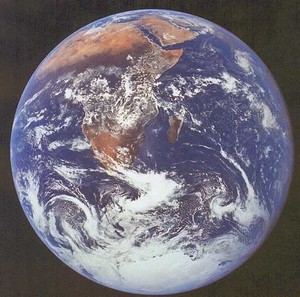
Sagan talks about out insignificance [text of video here], about the miniscule size of this plant and our short time upon it. I think that misses the pale blue point. More importantly, we need to recognise that this world is finite. In both size and resources. Just as Silent Spring kick-started the environmental movement, another image taken from space a decade later and almost two before Sagan’s Pale Blue Dot, ‘The Blue Marble‘ highlighted that the blue planet in our solar system is not the infinite horizon it may seem from the surface.


Sagan is probably right, we are alone for now in this part of the universe to solve our own problems. But we can’t prove that (which is quite a cool thought eh?). What we do know for sure, by looking at images from space for example, is that this planet is finite and that many of the resources we require to survive here are not infinite but are most definitely exhaustable.

Sometimes, as an individual sat atop a mountain ridge surrounded by miles of forest it may feel as though we are so small that we would have an insignificant effect upon the landscape. But we are now over six and a half billion individuals and that is no small number. Upon the Geologic scale and relative to the size and age of the known universe our number and time here may well be insignificant. Upon the scale of our finite pale blue dot however, the global population is now of such a size that in all likelihood our actions are having a significant effect on our capacity to survive.

Just as we might remember our insignificance in the Grand Scheme of Things, we might also remember our significance in the smaller scheme of things too.

Addendum 31st Jan 2007: An editorial in this week’s Nature takes a similar view with regards looking at Earth from space (rather than turning our attention to the moon).

Technorati Tags: , , , , ,

Just Science Week

OK, so after a little deliberation I’ve signed up for Just Science week. In a response to the strong anti-science presence on the internet (global warming denialists, creationists, the anti-vaccination movement etc.), starting 5th February science bloggers will post about science only, with at least one post per day for the whole week. Issues which are favoured by anti-scientific groups (creationism, global warming, etc.) will be either avoided, or discussed without reference to anti-scientific positions.

The rationale behind this is that many science bloggers end up spending a fair amount of time combating the misinformation spread by anti-science groups at the expense of blogging about actual science. I generally don’t want to get embroiled in these sorts of arguments – I’ll leave it to those with much stronger feelings on the subject, know more about it and are generally much more organised.

What I am more interested in is the relationship between science and policy- and decision-making, specifically from modelling/environmental/resource management perspectives. I’m with Allen et al. (2001 p.484):


“The postmodern world may be a nightmare for … normal science (Kuhn 1962), but science still deserves to be privileged, because it is still the best game in town. … [Scientists] need to continue to be meticulous and quantitative. But more than this, we need scientific models that can inform policy and action at the larger scales that matter. Simple questions with one right answer cannot deliver on that front. The myth of science approaching singular truth is no longer tenable, if science is to be useful in the coming age.”

Just this week I’ve been considering how the recent work emerging from Demos, the UK thinktank, relates to my PhD research (more on this and this in the future no doubt). The Prometheus blog is great source of inspiration and for this sort of discussion too. But, in the interests of Just Science week I’ll try to steer clear of that stuff and focus on some my work on wildfire regimes (that I haven’t talked about in much detail here but have outlined on my website), recent publication in the environmental modelling literature, and also I’m thinking maybe a post on the Geography of Science (seeing as I am Geographer at heart…)

Generative Landscape Science

A paper from the recent special issue of Professional Geographer (and discussed briefly here) of particular interest to me, as it examines and emphasises an approach and perspective similar to my own, was that by Brown et al. (2006). They suggest that a generative landscape science, one which considers the implications microscale processes for macroscale phenomena, offers a complementary approach to explanation via other methods. Such an approach would combine ‘bottom-up’ models of candidate processes, believed to give rise to observed patterns, with empirical observations, predominantly through individual-based modelling approaches such as agent-based models. There are strong parallels between modelling in a generative landscape science approach and the pattern-oriented modelling of agent-based systems in ecology discussed by Grimm et al. (1995). As a result of the theory-ladeness of data (Oreskes et al. 1994) and issues of equifinality (Beven 2002) landscape modellers often find themselves encountering an ‘interesting’ issue (as Brown et al. put it):


“we may understand well the processes that operate on a landscape, but still be unable to make accurate predictions about the outcomes of those processes.”

Thus, whilst pattern-matching of (model and observed) system-level properties from models of microscale interactions may be useful for examining and explaining system structure, it does not imply prediction is necessarily possible. There is a distinction between pattern-matching for validation (sensu Oreskes and Beven) and pattern-matching for understanding (via strong inference), but it is a fine line. If we say, “Model 1 uses structure A and Model 2 uses structure B, Model 1 reproduces observed patterns at multiple scales more accurately than Model 2, so Model 1 is more like reality, and therefore we understand reality better”, we’re still left with the problems of equifinality.

And so (rightly IMHO) in turn, Brown et al. suggest that whilst the use of pattern-matching exercises to evaluate and interpret models will be useful, we should wary of an over-emphasis on these techniques at the expense of intuition and deduction. This perspective partly contributed to my investigation of the use of ‘stakeholder assessment’ to evaluate the landscape change model I’ve been developing as part of my PhD.

In conclusion Brown et al. suggest a generative component (i.e. exploiting individual- and process-based modelling approaches) in landscape science will help;

  • develop and encode explanations that combine multiple scales
  • evaluate the implicaitons of theory
  • identify and structure needs for empirical investigation
  • deal with uncertainty
  • highlight when prediction may not be a reasonable goal

This modelling approach adopts perspective that is characteristic of recent attitudes toward the uses and interpretation of models arising recently in other areas of simulation modelling (e.g. Beven in hydrology and Moss and Edmonds in social science) and is also resonant with perspectives arising from critical realism (without explicitly discussing ontology). As such their discussion is illustrative of recent trends environmental and social simulation with some good modelling examples from Elk-Wolf population dynamics in Yellowstone National Park, and places the discussion in a context and forum in which individuals with backgrounds in Geography, GIScience and Landscape Ecology can all associate.

Reference
Daniel G. Brown, Richard Aspinall, David A. Bennett (2006)
Landscape Models and Explanation in Landscape Ecology—A Space for Generative Landscape Science?
The Professional Geographer 58 (4), 369–382.
doi:10.1111/j.1467-9272.2006.00575.x

Technorati Tags: , , , , , , ,

Spring Conferences

The preliminary program and schedule of sessions for the 2007 AAG (Association of American Geographers) National Meeting in San Francisco, April 17-21, is now available online.

It looks like I should have some time during April, and several colleagues from King’s Geography Dept. are going to San Francisco, so it might be good to go. Unfortunately, I wasn’t banking on having the opportunity so I haven’t submitted anything to present.

The alternative would be to go to the EGU (European Geophysics Union) General Assembly 2007 in Vienna, Austria, 15 – 20 April. I’m second author on a poster due to be displayed there:

Spatial analysis of patterns and causes of fire ignition probabilities using Logistic Regression and Weights-of-Evidence based GIS modelling
Romero-Calcerrada, R. and Millington, J.D.A
Session NH8.04/BG1.04: Spatial and temporal patterns of wildfires: models, theory, and reality (co-organized by BG & NH)

I’ll have a think about it…

Technorati Tags: , , , , , ,

mega moves

On of my good friends has just been putting the finishing touches on the second series of the cult engineering show ‘Mega Moves’ (‘Monster Moves’ in the UK). The series will be showing on National Geographic in the States and Channel Five in the UK. Checkout the trailer below – pretty cool eh?

View at youTube here

RGS-IBG 2007 Call for papers

The on-line registration procedure for abstract submission for the Royal Geographical Society (with IBG) Annual International Conference 2007 is now ready and the call for papers has begin.

The conference has the theme “Sustainability and Quality of Life” and is to be held at the RGS-IBG and Imperial College in London, from 28-31 August 2007 with the first papers being presented on 29 August.

Details of accepted sessions can be found here (scroll to bottom to view .pdf version of all sessions) and details of how to submit an abstract found here. All abstracts need to be received on-line by the revised deadline of Thursday 1 March 2007 (previously advertised as 14 February 2007).

The RGS Postgraduate Forum will be sponsoring the following sessions:

  • Postgraduate Research
    (Sponsored by the PGF)
  • Postgraduate Research in Urban Geography
    (Jointly sponsored by the Urban Geography Research Group and the PGF)
  • Postgraduate Research in Applied Quantitative Geography
    (Jointly sponsored by the Quantitative methods Research Group and the PGF)
  • Postgraduate Research on Planning, the environment and sustainable development
    (Jointly sponsored by the Planning and Environment Research Group and the PGF)

Each of these session is designed to provide postgraduate students at any stage of their career, the opportunity to present their research and obtain constructive feedback in a supportive environment.

Past from Above: George Gerster

I went to Georg Gerster’s exhibition ‘Past from Above’ at the British Museum over the weekend. As the title might suggest the exhibition is a collection of photographs of archaeological and historical landmarks shot from the air. Gerster suggests


“Height provides an overview. And an overview facilitates insight, while insight generates consideration.”

Some of the photos don’t really fit this perspective however, shot with such a zoom that an overview isn’t actually provided. For example the shot of the Minaret of the Great Mosque at Samarra, Iraq (see it here). What’s the scale of this building? What’s the context? This shot is from above but it doesn’t provide an overview. I get the feeling some the shots like this might have provided more insight if they’d been taken from a location on the ground.

However, this aside there are some images that really show off the context of the archaeological sites well. Whether it be the grand locations of derelict temples or the juxtaposition of sweeping, fluid sand dunes encroaching upon and over the geometric remains of a dead city. These are the shots that do provide some insight into what the past might have been like, how the landscape may have been different from today, and how it is still changing now.

Obviously some of these images are very reminiscent of Yann Arthus Bertrand and his “Earth from Above” project, and browsing Gerster’s website I think I actually prefer some of his shots of contemporary landscape patterns – both those imposed by humans and those of a more natural origin.

Overall, the exhibition was an interesting way to spend 45 minutes on a Sunday afternoon – but some of the shots didn’t quite fit the ethos of the exhibition.

Landscapes as Kaleidoscopes

A recent special issue of The Professional Geographer focuses specifically on the integration of theory and methods from Landscape Ecology and Geographic Information Science (GIScience). Entitled “Landscape Form, Process and Function: Coallescing Geographic Frontiers”, the six papers arose from the Centennial meeting of the 2004 Association of American Geographers and span the application-theory (e.g. Mast and ChambersMalanson et al. respectively) and the GIScience-Landscape Ecology (e.g. Southworth et al.Young and Aspinall respectively) spectra.

The general message is that the integration of method and theory GIScience and Landscape Ecology offers the opportunity to better examine and understand the interactions of pattern, process and landscape change. Concluding the special issue, Young and Aspinall use the metaphor of landscapes as kaleidoscopes;


“… a kaleidoscope serves as an engaging metaphor in this context because of its visualization of fragments, shreds, patches, and filaments that create a host of mosaics. A kaleidoscope creates these and other patterns and then shifts them, changing one set of forms into another, by altering colors and the locations of edges, thereby changing the appearances, sizes, and spatial distributions of the fragments. This device captures some of the complexity and shifting dynamics of the forms that characterize the Earth’s land surfaces. It would be difficult, but feasible, to record, measure, and otherwise describe those changes taking place within a kaleidoscope. It might even be possible to predict future patterns, or at least bracket the possible forms and patterns that could occur by tracking changes through time. Rather than a person creating these patterns by rotating a colorful tube, however, it is the landscape-forming and landscape-transforming processes that do so in reality.”

But in the majority of contemporary landscapes it is people rotating the landscape. Those landscape-forming and landscape-transforming processes are people-driven. The emphasis in this special issue is still largely presented from a formal (spatial) scientific perspective in the tradition of American Landscape Ecology, emphasising technical and philosophical approaches for examining patterns and processes. Given Professional Geographer is the forum and journal of the Association of American Geographers this is understandable and these approaches will surely improve and enhance our ability to examine and understand landscape change. However, landscape is an intrinsically holistic concept and change is often due to the interplay of both biophysical and human causes. Alongside furthering our technical abilities to study changing landscapes we need to continue to develop innovative approaches that consider the more humanistic side of landscape change and integrate them with the technical tools. Computer models, satellite imagery and the tools of GIScience are and will continue to be useful to monitor, evaluate and project change in their own right, but increasingly we need to find and develop ways that incorporate and include the humans turning the kaleidoscope.

Generational Landscape Change: Montana and Madrid

It’a been out for a while (so there are several reviews available ) but I only just got and started reading Jared Diamond’s Collapse (How societies choose to fail or survive). I’ve only read the first part (Modern Montana) so far, but already I’ve come across several parallels between the socio-economic changes, and their potential ecological impacts, occuring in the landscapes under Montana’s Big Sky and Madrid’s Sun-Blessed Skies.

The broad similarity between the change Diamond describes in Montana and that occurring in my PhD study area (SPA 56, an EU protection area for endangered bird species to the west of Madrid, Spain) is the shift from an economy and landscape driven by agricultural activity to one driven by recreational activities. Such a shift reflects both the differing visions of multiple stakeholders within these landscapes, but also generational changes in attitude between older inhabitants and their children and grandchildren. In Montana’s Bitteroot Valley larger macroeconomic changes nationally and internationally have made previously profitable extractive industries (forestry, mining and agriculture) largely unsustainable economically. This has come about as land is now valued not according to resource and agricultural production but according to real-estate potential for incoming retirees, second-homers and tourists. Incoming (usually older) ‘out-of-staters’ arrive to enjoy the outdoor recreation (fishing, hiking, etc.), beauty and lifestyle opportunities, replacing the younger generation of Montanans going the other way to seek modern urban lifestyle opportunities and lifestyles;


“It’s a wonderful lifestyle to get up before dawn and see the sunrise, to watch fly hawks overhead, and to see deer jump through your hay field to avoid your haying equipment. … Occasionally I get up at 3 AM and work until 10 AM. This isn’t a 9 to 5 job. But none of our children will sign up for being a farmer if it is 3 AM to 10 PM every day.”

Dairy Farmer, Montana

Locals in SPA 56 have expressed similar feelings and ideas when I have visited over the last few years. Younger generations that would have previously continued the family farm that has passed through generation upon generation of farmers, are now seeking out employment in construction and service sectors to secure what is understood as a more ‘modern’ lifestyle. A lifestyle that affords leisure time at specified times of the week and at regular intervals (i.e. the weekends and paid holidays);


“Most farmers are part-time, maintaining the tradition agriculture. The children or grandchildren of those [farmers] do not have interest [in agriculture] because is it not profitable and requires a lot of dedication. The youths go or they seek other work.”

Local Development Official, Madrid (2006)

In Montana, Diamond describes the conflicts that have arisen between existing inhabitants and the new-comers, each with differing world-views, priorities and values. For example, contrast the attitudes of the third generation dairy farmer fighting to ensure the survival of his farm in the global economy vs. the lady who complained to him when she got manure on her white running shoes. Of course, these multiple perspectives within the landscape are inevitable in a changing world and tools and strategies must be found and employed to ensure appropriate decisions and compromises are made. In my simulation model of agricultural decision-making I have attempted to represent the influence of two differing world-views on landscape change (as have other modellers). I have termed the representative agents ‘commercial’ and ‘traditional’; the former behaving as a perfectly rational actor (in economic terms), the latter designed to reflect the importance of traditional cultural values in land-use decision-making;


“Whoever has a vineyard nowadays is like a gardener… they like to keep it, even if they lose money. They maintain vineyards because they have done it all their life and they like it, even having to pay for it. If owners were looking for profitability there would be not a singe vineyard… People here grow wine because of a matter of feeling, love for the land…”

Vinter, Madrid (2005)

As the primary thesis of his book Diamond highlights, for both contemporary and historical societies, the impacts of social, economic and technological change on the physical environment, and the sustainability of those changes. Of the several issues of concern in Montana, those related to forestry and water availability are likely to be of most concern in SPA 56. One particular interest of my PhD thesis is the importance of changes in the landscape for wildfire regimes, which Diamond discusses with reference to previous management strategies of the Unites States Forest Service (USFS). Commercial forestry has not been a widespread activity in SPA 56, the nature and human history of Mediterranean ecosystems restricting contemporary timber productivity. However, the problems of increased fuel loads due to the fire suppression policies of the USFS during the 20th century may be beginning to present themselves in SPA 56. If the agricultural sector continues to decline due to the social and economic trends just outlined, farmland will (continue to) be abanoned or converted to recreational uses (for example, hunting reservations). In turn this will leading to increased biomass and fuel loads in the landscape. As yet the consequences of such change on the frequency and magnitude of fires in the region is unclear due to spatial relationships and feedbacks between vegetation growth and burning. In the very near future the results of my simulation model will be able shed some light on this aspect of the region’s changing landscape and ecology.

Buy on Amazon


Diamond Reviews
GristMill
Ecological Economics
Futures