The Tyranny of Small Decisions

How did we get to where we are today?

William Odum highlighted the importance of small decisions effects on wider environmental issues and management — the “tyranny of small decisions” as it is has been called. When the accretion of small decisions give rise to broader scale events and phenomena, the results that emerge are not necessarily optimal for society or the environment.

In the case of my PhD study area an important issue is the sustainable maintenance of the relationship between fire, vegetation and human activity across landscape, as a result of land use decisions made by individual humans within that landscape. To ignore the potential effects of these small decisions on the wider environment could prove costly.

Equally, when studying these effects of these individual decisions, the reciprocal effects of changes in the wider environment (e.g. the wildfire regime) upon them shouldn’t be omitted. The tyranny of small decisions means that any model of landscape change in needs to represent the feedbacks between individual decisions and the landscape consequences. Agent-based modelling, integrated with a cellular automata is one way I’m attempting to do this.

But these feedbacks don’t only happen in space across landscapes, they happen over time through one’s life. All the small minute-by-minute decisions that have led me to be where I am now. Individual minute-by-minute decisions made now, with an eye to future based on past experience. If making a decision at the current time is dependent upon one’s situation at the present time, which in turn has arisen due to past decisions, have those past decisions reduced the viable options one has open at the present time? Or have as many new doors opened as closed?

The tyranny of minute decisions. Why every minute counts. Any why we’ll never know whether a decision was the right or wrong one to make until all our minutes have gone…

Reference
Odum, W.E. 1982 Environmental Degradation and the Tyranny of Small Decisions Bioscience 32:9

Categories:
, , , , , ,

Lester Brown: Plan B 2.0

We went straight from the pub to Lester Brown’s lecture at MSU this evening so I didn’t have a pen or pad of paper with me. I need to jot something down before I forget so why don’t I blog it…

President of the Earth Policy Institute, Lester Brown’s talk was based largely around his recently updated book Plan B 2.0. Essentially this was an ecological economics discussion, and many of his examples echoed what I heard at the THEMES summer school earlier this year (did I blog that yet? I should). For example, one clear message was that biofuels (ethanol) is NOT a viable alternative to gasoline for running cars; the resources and area demanded to grow the products to produce the biofuel are to great to ensure it’s economic or ecological viability. A more sustainable alternative presented was wind power; the US could satisfy its annual electricity needs by installing wind turbines in just the three windiest states (I forget which they are). If the number of hybrid electricity/gasoline cars increased this wind power could be efficiently harnessed, stored and used for travel.

Orders for wind turbines globally are so high that waiting lists for production currently stretch to 2008. Why not use the infrastructure already in place in the form of automobile factories to constuct these wind turbines? Unfeasible? Not possible? The example of the shift from automobilie manufacture to arms manufacture in the US during the second World War shows that “where there’s a will there’s a way”.

But do we want have the will? Are we in denial? Why is it so easy to persuade ourselves that there isn’t a problem? Lester Brown suggests that one reason is that we’re not doing our economics properly; we’re hiding many of the costs of the products we produce just as Enron did before their collapse. It may only ‘cost’ $3 to produce a packet of cigarettes (at least that’s the cost they could sell at before tax), but when you factor in ecological and human health into the equation we find that it actually costs $7 in terms of ecosystem and health services.

Echoing Al Gore in his recent movie (still need to blog about that), unless the environmental question is on the lips of the constituent when they meet their political representative, these issues can get swept under the carpet. We need to have the will to make the necessary changes, and we need to let our politicians know we want that change.

And I need to get some sleep so that my presentation tomorrow doesn’t collapse into farce…

Categories: , , , , , , , ,

summer 2006: going slightly crazy

So I’ve finally finished this summer’s compilation, the fourth in a growing series. Music I was listening to and a reflection what the summer was like for me. The subtitle? That’s due to a summer spent in isolation trying to break the back of a PhD thesis whilst trying not think about people a long way away… How was it for you?

Here’s the tracklist for those of you lucky enough to receive a copy.

# Artist Title Length
1 Blowers LovelyDay 0:21
2 Grandaddy Underneath the Weeping Willow 2:40
3 Jack Johnson Better Together 3:27
4 Black Eyed Peas Ft. Jack Johnson Gone Going 3:13
5 Blowers MontyPython 0:18
6 Devendra Banhart At The Hop 2:14
7 Get Cape. Wear Cape. Fly Once More With Feeling 2:04
8 Jose Gonzalez/Massive Attack Teardrop 8:23
9 Hot Chip Crap Kraft Dinner 6:34
10 Faithless Crazy English Summer (Brothers On High Remix) 6:24
11 Blowers Wicket 0:27
12 Maxence Cyrin/Felix Don’t You Want Me 2:51
13 Diplo Sonar 2006 Mix 6:31
14 NERD Rockstar (Jason Nevins Remix) 3:49
15 Blowers AssemblingForBattle 0:05
16 Pendulum Masochist 4:56
17 Blowers Pigeon 0:44
18 Aspects We Get Fowl 3:17
19 Queen I’m Going Slightly Mad 4:22
20 Blowers WalkingOnWater 0:30
21 Get Cape. Wear Cape. Fly The Chronicles of a Bohemian Teenager Pt 1 4:06
22 Israel Kamakawiwo’ole Somewhere Over The Rainbow 4:49

Total Tracks: 22 Generated by MediaMonkey

[If you want a copy email me]

Categories: , , , , ,

del.icio.us

OK, so I may be a little behind the times but I’ve finally discovered del.icio.us. In the side bar you find a link to my del.icio.us page and on each individual post page there is now a link to save that page to your del.icio.us account using the tags on that page (I’m going to slowly go back through all previous posts and add tags to them).

Also, I’ve added a del.icio.us section to the links page on my website detailing my 10 latest deli.icio.us posts…

Just doing my bit to keep the diameter of the web in check…

Categories: , , , , ,

arsenal vs porto

Arsenal 2 – 0 Porto


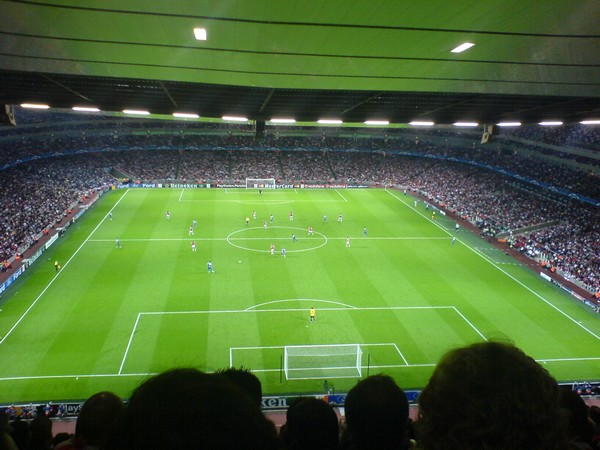
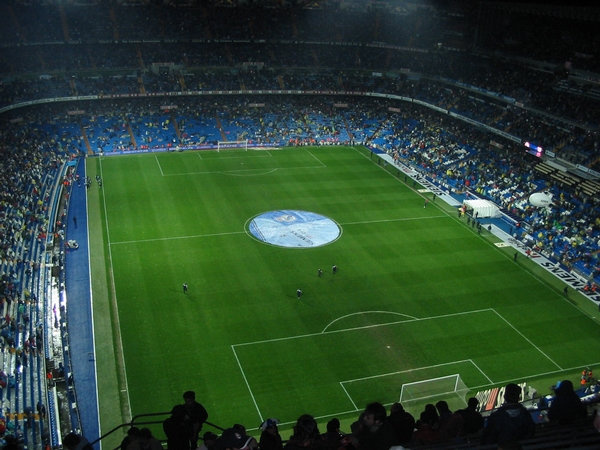
I went to the Arsenal vs. Porto Champions League game on Tuesday (tickets courtesy of Mark; cheers mate!) at the spanking new Emirates Stadium. Our view (top) was similar to that of the game I managed to get to at the Bernabau in Madrid a few years ago (bottom), but dare I say we weren’t quite as close to the action (the seats in Spanish stadium sit almost vertically on top of one another).

As for the football, it felt all very ‘continental’ and refined — a little different from the standard fare I was brought up on at Ashton Gate. Considering there wasn’t a single English player on the pitch until the last 5 minutes that’s not really suprising though I suppose. Good game, but it’s just not the same emotional experience as going to see your own team play. For one, you can look at the game more objectively; Mark with his rose-tinted Arsenal glasses on was not impressed by some of my analysis…

Categories: , , , , , , ,

Reading is Believing?

“Don’t believe everything you read in the newspapers” they used to say. Well now it seems that the phrase is (or should be) “Don’t believe everything you read on a blog“.

As we’ve seen on this very blog, we need to be wary of of fact and fiction. But everybody knew that already did’t they? Richard Ladle suggests:

Misreporting and misrepresentation are important because they can lead to a loss of trust at a time when public support for pro-environmental policies is most crucial.

Poor reporting of environmental science may also have a disproportionate effect on children who are increasingly turning the internet as their preferred source of information and who are least able to judge the validity of claims or the legitimacy of one blog over another.

So how should we be responding to the challenges and opportunities presented by the blogosphere?

One way to deal with misrepresentation in blogs is to increase the weight of informed opinions in the blogosphere. An influx of scientifically informed opinion and accurate information would also help combat and correct misrepresentations in the traditional news media and draw public attention to important new research findings.

Recently there has been plenty of debate about the politicisation of environmental science. Scientists are increasingly using the media, including blogs, to promote and disseminate their work. This has left them open to criticism that they are cherrypicking their arguments and misrepresenting science. NGO’s and advocacy groups have been cherrypicking their arguments for decades — but scientists shouldn’t fall into this habit and they will only be devaluing their credibility if they do. However, this is not to say scientists should not be disseminating their work, quite contrary. They should, if nothing else to add to the debate. If a scientific finding is to be useful in the ‘real world’ it will be always be political – we have to accept that. The time has gone when scientists were able to say “I just do the science, not the politics”. Environmental science in the 21st century must accept this, and learn how to engage with the public at large to communicate its findings and the implications of those findings. (How this in turn influences how the science proceeds is another, interesting, question).

Of course there’s uncertainty in science, and there always will be. As Rodger Bradbury suggests, Science is 3-tuple:

  1. a body of knowledge,
  2. a method for generating that knowledge, and
  3. a collection of people using those methods to increase that knowledge.

The knowledge generated by science is, and should be, constantly re-evaluated and questioned. For me this is the best way to examine the world, by constantly questioning. But the people using the methods and tools of science will always have their own agenda — even if it is simply the advancement of their own scientific career. Scientists are human beings. But now we need to continue to work to improve another facet of our scientific toolbag – the accurate communication of scientific work to the public at large. Who is better qualified to deliver the message, the scientist or the journalist? Scientists should work hard to make sure it is them.

But what about the situation right now? Richard Ladle again:
Fortunately, there are several ways in which the credibility of a website or blog can be quickly assessed:

  • Check the data – strong scientific arguments are based on information from recognised sources that is available for public scrutiny, while weak or spurious arguments are often backed up with data from secondary sources or often no data at all
  • Take note of the language – arguments couched in hyperbolic language may be masking a lack of understanding or sound information


These are sound starting points for anyone reading anything on the internet. Personally, on this blog I try to make a distinction between ‘serious’ comments and more ‘tounge-in-cheek’ comments by capitalising words in titles of the former, but not the latter. A good scientist will never deliberately mislead — but at the same time it needs to be understood that they can never be 100% sure of their findings. Scientific knowledge is provisional and always open to scrutiny and change. That’s how it differs from faith.

Naveh’s Holistic Landscape Ecology

(or “One of the reasons I’ve ended up doing what I’m doing“)

I don’t know if he was the first to come up with the term, but I first read about holistic landscape ecology in a couple of papers by Prof. Zev Naveh (in 2001 during my third year undergrad course at King’s, ‘Landscape Ecology’ run by Dr. George Perry). Whilst reading today I came across some old notes I made from one of those papers (not terribly critical as you can see!?). Distinguished Professors of a Certain Age are allowed licence to run riot with their accumulated wisdom as you can see. I’m not being facetious – they can write bigger ‘blue skies’, ‘call to arms’ pieces than other (more lowly) academics.

These are the two papers that really got me interested anwyay (as well as my Disertation; finally, as a 3rd year undergrad!?). I think I thought something along the lines of, “there are problems here that we should be thinking about now and this guy is suggesting a paradigm of how we might start approaching them scientifically“. I think they’re one of the reasons I started a MSc (“I can’t stop now I’ve only just found this stuff“), and then later continued onto this ‘ere PhD (“this is interesting – I want to keep going“).

Later I got to these questions;

  • What sort of scientific tools and methods will we need to address problems that we have in our socio-environmental systems now?
  • How do we integrate tools and methods from different scientific disciplines? (i.e. how do we really become ‘inter-disciplinary’?)
  • What sort of science will this be? Normal? Post-Normal? Something else?

It could take a while to answer these – but it doesn’t seem like we’ve got that long. We’ll have to work them out as we go along I think…

Refs

Categories: , , , , , ,