Catching up on 2012

This blog has been seriously neglected over the last six months, so there’s a lot of catching up to do here.

There’s lots of conferences and papers to list, but first I should highlight the slight difference in look of this blog and the entire website. I recently decided I was going to switch to Google sites to host www.landscapemodelling.net and move this blog from WordPress to Blogger (for multiple reasons I won’t go into here). The website is lacking many of the pages from its previous guise and the NetLogo models have been moved to openABM.org. I’m continuing to add the old (and maybe some new) content to the website but that’s likely to be a slow process (particularly given how long it’s taken me to get to write this post!). The link structure of the blog pages has changed – I think I’ve managed to change most links but there may still be some that are broken (if you find any please let me know). Many of the images are also currently missing – I’ll get to re-inserting those sometime…

I’ve managed to get to quite a few conferences this year in the US, UK and Germany.A particular highlight was getting to see my old PhD advisor George Perry in the US. George was on sabbatical at Harvard Forest and he invited me to the forest to give a seminar. It was also great to attend the 4th USFS FVS conference in Fort Collins, CO and to be one of the only four or so international attendees. There’s a list below of all the conference presentations I gave with links to the conference websites.

I’ve also been working hard to get a few papers published. The paper I’ve been working on with George and David O’Sullivan on the narrative properties of generative simulation models (i.e., agent-based models and the like) has now been accepted and is in press at Geoforum. Two papers I have been working on related to my work in Michigan have also been accepted, subject to corrections, by Ecological Modelling. The papers are closely linked, with one describing the northern hardwood forest gap regeneration model we developed and the second showing how that model can be used in the integrated model to examine trade-offs and synergies in managing for both timber and deer in the forests. The current (provisional) citations for the three papers are below. When all are available online and in print I’ll post again here with the abstracts and links to the full text (and likely tweet the links before I blog!)

I’m still working on lots of other things, including a paper on the school choice modelling I have been doing, and another paper for a special issue in Ecology and Society on feedbacks in Coupled Human and Natural Systems. I’m also preparing some exciting (I hope) new classes for the students at King’s, including a field day at Heartwood Forest and a class on GPS and mapping. More details on that to come in the future too I’m sure!

Papers
Millington, J.D.A., O’Sullivan, D., Perry, G.L.W. (in press) Model histories: Narrative explanation in generative simulation modelling Geoforum
[Online] [Geoforum]

Millington, J.D.A., Walters, M.B., Matonis, M.S. and Liu, J. (accepted) Modelling for forest management synergies and trade-offs: Tree regeneration, timber and deer; research manuscript accepted, subject to corrections, by Ecological Modelling
[Ecological Modelling]

Millington, J.D.A., Walters, M.B., Matonis, M.S. and Liu, J. (accepted) Filling the gap: A compositional gap regeneration model for managed northern hardwood forests; research manuscript accepted, subject to corrections, by Ecological Modelling
[Ecological Modelling]

Conferences
Millington, J.D.A., Walters, M.B., Matonis, M.S., Liu, J. Trade-offs in long-term forest ecosystem management: Timber, birds and deer Presented at: 19th ialeUK conference, Edinburgh, UK, September 2012
[ialeUK]

Millington, J.D.A. Using social psychology theory for modelling farmer decision-making Presented at: 6th International Congress on Environmental Modelling and Software, Leipzig, Germany, July 2012
[iEMSs 2012]

Millington, J.D.A., O’Sullivan, D., Perry, G.L.W. Narrative explanation of agent decision-making Presented at: 6th International Congress on Environmental Modelling and Software, Leipzig, Germany, July 2012
[iEMSs 2012]

Millington, J.D.A., Walters, M.B., Matonis, M.S., Liu, J. Investigating Combined Long-Term Effects of Variable Tree Regeneration and Timber Management on Forest Wildlife and Timber Production Using FVS Presented at: Fourth Forest Vegetation Simulator (FVS) Conference, Fort Collins, Colorado, April 2012
[FVS 2012]

Millington, J.D.A. Agricultural Landscape Change: Using social psychology theory in agent-based models of land-use change Presented at: US-IALE Symposium, Newport, Rhode Island, April 2012
[US-IALE 2012]

Millington, J.D.A., Walters, M.B., Matonis, M.S., Liu, J. Regeneration for Sustainability: Coordinating Long-term Forest Ecosystem Management for Timber Production and Wildlife Habitat Presented at: US-IALE Symposium, Newport, Rhode Island, April 2012
[US-IALE 2012]

Social simulation: what criticism do we get?

This week on the SIMSOC listserv was a request from Annie Waldherr & Nanda Wijermans for modellers of social systems to complete a short questionnaire on the sort of criticism they receive. The questionnaire is only two short questions, one asking what field you are in and the other asking you to ‘Describe the criticism you receive. For instance, recall the questions or objections you got during a talk you gave. Feel free to address several points.’

Here was my quick response to the second question:

1) Too many ‘parameters’ in agent-based models (ABM) make them difficult to analyse rigorously and fully appreciate the uncertainty of (although I think this kind of statement highlights the mis-understanding some have of how ABM can be structured – often models of this type are more reliant on rules of interactions between agents than individual parameters).

2) The results of models are seen as being driven by the assumptions of the modeller than by the state of the real world. That is, modellers may learn a lot about their models but not much about the real world (see similar point made by Grimm [1999] in Ecological Modelling 115)

I think it would have been nice to have a third question offering an opportunity to suggest how we can, or should, respond to these critisisms. Here’s what I would have written if that third question was there:

To address point 1) above we need to make sure that we:

i) document our models comprehensively (e.g., via ODD) so that others understand model structure and can identify likely important parameters/rules and assumptions;

ii) show that the model parameter space has been widley explored (e.g., via use of techniques like Latin hypercube sampling).

To address 2) we need to make sure that:

iii) when documenting our models (see i) we fully justify the rationale of our models, hopefully with reference to real world data;

iv) we acknowledge and emphasise that the current state of ABM means that usually they can be no more than metaphors or sophisticated analogies for the real world but that they are useful for providing alternative means to think about social phenomena (i.e., they have heuristic properties).

If you’re working in this area go and share your thoughts by completing the short questionnaire , or leaving comments below.

Time(-lapse), Environment and Landscape

For the second half of this term I’m teaching the ‘Time, Environment and Landscape’ module of the First year undergraduate class ‘Geography Concepts, Skills and Methods’ at KCL.

Today was my first lecture, on ‘time’. I talked about some of the issues we need to take into consideration when we are collecting data over time, and then how that influences what we can see from the data and how we analyse them (i.e., time-series analysis). To help think through some of the considerations I used some time-lapse movies of landscapes.

I’ve been experimenting with making my own time-lapse videos after getting a remote control for my dSLR last year. In lectures the movies are useful for illustrating how our understanding of things is influenced by the frequency and duration over which we sample our data collection.

As one of the datasets we’ll be analysing in the computer practical sessions that go with the lectures on this module is the Keeling curve, at the outset of the lecture today I showed this movie of some of some Hawaiian landscapes:

Mauna Lapse: From Sea to Summit from The Upthink Lab on Vimeo.

Then, later in the lecture, to get students thinking about how sampling data ‘compresses’ time so that we can see things differently, I showed this movie of the Jorge Montt Glacier in Chile:

Jorge Montt Glacier, Chile (English) TL from Centro de Estudios Científicos on Vimeo.

Finally, we looked at some time-lapse movies I made myself. I show the students different versions of the same video (below) to illustrate how different sampling frequencies combined with different numbers of photos (data points) changes what we can see happening.

Thames Time-Lapse 1 from James Millington on Vimeo.

You can see more time-lapse movies I’ve made in my vimeo album. Once I’ve got enough maybe I’ll try stitching them together with some music like that fancy Hawaii one!

Modelling Spatial Patterns of School Choice

A couple of weeks ago I visited King’s Department of Education to give a seminar I entitled Agent-based simulation for distance-based school allocation policy analysis. The aim was to introduce agent-based modelling to those unaware and hopefully open a debate on how it might be used in future education research. This all came about as I’ve been working on modelling the drivers and consequences of school choice with Profs Chris Hamnett and Tim Butler here in King’s Geography Department.

Hackney School Admissions Brochure

In their recent research, Chris and Tim looked at the role geography plays in educational inequalities in East London. Many UK local education authorities (LEAs) use spatial distance as a key criterion in their policy for allocating school places: people that live closer to a school rank get allocated to it before those that live farther away. This is necessary because it’s often the case that more people want to send their children to a school than there are places available at it. For example, you can read about the criteria the Hackney LEA uses in their brochure for 2012.

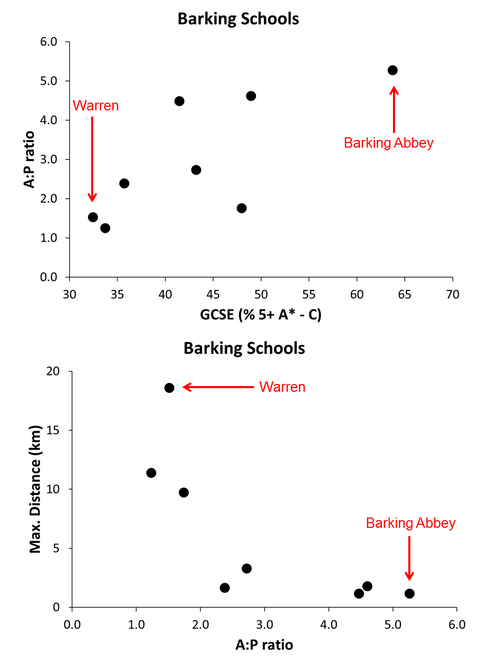
Using data from several LEAs, Chris and Tim showed empirically how this distance criterion is related to school popularity. School popularity is indicated for example by the ratio of school applicants to the number of places available at the school (A:P) – some schools have very high ratios (e.g. up to 8 applications per place) and others very low (e.g. down to around one application per place). Furthermore, this spatial allocation criterion is an important influence on parents’ strategies for school applications, dependent on the location of their home relative to schools and their ability to move home.

These allocation rules, combined with parent’s strategies, produce patterns and relationships between schools’ GCSE achievement levels, A:P ratio and the maximum distance that allocated pupils live from the school. In Barking, for example, we see in the figure below that more popular schools have higher percentages of pupils achieving five GCSE’s with grades A* – C, and that these same popular schools also have the smallest maximum distances (i.e. pupils generally live very close to the school).

Empirical Patterns in Barking Schools

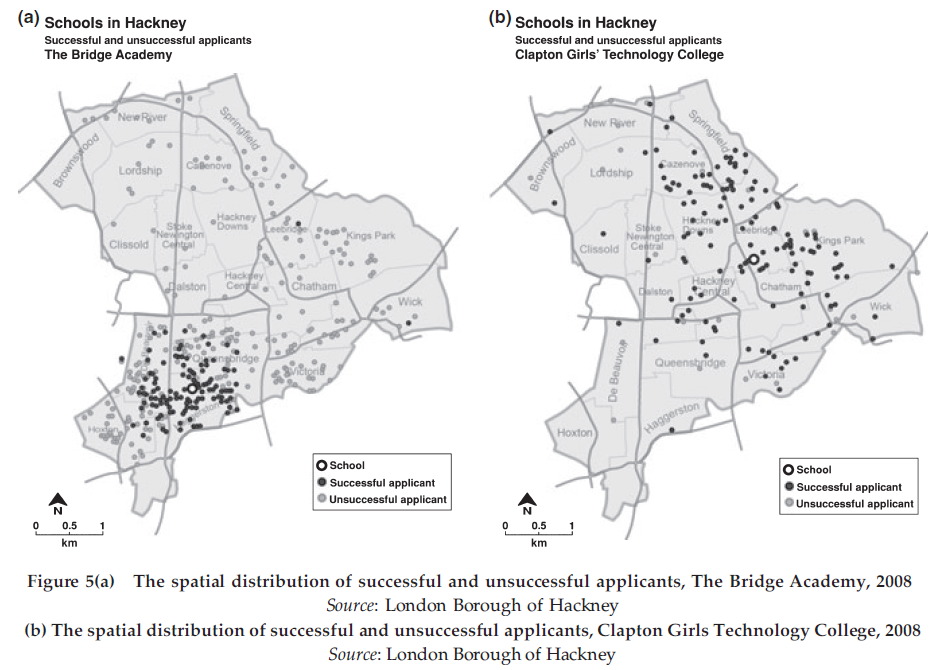
This spatial pattern can also seen when we look at maps of the locations of successful and unsuccessful applicants to popular and less popular schools in Hackney. For example, looking at the figure below (found in Hamnett and Butler 2011) we can see how successful applicants to The Bridge Academy (a popular school) are more tightly clustered around the it than those for Clapton Girls’ Technology College (not such a popular school).

Map of successful and unsuccessful applicants to two schools in Hackney

The geography of this school allocation policy, combined with differences in parents’ circumstances, suggests this issue is a prime candidate for study using agent-based modelling. Agent-based simulation modelling might be useful here because it provides a means to represent interactions between individual actors with different attributes (in this case schools and parents) across space and time. Once the simulation model structure (e.g. rules of interactions between agents) has been established, it can then be used to examine the potential effects of things like opening or closing schools (i.e. changes in external conditions) or changes in school allocation policy rules or parents’ application strategies (i.e. internal model relationships and rules).

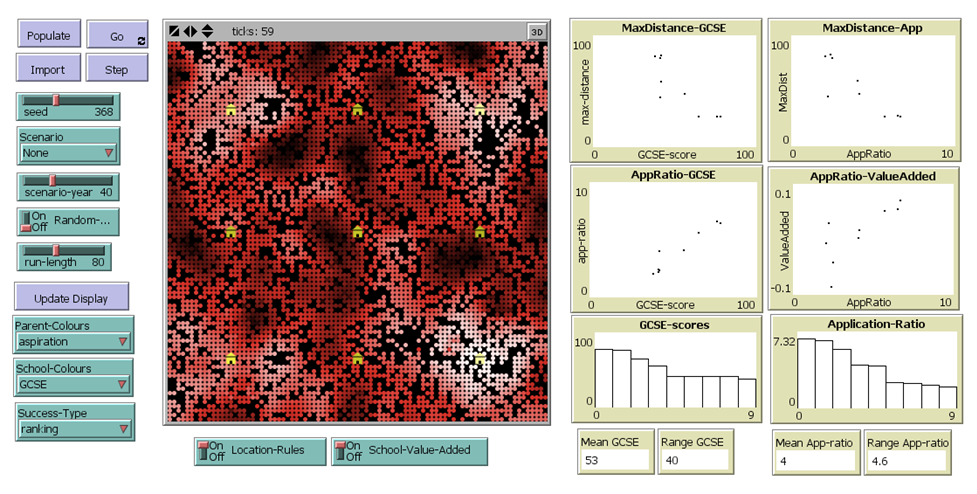
I developed an initial ‘model’ as a proof of concept and which you can try out yourself. Things have progressed from that proof of concept model, and the model now represents changes in cohorts of school applicants and pupils through time, including the potential for parents to move house to be more likely to get their child into a desired school.

In the seminar with the Department of Education guys I presented some ouput from the recent modelling. I showed how the abstract model with relatively few and simple assumptions can start from random conditions to reproduce empirical spatial patterns in school applications and attainment outcomes like those described above (see the figure below)

School model screenshot

I also presented early results from using the simulation model to explore implications of potential policy alternatives (such as closing failing schools). These ideas were generally welcomed in the seminar but there were some interesting questions about the what the model assumptions might entail for maintaining existing policy assumptions and intentions (what we might term the rhetoric of modelling).

I’m exploring some of these questions now, including for example issues of how we define a ‘good’ school and how parents’ school application strategies might change as allocation rules change. These will feed into a research manuscript that I’ll continue to work on with Chris and Tim.

Answering forest management questions

Although I’ve been working on new ideas since leaving Michigan and returning to London about a year ago, there’s still lots to do to examining alternative forest management strategies.

Several years ago we set out to develop a simulation model that could be used to investigate the effects of interactions between timber harvest and deer browse disturbances on economic productivity and wildlife habitat. We’ve already published several papers on this work, but just before Christmas we submitted a manuscript to Ecological Modelling entitled ‘Modelling for forest management synergies and trade-offs: Tree regeneration, timber and wildlife’. In the manuscript we report error analyses of the full simulation model (which uses the USFS Forest Vegeation Simulator) and use the model to investigate scenarios of different timber and deer management actions. Our results indicate that greater harvest of commercially low-value ironwood and lower deer densities significantly increase sugar maple regeneration success over the long term.

I expect we’ll also report some of these results at the Fourth Forest Vegetation Simulator (FVS) Conference to be held in April this year in Fort Collins, CO. Our abstract, entitled ‘Investigating combined long-term effects of variable tree regeneration and timber management on forest wildlife and timber production using FVS’, has been accepted for oral presentation. It would be great to be there myself to present the paper and discuss things with other FVS experts, but I’m not sure if that will be possible. If it’s not, Megan Matonis will present as, handily, she’s currently doing her PhD in that neck of the woods at Colorado State University.

In the meantime, Megan and I are in the process of finishing off a different manuscript describing the mesic conifer planting experiment we did in Michigan. In that experiment we planted seedlings of white pine (Pinus strobus), hemlock (Tsuga canadensis), and white spruce (Picea glauca) in northern hardwood stands with variable deer densities and then monitored browse on the seedlings over two years. We found that damage to pine and hemlock seedlings was inversely related to increasing snow depth, and our data suggest a positive relationship between hemlock browse and deer density. These results suggest that hemlock restoration efforts will not be successful without protection from deer. Hopefully we’ll submit the manuscript, possibly to the Northern Journal of Applied Forestry, in the next month or so.

All of this work has been pursued with management in mind, so it was nice this week to receive a call from Bob Doepker, a manager at the Michigan Department of Natural Resources with whom we worked to co-ordinate data collection and establish key research questions. Bob had some questions about the details and implications of our previous findings for deer habitat, tree regeneration and how they should be managed. It was good to catch up, and no doubt our ongoing work will continue to contribute to contemporary management understanding and planning.

Agent-based models – because they’re worth it?

So term is drawing to an end. There’s lots been going on since I last posted here and I’ll write a full update of that over the Christmas break. I’ll just highlight here quickly that the agent-based modelling book I contributed to has now been published.

Agent-Based Models of Geographical Systems, is editied by Alison Heppenstall, Andrew Crooks, Linda See and Mike Batty and presents a comprehensive collection of papers on the background, theory, technical issues and applications of agent-based modelling (ABM) in geographical systems. David O’Sullivan, George Perry, John Wainwright and I put together a paper entitled ‘Agent-based models – because they’re worth it?’ that falls into the ‘Principles and Concepts of Agent-Based Modelling’ section of the book. To give an idea of what the paper is about, here’s the opening paragraph:

“In this chapter we critically examine the usefulness of agent-based models (ABMs) in geography. Such an examination is important be-cause although ABMs offer some advantages when considered purely as faithful representations of their subject matter, agent-based approaches place much greater demands on computational resources, and on the model-builder in their requirements for explicit and well-grounded theories of the drivers of social, economic and cultural activity. Rather than assume that these features ensure that ABMs are self-evidently a good thing – an obviously superior representation in all cases – we take the contrary view, and attempt to identify the circumstances in which the additional effort that taking an agent-based approach requires can be justified. This justification is important as such models are also typically demanding of detailed data both for input parameters and evaluation and so raise other questions about their position within a broader research agenda.”

In the paper we ask:

  • Are modellers agent-based because they should be or because they can be?
  • What are agents? And what do they do?
  • So when do agents make a difference?

To summarise our response to this last question we argue;

“Where agents’ preferences and (spatial) situations differ widely, and where agents’ decisions substantially alter the decision-making con-texts for other agents, there is likely to be a good case for exploring the usefulness of an agent-based approach. This argument focuses attention on three model features: heterogeneity of the decision-making context of agents, the importance of interaction effects, and the overall size and organization of the system.”

Hopefully people will find this, and the rest of the book useful! You can check out the full table of contents here.

Citation
O’Sullivan, D., J.D.A. Millington, G.L.W. Perry, J. Wainwright (2012) Agent-based models – because they’re worth it? p.109 – 123 In: Heppenstall, A.J., A.T. Crooks, L.M. See, M. Batty (Eds.) Agent-Based Models of Geographical Systems, Springer. DOI: 10.1007/978-90-481-8927-4_6

ABM, Prezi and the New Term

I’ve not been in the office much over the last month or so, but that’s all about to change now that the new academic term has arrived!

Since I last posted, I attended and presented work at the Royal Geographical Society Annual Conference, one presentation on our managed forest landscape modelling in Michigan and one on the narrative properties of simulation modelling. Both presentations were in the environmental modelling and decision making session, but despite being the graveyard session (last of the conference!) we had some interesting questions and discussion. I tried out Prezi for my narratives presentation (brought to my attention by Tom Smith). It certainly requires a different approach than the linear style PowerPoint enforces. Whether Prezi is a more useful tool probably depends on the message you’re trying to communicate – if your story isn’t particularly linear then Prezi might be useful.

These last few days I’ve been up in Edinburgh visiting folks at the Forestry Commission’s Northern Research Station to discuss the socio-ecological modelling of potential woodland creation I’ve been working on recently. I also got to talk with Derek Robinson at the University of Edinburgh about some of these issues. Everyone seemed interested in what I’ve been doing, particularly with the ideas I’ve been bouncing around relating to the work Burton and Wilson have been doing on post-productivist farmer self-identities, how these self-identities might change, how they might influence adoption of woodland planting and how we might model that. For example, I think an agent-based simulation approach might be particularly useful for exploring what Burton and Wilson term the ‘‘temporal discordance’ in the transition towards a post-productivist agricultural regime”. And I also think there’s potential to tie it in with work like my former CSIS colleague Xiaodong Chen has been doing using agent-based approaches to model the effects of social norms on enrollment in payments for ecosystem services (such as woodland creation).

I was away on holiday for a couple of weeks after the RGS. On returning, I’ve been preparing for King’s Geography tutorials with the incoming first year undergraduates. The small groups we’ll be working will allow us to discuss and explore critical thinking and techniques about issues and questions in physical geography. Looking forward a busy autumn term!

Philosophy of Modelling and RGS 2011

I just updated the Philosophy of Modelling page on my website. It’s not anything too detailed but I was prompted to add something by my activities over the last few weeks. I’ve been working on both making progress with my ‘modelling narratives’ project and a paper I’ve started working on with John Wainwright exploring the epistemological roles agent-based simulation might play beyond mathematical and statistical modelling (expected to appear in the new-ish journal Dialogues in Human Geography).

It’s only a few weeks now until this year’s Royal Geographical Society annual meeting (31 Aug – 2 Sept). I’m making two presentations, unfortunately both in the same session! It seems my work sits squarely within ‘Environmental modelling and decision making’, as the both abstract I submitted were allocated to that session on the Friday afternoon (Skempton Building, Room 060b; last session of the week so people might be flagging!). The first presentation will deal with the ‘generative’ properties of agent-based modelling [.pdf] and what that implies for how we might study and use that modelling approach, and the second will summarise the Michigan forest modelling work we’ve completed so far. Both abstracts are below.

This also seems a good point to highlight that King’s Geography Department are hosting a drinks reception on the Thurdsay evening from 18:45 at Eastside Bar, Princes Garden, SW7 1AZ. Free drinks for the first 50 guests, so get there sharpish!

Millington RGS 2011 Abstracts

Model Histories: The generative properties of agent-based modelling
Fri 2 Sept, Session 4, Skempton Building, Room 060b
James Millington (King’s College London)
David O’Sullivan (University of Auckland, New Zealand)
George Perry (University of Auckland, New Zealand)

Novels, Kundera has suggested, are a means to explore unrealised possibilities and potential futures, to ask questions and investigate scenarios, starting from the present state of the world as we observe it – the “trap the world has become”. In this paper, we argue that agent-based simulation models (ABMs) are much like Kundera’s view of novels, having generative properties that provide a means to explore alternative possible futures (or pasts) by allowing the user to investigate the likely results of causal mechanisms given pre-existing structures and in different conditions. Despite the great uptake in the application of ABMs, many have not taken full advantage of the representational and explanatory opportunities inherent in ABMs. Many applications have relied too much on ‘statistical portraits’ of aggregated system properties at the expense of more detailed stories about individual agent context and particular pathways from initial to final conditions (via heterogeneous agent interactions). We suggest that this generative modelling approach allows the production of narratives that can be used to i) demonstrate and illustrate the significance of the mechanisms underlying emergent patterns, ii) inspire users to reflect more deeply on modelled system properties and potential futures, and iii) provide a means to reveal the model building process and the routes to discovery that lie therein. We discuss these issues in the context of, and using examples from, the increasing number of studies using ABMs to investigate human-environment interactions in geography and the environmental sciences.

Trees, Birds and Timber: Coordinating Long-term Forest Management
Fri 2 Sept, Session 4, Skempton Building, Room 060b
James Millington (King’s College London)
Megan Matonis (Colorado State University, United States)
Michael Walters (Michigan State University, United States)
Kimberly Hall (The Nature Conservancy, United States)
Edward Laurent (American Bird Conservancy, United States)
Jianguo Liu (Michigan State University, United States)

Forest structure is an important determinant of habitat use by songbirds, including species of conservation concern. In this paper, we investigate the combined long-term impacts of variable tree regeneration and timber management on stand structure, bird occupancy probabilities, and timber production in the northern hardwood forests of Michigan’s Upper Peninsula. We develop species-specific relationships between bird occupancy and forest stand structure from field data. We integrate these bird-forest structure relationships with a forest model that couples a forest-gap tree regeneration submodel developed from our field data with the US Forest Service Forest Vegetation Simulator (Ontario variant). When simulated over a century, we find that higher tree regeneration densities ensure conditions allowing larger harvests of merchantable timber, and reducing the impacts of timber harvest on bird forest-stand occupancy probability. When regeneration is poor (e.g., 25% or less of trees succeed in regenerating), timber harvest prescriptions have a greater relative influence on bird species occupancy probabilities than on the volume of merchantable timber harvested. Our results imply that forest and wildlife managers need to work together to ensure tree regeneration and prevent detrimental impacts on timber output and habitat for avian species over the long-term. Where tree regeneration is currently poor (e.g., due to deer herbivory), forest and wildlife managers should pay particularly close attention to the long-term impacts of timber harvest prescriptions on bird species.

Summer 2011 Papers

Since I last posted, THREE of the papers I’ve mentioned here previously have become available online! Here are their details, abstracts are below. Email me if you can’t get hold of them yourself.

Millington, J.D.A., Walters, M.B., Matonis, M.S., Laurent, E.J., Hall, K.R. and Liu, J. (2011) Combined long-term effects of variable tree regeneration and timber management on forest songbirds and timber production Forest Ecology and Management 262 718-729 doi: 10.1016/j.foreco.2011.05.002

Millington, J.D.A. and Perry, G.L.W. (2011) Multi-model inference in biogeography Geography Compass 5(7) 448-530 doi: 10.1111/j.1749-8198.2011.00433.x

Millington, J.D.A., Demeritt, D. and Romero-Calcerrada, R. (2011) Participatory evaluation of agent-based land use models Journal of Land Use Science 6(2-3) 195-210 doi:10.1080/1747423X.2011.558595

Millington, J.D.A. et al. (2011) Combined long-term effects of variable tree regeneration and timber management on forest songbirds and timber production Forest Ecology and Management 262 718-729
Abstract
The structure of forest stands is an important determinant of habitat use by songbirds, including species of conservation concern. In this paper, we investigate the combined long-term impacts of variable tree regeneration and timber management on stand structure, songbird occupancy probabilities, and timber production in northern hardwood forests. We develop species-specific relationships between bird species occupancy and forest stand structure for canopy-dependent black-throated green warbler (Dendroica virens), eastern wood-pewee (Contopus virens), least flycatcher (Empidonax minimus) and rose-breasted grosbeak (Pheucticus ludovicianus) from field data collected in northern hardwood forests of Michigan’s Upper Peninsula. We integrate these bird-forest structure relationships with a forest simulation model that couples a forest-gap tree regeneration submodel developed from our field data with the US Forest Service Forest Vegetation Simulator (Ontario variant). Our bird occupancy models are better than null models for all species, and indicate species-specific responses to management-related forest structure variables. When simulated over a century, higher overall tree regeneration densities and greater proportions of commercially high value, deer browse-preferred, canopy tree Acer saccharum (sugar maple) than low-value, browse-avoided subcanopy tree Ostrya virginiana (ironwood) ensure conditions allowing larger harvests of merchantable timber and had greater impacts on bird occupancy probability change. Compared to full regeneration, no regeneration over 100 years reduces merchantable timber volumes by up to 25% and drives differences in bird occupancy probability change of up to 30%. We also find that harvest prescriptions can be tailored to affect both timber removal volumes and bird occupancy probability simultaneously, but only when regeneration is adequate. When regeneration is poor (e.g., 25% or less of trees succeed in regenerating), timber harvest prescriptions have a greater relative influence on bird species occupancy probabilities than on the volume of merchantable timber harvested. However, regeneration density and composition, particularly the density of Acer saccharum regenerating, have the greatest long-term effects on canopy bird occupancy probability. Our results imply that forest and wildlife managers need to work together to ensure tree regeneration density and composition are adequate for both timber production and the maintenance of habitat for avian species over the long-term. Where tree regeneration is currently poor (e.g., due to deer herbivory), forest and wildlife managers should pay particularly close attention to the long-term impacts of timber harvest prescriptions on bird species.

Millington, J.D.A. and Perry, G.L.W. (2011) Multi-model inference in biogeography Geography Compass 5(7) 448-530
Abstract
Multi-model inference (MMI) aims to contribute to the production of scientific knowledge by simultaneously comparing the evidence data provide for multiple hypotheses, each represented as a model. With roots in the method of ‘multiple working hypotheses’, MMI techniques have been advocated as an alternative to null-hypothesis significance testing. In this paper, we review two complementary MMI techniques – model selection and model averaging – and highlight examples of their use by biogeographers. Model selection provides a means to simultaneously compare multiple models to evaluate how well each is supported by data, and potentially to identify the best supported model(s). When model selection indicates no clear ‘best’ model, model averaging is useful to account for parameter uncertainty. Both techniques can be implemented in information-theoretic and Bayesian frameworks and we outline the debate about interpretations of the different approaches. We summarise recommendations for avoiding philosophical and methodological pitfalls, and suggest when each technique is best used. We advocate a pragmatic approach to MMI, one that emphasises the ‘thoughtful, science-based, a priori’ modelling that others have argued is vital to ensure valid scientific inference.

Millington et al. (2011) Participatory evaluation of agent-based land use models Journal of Land Use Science 6(2-3) 195-210
Abstract
A key issue facing contemporary agent-based land-use models (ABLUMs) is model evaluation. In this article, we outline some of the epistemological problems facing the evaluation of ABLUMs, including the definition of boundaries for modelling open systems. In light of these issues and given the characteristics of ABLUMs, participatory model evaluation by local stakeholders may be a preferable avenue to pursue. We present a case study of participatory model evaluation for an agent-based model designed to examine the impacts of land-use/cover change on wildfire regimes for a region of Spain. Although model output was endorsed by interviewees as credible, several alterations to model structure were suggested. Of broader interest, we found that some interviewees conflated model structure with scenario boundary conditions. If an interactive participatory modelling approach is not possible, an emphasis on ensuring that stakeholders understand the distinction between model structure and scenario boundary conditions will be particularly important.

Changing the ‘Targets and Timetables’ Climate Change Narrative

Earlier this week I was in Leipzig, Germany, to meet the Ecological Modelling research group at the Helmholz Centre for Environmental Research (UFZ) and one of my PhD supervisors, Dr. George Perry. While there I was lucky to meet and talk with some renowned ecological modellers: Thorsten Wiegand, who’s work includes spatial point process modelling (although some of his discussion with George about that was a bit technical for me!); Volker Grimm, proponent the ‘Pattern-Oriented Modelling’ approach (look out for a new review of this in Phil Trans. of the Royal Society in the near future), and Andreas Huth, notable forest dynamics modeller.

At UFZ I gave a presentation I entitled “Future Forests: Managing and Creating Forests for Biodiversity, Recreation, Timber and Carbon” in which I talked about some of the work I did in Michigan and the new project I’m working on now in the UK. The talk seemed to go down well and the research group had some very good questions, both about technical aspects of the modelling and the issues it is applied to (i.e. forest ecosystem management and woodland creation, including the Woodland Carbon Code). Thanks to Juergen Groeneveld for organising this (and his hospitality at UFZ).

Much of the data I presented regarding the Michigan work was collected by Megan Matonis. Her analyses of that data, on which I helped and supervised, are now available to read in a paper that is currently in press with Forest Ecology and Management (email me if you can’t access the online version).

Another interesting activity at UFZ was hearing Roger Pielke Jr. talk about the need to ‘change the climate change narrative’. In his talk he suggested that understanding all carbon policy can be boiled down to a single sentence;

‘people engage in economic activity that uses energy from carbon emitting generation’.

He emphasised that he thinks the “Targets and Timetables” approach to reducing anthropogenic carbon emissions is flawed. As an example, he used the case of the UK and the Climate Change Act of 2008 which set the aim of an 80% cut in the country’s carbon emissions by 2050 compared to 1990 levels, with an intermediate target of 34% by 2020. However, Pielke argues that given the ‘iron’ law of climate policy (that we cannot mitigate emissions by reducing GDP, both because people will pay only so much to mitigation now, and because increasing GDP is seen as a virtue by way of its effects on povety reduction) we cannot hit these types of targets.

Previous decarbonisation of the UK economy has been achieved by replacing the contribution to GDP from high-emitting manufacturing with low-emitting financial services. He wonders how long can this go and presented his estimate that for the UK to actually hit its 2020 target it will have to build more than 40 nuclear power stations in the next 10 years. In this context, he suggested that the building of a third runway at Heathrow was an insignificant concern (in terms of the new emissions it would generate) when there are still 1.5 billion people globally who do not have access to electricity. His argument is that we do not know how to achieve the targets and the timetables we have set ourselves.

Pielke argues that we must change the climate change narrative from

“We need to use less energy and fossil fuels are cheap

to

“We need more energy and fossil fuels are too expensive“.

This would allow these 1.5 billion people to access the electricity they aspire to whilst driving the growth of alternative, cleaner, sources of energy. I like this argument – and his one about making small steps towards these change to reach bigger changes – but it seems to run counter to his point about the insignificance of another runway at Heathrow (which by increasing capacity for flights would continue the narrative of cheap fossil-fuelled energy). Opening a third runway but only allowing non-fossil-fuelled aeroplanes to use it is ultimately most consistent with the change in narrative he argues for.

And of course, while at UFZ, George Perry and I took the opportunity to discuss past, current and ongoing work over beers and dinner. Mainly we discussed the idea surrounding the narrative properties of generative simulation models and on which I plan to submit a manuscript to a journal for publication soon. But we also thought about other areas of research including land use modelling (continuing our work in Spain) and landscape disturbance-succession modeling (including the use of the LFSM I’ve developed with paleo-estimates of wildfire regimes).

All-in-all a very interesting and productive trip!