Launching effective interdisciplinary human-environment research

After a while bouncing around various outlets, the paper that emerged from the CHANS Workshop at US-IALE 2009 in Snowbird has been published. Presented as a meeting review in the ESA Bulletin, Research on Coupled Human and Natural Systems (CHANS): Approach, Challenges, and Strategies discusses what the CHANS approach is and what the current challenges and strategies in this field are. For example, we suggest the following are the keys to launching effective CHANS research projects:

Identify the goals and final products of the project

  • Goals and products could include answers to scientific questions, hypothesis testing, a simulation model or decision-support tool, policy or management recommendations, or education.
  • Identify and articulate analysis boundaries and scales of interest: spatially, temporally, and in terms of physical processes.
  • A preliminary conceptual model may help initiate discussion among potential collaborators; the conceptual model need not be correct in what it is illustrating, but rather serve to “break the ice” and generate discussion.

Build a team around the identified goals and products

  • Identify project manager(s) and submanagers, where the submanagers may be discipline specific and responsible for a particular component of the project.
  • It may also be beneficial to assign to one person responsibility for overseeing and maintaining the project timeline. It might be advantageous for this person not to be a manager or submanager to minimize potential conflicts.
  • Once the team is together, reexamine the initial goals and final products.

Methods necessary to accomplish project goals and products should now be developed.

  • It is important to recognize that the final products may change in response to the project team’s vision and analysis. Team members must be prepared to be flexible, to reevaluate the project’s conceptual framework and methods as a partnership matures.
  • Potential challenges of complexity and uncertainty should be discussed at this point; where in the project may they later manifest themselves? How may they be overcome?
  • Each team member should be recognized as “a tool in a toolbox,” each providing a unique contribution that works in tandem with the other tools (e.g., the compass and ruler) to build the entire project.

We conclude; “The CHANS approach is emerging from its infancy, characterized by the use of rudimentary language skills in describing deeply complex systems. With proper support, it stands to contribute to a better understanding of the multifaceted interactions between human and natural systems, and thus inform societal choices in pursuit of sustainability.”
Long-Term Bird-Timber Trade-offs

Not surprisingly, during my time at Michigan State University many of my posts on this blog focused on the work I was doing there on forest ecosystem management. I’ll continue to write papers and use and develop the simulation model I initiated at MSU, but now I’m back in London I’m sure the emphasis on this blog will switch to the primary work I’ll be doing here. Before it does, here’s a post on the work I’ve done recently related to the Michigan study and which I’m about to submit for review.

I’ve written here previously about how I’ve been working on modelling the long-term impacts of poor tree regeneration on forest structure and estimating bird presence in forests given their structural characteristics. In my last few months in Michigan, I integrated these two issues as part of the development of the integrated ecological-economic simulation model. The aim was to assess trade-offs between between protecting bird species of conservation concern and ensuring the productivity of industrial forests given the variable tree regeneration densities we have seen across our study area and given the timber harvest options available. I was particularly interested in how the variations in tree regeneration we have seen across our study area [we have a paper on these currently under review – more details soon] might influence long-term forest sustainability. Simulation modelling is an excellent way to look at these types of issues over long time periods.

To examine the trade-offs I integrated bird occupancy models I had developed for four bird species (black-throated green warbler, eastern wood pewee, least flycatcher and rose-breasted grosbeak) with our our model of forest gap regeneration and FVS. I then used the model to simulate various scenarios of regeneration and timber harvest prescriptions. For example, I simulated different densities of trees regenerating in the forest gaps created by timber harvest and different proportions of these trees as either sugar maple or ironwood. These are the sorts of variables that Megan Matonis found to vary across our study area and that are most likely driven by white-tailed deer herbivory. With the simulation model we could then look at how these different scenarios influence forest structure and, in turn, bird occupancy probability. We also looked at how different timber harvest prescriptions interact with these different densities and compositions of regenerating trees.

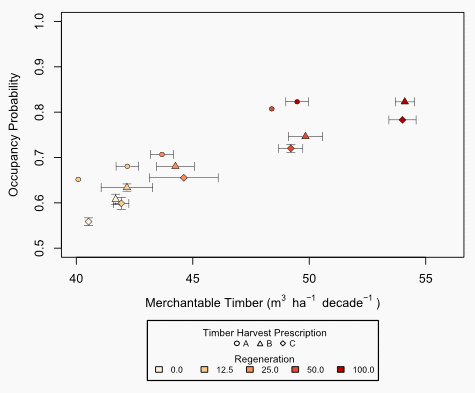
Using our model for a simulated century we found that the four bird species we examined responded uniquely to changes in forest structure (in turn due to the variation in regeneration composition and density and timber harvest prescriptions). We also found that 100-year average timber volume removals, which varied with harvest prescriptions and regeneration, were related to bird occupancy for three of the four species, positively for two and negatively for one. These results suggest that timber harvest prescriptions can be tailored to influence both timber removal volumes and bird occupancy probability, but only when regeneration is adequate. This is illustrated by the figure below for one of the bird species.

Plot illustrating tradeoffs

Mean annual timber removed is plotted on the horizontal axis and mean bird occupancy probability on the vertical axis. The different colours of points are the different densities of regeneration (darker is higher) and the different shapes are the different timber harvest prescriptions. When regeneration is poorer (lighter colours), differences in the volume of timber removed are smaller between prescriptions (horizontal axis) than differences in bird occupancy probability (vertical axis, relative to the uncertainty bars).

These results imply that management actions that promote high tree regeneration rates (for example, by reducing deer herbivory) will benefit both bird populations and timber production in the long-term. Consequently, we suggest that where tree regeneration is currently poor, forest managers should pay closer attention to the long-term impacts of timber harvest prescriptions on bird species.

As I highlighted above, this work is very near being submitted for publication. I’ll post here as the review and publication process progresses (and maybe try to use fewer hyphens in the title).

Multi-Model Inference in Biogeography

Earlier this month I, along with George Perry, finished a review on multi-model inference for the journal Geography Compass. Geography Compass publishes state-of-the-art reviews aimed at students, researchers and non-specialist scholars. The manuscript is currently under review so we’ll have to see what the reviewers think before the paper is published. Once it’s available I’ll re-post here. In the meantime, here’s the abstract to whet your appetite;

Multi-model inference (MMI) aims to produce scientific knowledge by simultaneously comparing the evidence data provide for multiple hypotheses, each represented as a model. Stemming from the method of ‘multiple working hypotheses’, MMI techniques have been advocated as an alternative to null hypothesis significance testing. These techniques will likely be particularly useful in research fields such as biogeography where formal experimentation is difficult and data are often influenced by uncontrolled factors. In this paper we review two complementary MMI techniques – model selection and model averaging – and highlight examples of their use in the biogeography literature. Both techniques can be implemented in a Bayesian framework and we outline the debate about different interpretations of probability. We summarise recommendations for avoiding philosophical and methodological pitfalls, and suggest circumstances in which each technique will likely be most useful in. We finish by advocating a pragmatic approach to MMI, one that emphasises the ‘thoughtful, science-based, a priori’ modelling others have argued is vital to ensure valid scientific inference.

The Politics of Expectations

Next year’s Annual meeting of the Association of American Geographers will be in Seattle. I was considering attending but I think it might be best to let the dust settle after moving back to the UK in January. Many others will be there however, including James Porter, a colleague and friend from PhD times at King’s College, London. On his behalf, here’s the call for papers for a session he’s organising at the meeting. Deadline is 1st October, more details at the bottom.

Call for Papers
The Politics of Expectations: Nature, Culture, and the Production of Space

Association of American Geographers, Annual Meeting, 12-16th April 2011, Seattle.

Session Organisers:
James Porter (King’s College London) and Samuel Randalls (University College London)

Expectations are incredibly powerful things. Whether materialized via climatic models, economic forecasts, or based on the promise of personalised medicines, expectations (and those who engineer them) play a deeply political yet often unsung role in bringing into being a particular kind of future as well as shaping a particular kind of present. Savvy actors seeking to engineer change may decide to write editorials, give press briefings, or try to normalise trust between the communities involved so as to enrol support and resources for an emerging marketplace (and consumer) they have envisioned. Such discursive as well as performative practices pre-emptively shape the social and economic context for developing technologies so that the actors involved not only develop their physical objects but also influence other people’s thinking. Rather than dismiss such efforts as exaggerated or self-serving claims, the “sociology of expectations” (cf. Brown, 2003; Hedgecoe, 2004; Law, 1994) points to the constructive, performative, and even destructive role such expectations have in today’s world where competition for funding, research impact and innovation are so intense. As many geographers researching the ‘commercialization of nature’ have noted (cf. Castree, 2003; Johnson, 2010; Lave et al., 2010; Prudham, 2005), expectations of future natures inhabit contemporary environmental management in a series of subtle and not so subtle ways for all actors.

But how are expectations created, configured, and stabilized? What, and whose, interests shape them, and in turn, whose interests do they shape? And why do some persist whilst others don’t? Such questions speak directly to the ways in which nature (and knowledge of it) is being increasingly commercialized and commodified through its interactions with science and technology. This session builds on controversies such as the climate change emails at UEA, medical trials, carbon forestry and much more to showcase how the “future” is mobilized to govern or proliferate uncertainty and justify particular mechanisms for managing environmental problems. Geographers are uniquely placed to comment on this providing theoretical depth and empirical evidence that sheds light on the commodification of nature whilst also contributing to the socio-technical analyses employed by science and technology studies scholars. We therefore invite papers addressing (though not limited to) the following questions:

  • Who constructs expectations and why? How / where do they get enacted (i.e. technological, sociocultural, artefacts, etc.)? And how do they get accepted, institutionalized, or perhaps resisted?
  • How are expectations of nature commercialized? To what extent are expectations central to processes of commercialization and does this vary depending on the specific environmental arena? Are there unnatural expectations?
  • Do expectations have agency? Can they be negotiated or adapted? If so, what role have geographers played in shaping past perceptions and might hope to play in the future?
  • What happens if a set of expectations is not successful? Why didn’t they succeed? And what lessons can we learn?

Abstracts should be sent to both James Porter (james.porter at kcl.ac.uk) and Samuel Randalls (s.randalls at ucl.ac.uk) by Friday 1st October 2010.

For conference information, see: www.aag.org/cs/annualmeeting

Changing Forest Structure

It’s been a while since I posted here about the forest modelling I’ve been working on here at MSU. Over the last couple of months I’ve been working on finalizing the regeneration modelling component, refining the timber harvest rules, linking simulations to the bird occupancy modelling I started this spring, and writing it all up for manuscripts.

Across our study area we’ve found that regeneration of juvenile trees following timber harvest varies greatly. For example, from our empirical data we find that sugar maple saplings were present in over 70% of northern forest gaps but were completely absent from 96% of gaps in southern areas. Megan Matonis suggested in her thesis that this variation is related to snow depth, deer density and soil nutrient conditions. To examine the potential long-term effects of these differences in regeneration on forest structure I’ve been running our simulation model with pre-set levels of regeneration that reflect our observations, ranging from the maximum possible (given the space available in a post-harvest gap) to a complete absence of regenerating juvenile trees.

These ‘gaps’ I’m talking about are created in northern hardwood forests when individual or small groups of trees are removed in an uneven-aged timber management approach. The removal of these trees creates openings (‘gaps’) in the forest canopy allowing light into lower levels for younger trees [gaps may also be created naturally but we’re focusing on those created by human activity which is the dominant driver in our study area]. When harvesting trees in this approach foresters aim to produce a forest structure with a ‘reverse-J’ distribution of tree sizes; high densities of small, young trees and low densities of larger, older trees (approximating a gamma-distribution like I found in our data previously). The idea is that through time an abundant supply of competing smaller trees will replace larger trees trees that are removed.

Representing this approach in our model (using FVS keywords [.pdf]) requires quite a bit of code, but working through the example provided by Don Vandendriesche [.pdf] helped. This approach requires the model user to specify a residual basal area (the area occupied by trees) and the ratio between the number of trees in successive size classes (the q-factor).

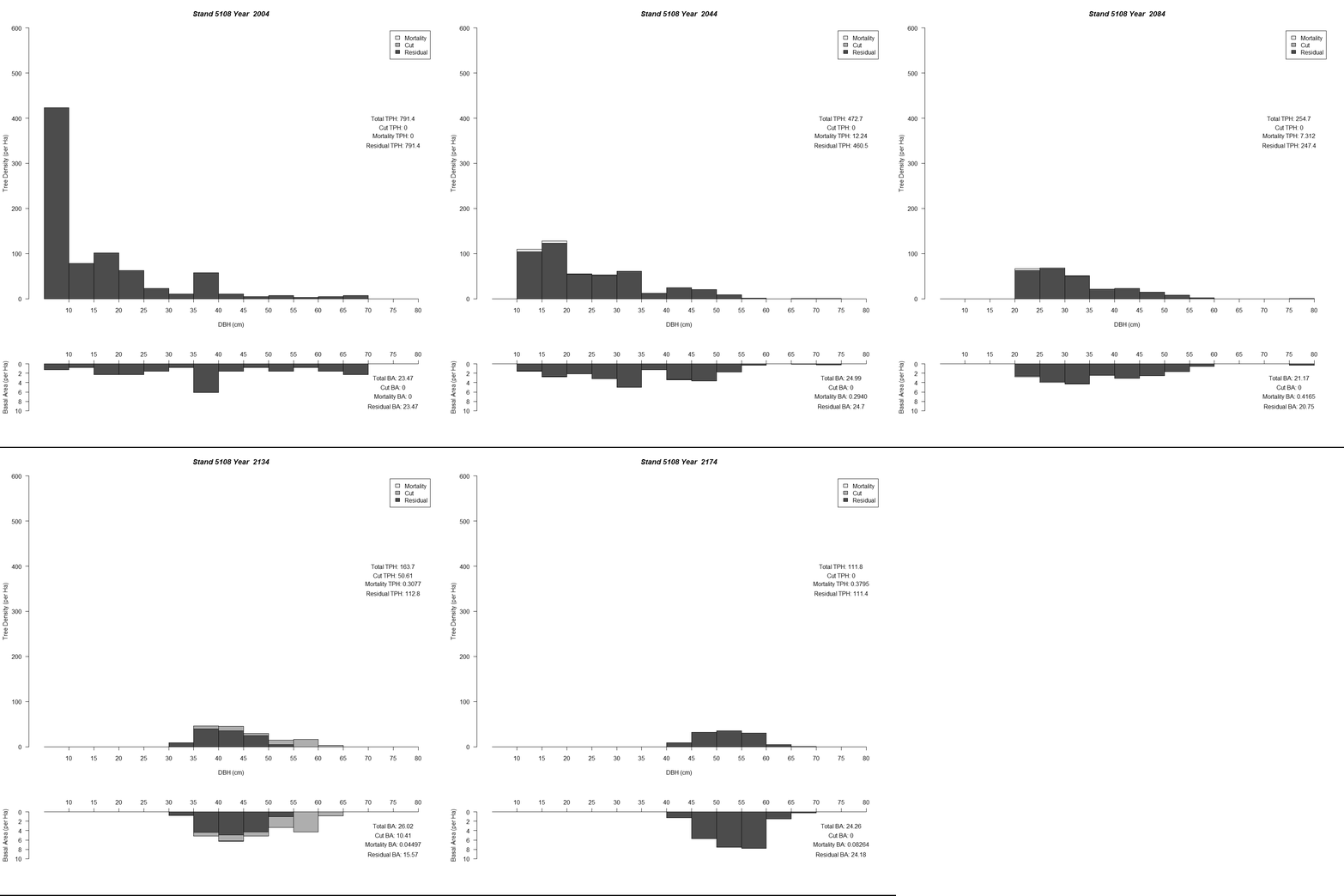
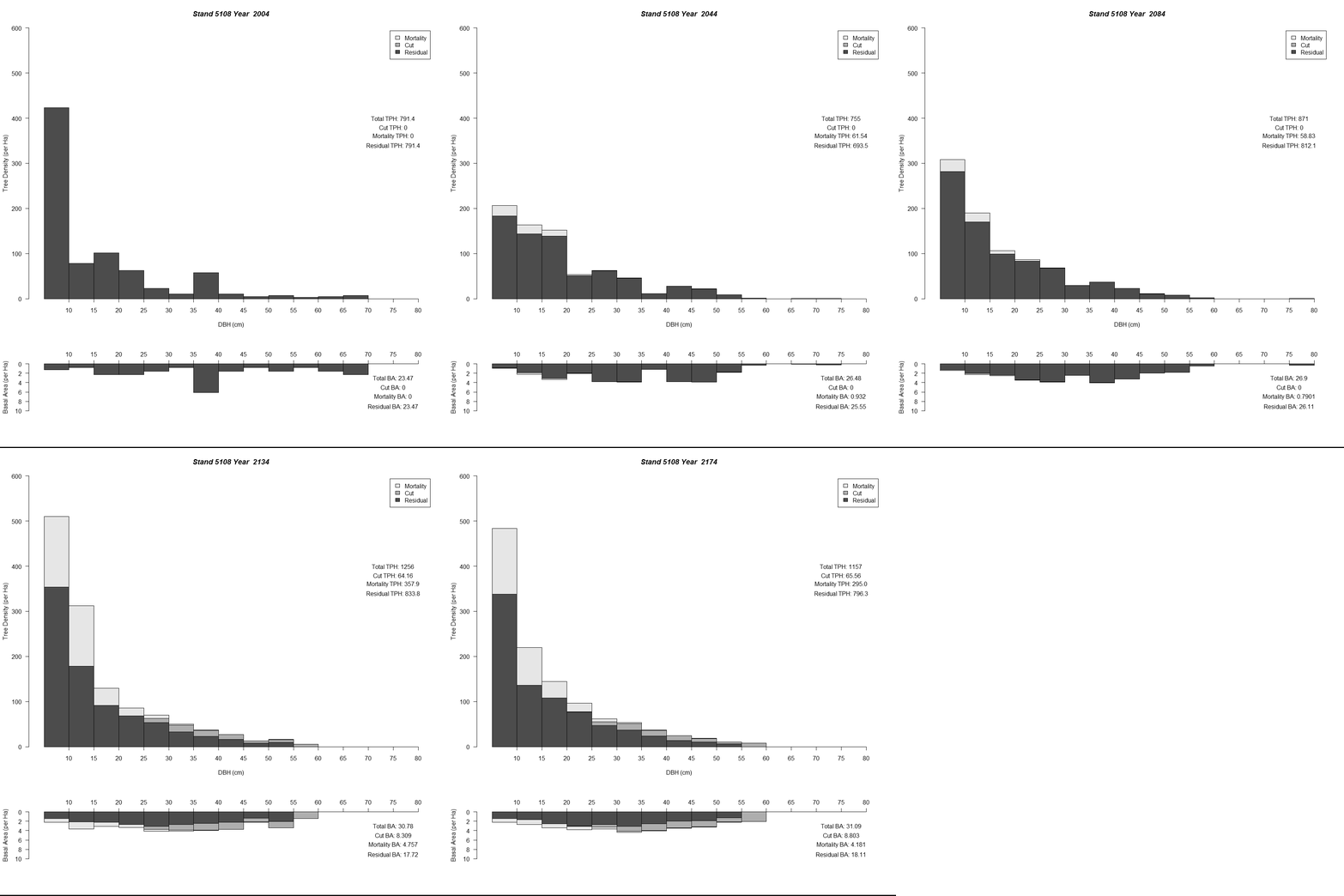
To examine my initial results (and to help debugging during the whole modelling process) I used R to plot size-class distributions for tree densities and basal area. As is the norm I used size-classes defined by the diameter-at-breast-height of the trees (5 cm or about 2 inches). Then I combined plots for simulated years into animated .gif files to see how the distributions changed through time for different regeneration levels. Here are a couple of examples (click for larger versions):


By the end of these 200-year simulations the same stand has a very different forest structure. In the top example regeneration is sufficient to replace trees removed during harvest, growing into larger size-classes as more resources (light and space) become available. But in the bottom example we see the consequences of when no new trees grow to replace the the removed trees – by the mid-21st century there are no trees in the smaller size-classes and timber harvesting has to become less frequent to meet timber removal goals (and remain viable).

I’m continuing to analyse the model output in a more quantitative manner and assessing the impacts of these potential changes in forest structure on bird habitat (specifically the probability that different species will be present in a forest stand). All together this should make a nice manuscript and provide some interesting information for the foresters working in these northern hardwood forests.

Leverhulme Early Career Fellowship

Around the time I wrote this blog about the National Assessment of UK Forestry and Climate Change Steering Group report I was thinking about writing a proposal to the Leverhulme Trust for an Early Career Fellowship. I found out recently that my proposal was successful and so from January 2011 I will be back at King’s College, London!

The Leverhulme Trust makes awards in support of research and education with special emphasis on original and significant research that aims to remove barriers between traditional disciplines. Their Early Career Fellowships are awarded across all disciplines and in 2010 approximately 70 were expected to be awarded to individuals to hold at universities in the UK. Given the emphasis on original, significant and cross-disciplinary research made by the Trust I looked for something that matched my research skills in coupled human and natural systems modelling but that pushed work in that area in a new direction. I thought back to the ideas about model narratives I have previously explored with David O’Sullivan and George Perry (but have not worked on since then) and Bill Cronon’s plenary address at the Royal Geographical Society in 2006 on the need for ‘sustainable narratives’. With that in mind, and given the UK Forestry and Climate change report I had been reading, I decided to make a pitch for a project that would explore how narratives from the use of models could help individuals identify how local actions transcend scales to mitigate global climate change in the context of the anticipated woodland planting that will be ongoing in the UK in future years. It proved to be a successful pitch!

I’m sure I will blog plenty more about the project in the future, so for now I will just leave you with the proposal rationale (below). I’m looking forward to getting to work on this when I get back to London, but before that there’s plenty more things to get done on the Michigan forest landscape ecological-economic modelling.

Model narratives for climate change mitigation
The abstract, vast, and systemic narratives that dominate the issue of global climate change do little to illustrate to individuals and groups how their actions might contribute to mitigate the effects of what is often framed as a global problem (Cronon 2006). Ways to improve the ability of individuals and groups to identify how their local actions transcend scales to mitigate global climate change are needed. In this research I will explore how narratives produced from computer simulation models that represent individuals’ actions can provide people with insights into how their behaviour affects system properties at a larger scale. Although the narrative properties of simulation models have been highlighted (O’Sullivan 2004), the use of models to develop localised narratives of climate change which emphasise individual agency has yet to be explored. Confronting individuals with these narratives will also help researchers reveal important underlying, and possibly implicitly held, assumptions that influence choices and behaviour.

This research will address the following general questions:

  • How can computer simulation models be better used to reveal to individuals how their local actions can contribute to global environmental issues such as Climate Change Mitigation (CCM)?
  • What are the narrative properties of simulation models and how can they be exploited to help individuals find meaning about their actions as they relate to global climate change?
  • By using simulation tools to spur reflection what can we learn about the factors influencing individuals’ choices and behaviour with regards CCM options?

Answering these questions will require a uniquely interdisciplinary research approach that spans the physical sciences, social sciences and humanities. Such ground-breaking, boundary-crossing work is necessary if we are to re-connect the physical sciences with the publics they intend to benefit and find solutions to large-scale and pressing environmental problems. For example, one of the key findings from a recent report by the National Assessment of UK Forestry and Climate Change Steering Group (Read et al. 2009) was that “[t]he extent to which the potential for additional [greenhouse gas] emissions abatement through tree planting is realized … will be determined in large part by economic forces and society’s attitudes rather than by scientific and technical issues alone” (p.xvii). The report also argued the need “to better understand and consider the role of different influences affecting choices and behaviour. Without the appropriate emotional, cultural or psychological disposition, information will make no difference.” (p.210). Narratives based on scientific understanding which portray how individuals can make a difference to large-scale, diffuse environmental issues will be important for fostering such a disposition. Simulation models – quantitative representations of reality which provide a means to logically examine how high-level and large-scale patterns are generated by lower-level and smaller-scale processes and events – have the potential to contribute to the construction of these narratives.

Spatial modelling and analysis of self-organization

Next week I’ll be at the European Science Foundation workshop ‘Self-organised ecogeomorphic systems: confronting models with data for land-degradation in drylands‘ in Potsdam, Germany. We’ve been asked to provide a poster for the ice-breaker session. I’ve been busy here at CSIS with proposal writing so I had to throw something together rather quickly. Here’s a pdf of what I came up with – at the very least it should give an idea of what I’ll talk about in the session I’m contributing to on ‘Spatial modelling and analysis of self-organisation’. The workshop abstract is at the bottom and I’ll write more here after the workshop about what we talked about.
Potsdam Poster Thumbnail
Workshop Abstract
Desertification and land degradation are major environmental problems in the EU and globally. The difficulty of understanding vegetation-environment interactions requires major changes to the ways in which dryland environments are investigated. The workshop will evaluate approaches based on complexity theory and advanced self-organized models for such investigations, and deals with the difficult issue of how to use existing data to test these approaches, as well as identify the need for new datasets. The workshop aims to provide a keystone manual in modelling and analytical approaches, and to set up interrelated networks on model and data development.

Landscape time-lapse

My blogging’s been quite dry recently. So here’s something more fun. If you like landscape photography, you’ll love this video (expand to fullscreen if you can):

http://vimeo.com/moogaloop.swf?clip_id=10655199&server=vimeo.com&show_title=1&show_byline=1&show_portrait=0&color=&fullscreen=1

Stomacher – Untitled/Dark Divider from Sean Stiegemeier on Vimeo.

There’s some more by the same guy here, and an awesome one of the recent Icelandic volcanic eruptions here.

Social Network Analysis

As I mentioned in a tweet earlier this week, Prof. Ken Frank was ‘visiting’ CSIS this week. Ken studies organizational change and innovation using, amongst other methods, Social Network Analysis (SNA). SNA examines how the structure of ties between people affects individuals’ behaviour, at how social network structure and composition influences the social norms of a group, and how resources (for example, of information) flow through a social network. This week Ken organised a couple of seminars on the use of SNA to investigate natural resource decision-making (for example, in small-scale fisheries) and I joined a workshop he ran on how we actually go about doing SNA, learning about software like p2 and KliqueFinder. Ken showed us the two main models; the selection model and the influence model. The former addresses network formation and examines individuals’ networks and how they chose it. The latter examines how individuals are influenced by the people in their network and the consequences for their behaviour. As an example of how SNA might be used, take a look at this executive summary [pdf] of the thesis of a recent graduate students from MSU Fisheries and Wildlife.

On Friday, after having been introduced through the week to what SNA is, I got to chat with Ken about how it might relate to the agricultural decision-making modelling I did during my PhD. In my agent-based model I used a spatial neighbourhood rule to represent the influence of social norms (i.e. whether a farmer is ‘traditional’ or ‘commercial’ in my categories). However, the social network of farmers is not solely determined by spatial relationshps – farmers have kinship ties and might meet other individuals at the market or in the local cerveceria. We discussed how I might be able to use SNA to better represent the influences of other farmers on an indiviuals’ decision-making in my model. I don’t have the network data needed to do this right now but it’s something to think about for the future.

If I’d been more aware of SNA previously I may have incorporated some discussion of it into the book chapter I re-wrote recently for Environmental Modelling. In that chapter I focused on the increasing importance of behavioural economics for investigating and modelling the relationships between human activity and the environment. SNA is certainy something to add to the toolbox and seems to be on the rise in natural resources research. Something else I missed whilst working on re-writing that that chapter was the importance of behavioural economics to David Cameron‘s ‘Big Society’ idea. He seems to be aware of the lessons we’ve started learning from things like social network analysis and behavioural economics – now he’s in charge maybe we’ll start seeing some direct application of those lessons to UK public policy.

Bayesian Modelling in Biogeography

Recently I was asked to write a review of the current state-of-the-art of model selection and Bayesian approaches to modelling in biogeography for the Geography Compass journal. The intended audience for the paper will be interested but non-expert, and the paper will “…summarize important research developments in a scholarly way but for a non-specialist audience”. With this in mind, the structure I expect I will aim for will look something like this:

i) Introduction to the general issue of model inference (i.e., “What is the best model to use?”). This section will likely discuss the modelling philosophy espoused by Burnham and Anderson and also highlight some of the criticisms of null-hypothesis testing using p-values. Then I might lead into possible alternatives (to standard p-value testing) such as:

ii) AIC approaches (to find the ‘best approximating model’)

iii) Bayesian approaches (including Bayesian Model Averaging, as I’ve discussed on this blog previously)

iv) Some applied examples (including my deer density modelling for example)

vi) A brief summary

I also expect I will try to offer some practical hint and tips, possibly using boxes with example R code (maybe for the examples in iv). Other published resources I’ll draw on will likely include the excellent books by Ben Bolker and Michael McCarthy. As things progress I may post more, and I’ll be sure to post again when the paper is available to read in full.