US-IALE 2009: Overview and Fire

Last week I was at 2009 US-IALE in Snowbird, Utah. It was a great meeting; my presentations went down well, I participated in two stimulating symposia and a statistics workshop, heard interesting presentations that spanned a range of subjects, made new friends, talked about potential collaborations and even found time at the end of the week for a spot of Spring snowboarding. There was so much going on that I’m going to devote two other blog posts to the ‘Complexity in Human-Nature Interactions across Landscapes’ symposium and the ‘Global Land Project Symposium on Agent-Based Modeling of Land Use Effects on Ecosystem Processes and Services’.

The conference plenary, entitled ‘Facilitating the Conduct of Naturally Humane and Humanely Natural Research’, was given by Thomas Baerwald, Senior Science Advisor at the National Science Foundation. In-keeping with his position, Baerwald dealt with several issues related to the execution of coupled human-natural type research, from the scientific or policy questions that need to be addressed to the mechanics of putting together a research team or proposal. Broadly, his comments could be interpreted (respectively) as i) CHANS research needs to provide a better understanding of the processes underlying observed dynamics, and ii) that effective teamwork (including developing a common language between researchers from diverse backgrounds) are required in the interdisciplinary research projects his department funds. Many questions and issues raised in the plenary were later addressed in the Complexity in Human-Nature Interactions symposium.

Two areas of research caught my attention in the Fire and Landscapes session. First was the ongoing work of Don McKenzie and his PostDoc Maureen Kennedy at USFS. Don has been examining the mechanisms behind scaling laws in wildfire regimes such as those I worked on during my Masters with Bruce Malamud. In particular, Don and Maureen are trying to determine whether scaling relationships like the power-law frequency-area wildfire distribution arise from physical mechanisms or are numerical artifacts of the way data are quantified.

In his presentation Don proposed that topographic controls on fire spread are the underlying driver for more proximate mechanisms that govern the observed scaling relationships. Maureen then demonstrated how they used a raster-based neutral model for fire history to generate fire history patterns to examine this. Using the neutral model, Maureen has found the expected value of Sorensen distance (a metric for fire co-occurrence between pairs of trees) depends both on the probability two trees are both in a given fire, and on the probability a tree that is in a fire records that fire with a scar [this is important given much wildfire regime data come from paleorecords of wildfire scars]. In turn, this is related to the topographic complexity of the simulated landscape.

In conclusion, Don suggested that “the search for mechanisms behind scaling laws in landscape ecology may be fruitful only when the scope of observed phenomena is sufficiently local to be in the domain of a contagious process… Power laws and other scaling relationships at broader scales, even if not simply numerical artifacts, are likely to be phenomenological in nature rather than governed by identifiable mechanisms.” Thus, Don is arguing against trying to find mechanisms driving broad-scale patterns in wildfire regimes like those Bruce Malamud, George Perry, and I found for the ecoregions of the conterminous USA. The neutral model approach is certainly appealing and provides a definitive way to test the importance of a variety of variables. We’ve stalled lately on following-up on our PNAS paper, but the work Don and Maureen are tackling definitely provides some food for thought.

The second area of fire research that interested came from a distinctly different background. Francisco Seijo Maceiras discussed the governance of wildfire regimes. Following-up on previous work, Francisco developed the idea that the disruption of ‘Pre-Industrial Anthropogenic Fire Regimes’ (PIAFRs) – and the livelihoods and lifestyles of the social groups that generated them – is an important factor in changes in wildfire regimes in recent decades. Using Spain as an example, Francisco argues that changes in understanding regarding the ecological role of wildfire in landscapes (e.g. see Perry 2002) “provides an excellent opportunity for both re-enfranchising local communities regarding fire use and improving fire management.” I am no expert in the history of Spanish wildfire policy but I can certainly see potential uses of my Landscape Fire Succession Model I to examine potential consequences of a change in wildfire management strategies from top-down, state-organised management towards those favoured by local community fire practitioners.

In another session I happened to drop in on, Virginia Dale gave an interesting presentation on climate change, land-use change, and energy use. What specifically caught my attention was her discussion of the use of the net environmental benefit framework for landscape ecologists to explore the land and water resource effects climate change and different energy options might bring. Papers will be appearing with more on that soon I believe.

On the final day of the meeting I attended the bayesian statistics workshop led by Mevin Hooten from Utah State University. The introduction looked at hierarchical models and the difference between forward models (e.g. forest simulation modelling: set the parameters, run the model, look at the data produced) and inverse model (e.g. linear regression: collect the data, think about how the process works, fit the parameters). Bayesian modelling is inverse modelling that uses conditional probability: first we specify a stochastic model that explains where the data come from (i.e. a likelihood) and a stochastic model for the parameters (i.e. a prior), then we fit the model by finding the posterior distribution of the parameters give the data. That’s a very simplified explanation of the approach and the workshop proceeded to get technical. What re-affirmed my determination to experiment with this approach in the future were the examples Mevin’s graduate students provided: Ephraim Hanks presented his work and a tutorial on the prediction of dwarf mistletoe incidence in Black Spruce stands of Northern Minnesota using Bayesian methods, and Ryan Wilson presented his work and a tutorial that used Bayesian methods to examine uncertainty, and multi-scale clustering in core area (habitat) characterisation of a variety of mammals (hopefully forthcoming in Ecology).

Even without my notes on the comments on the ‘Complexity in Human-Nature Interactions across Landscapes’ symposium and the ‘Global Land Project Symposium on Agent-Based Modeling of Land Use Effects on Ecosystem Processes and Services’ this has turned into a long blog post. There really was a lot on at the US-IALE this year. I hope to post on those symposia very soon.

A Companion to Environmental Geography: Brief Review

A couple of weeks ago I received my copy of ‘A Companion to Environmental Geography‘ to review for Progress in Physical Geography. I’m still working my way through the edited volume’s diverse material, and on the review, but I thought I’d post a brief outline here along with a few thoughts.

The diversity of issues and approaches demonstrated in the Companion is a result of both the editors’ objectives to demonstrate the size, breadth and multiplicity of geographical work at the people-environment interface, and definition of environmental geography; “any form of geographical inquiry which considers formally some element of society or nature relative to each other” (p.6). The chapters address issues ranging from ‘Complexity, Chaos and Emergence’ and ‘Uncertainty and Risk’, through ‘Landscape, Culture and Regional Studies’ and ‘Ecosystem Prediction and Management’ to ‘Marxist Political Economy and Environment’ and ‘Environmental Discourse and Representation’.

The editors’ broad definition of Environmental Geography is, in part, a response to the increasing specialisation of science in general and geography specifically. Their definition is also a result of the perceived need to think more clearly about the relationships between the sub-discplines of geography rather than just the simple human/physical dichotomy, as I have discussed previously. Increasing research specialisation has resulted in a growing irrelevance of (and difficulty of achieving) the traditional view of ‘symmetric’ Environmental Geography in which both humans and their environment receive equal attention and treatment. Research in contemporary Environmental Geography is largely asymmetrical (i.e., research focus is generally more on either the human or environmental dimension) as demonstrated by the many of the chapters in the Companion.

Such a broad definition also allows the emphasis of what is seen as a traditional strength of Geography – the possibility of multiple diverse approaches to examine human-environment interactions. Indeed, editors Castree, Demeritt, Liverman and Rhoads suggest that “Environmental Geography’s plurality can make it a player in such grand endeavours [as addressing global environmental chage and sustainability] yet without sacrificing its capability to offer multiple insights and perspectives on human-environment relations” (p.12). A player it may be, but other human-environment researchers are now arguing that their more systematic approaches move beyond Environmental Geography and, as Billie L. Turner’s chapter highlights, the geography is no longer necessarily the primary domain of the study of coupled human-environment systems; “the immediate future appears to be one in which geographic practitioners of land systems are drawn increasingly into integrative science programmes, while geograghic pedagogy, more so than at any other time in the past, opens to practitioners from beyond the formal discipline” (p.174).

The Companion, is certainly more than a Dictionary – each of the 32 chapters following the introduction from the editors provides an introduction to key ideas, methods and debates that will be accessible to advanced undergraduates and beyond. The chapters are divided into four sections – Concepts, Approaches, Practices, and Topics – some tackling questions at the cutting edge (e.g., what are the interlinked social and environmental implications of commodifying nature, and of commodification more generally?), some calling for advances or changes in perspective (e.g., current consideration of uncertainty and risk is a facade on deterministic approaches) and others providing more benign, yet no less stimulating, introductions to the issues. Such is the diversity of human-environment issues covered that not all chapters will be of interest to all readers. However, the book will be a useful reference for all scholars of human-environment interactions, whether to provide inspiration for potential research approaches or as a teaching tool to introduce students to the breadth of topics in Environmental Geography.

I’ll post again with a link to the final review once it’s published.

Buy at Amazon

Environmental Modelling and Software paper In Press

It took a while (first submitted late February 2008) but the manuscript I submitted with colleagues to Environmental Modelling and Software has now been accepted for publication. The paper describes the bio-physical component of the integrated socio-ecological simulation model I developed during my PhD. I don’t envision it changing it much so the abstract is copied below. When it’s in print I’ll holler again…

Modelling Mediterranean Landscape Succession-Disturbance Dynamics: A Landscape Fire-Succession Model
James D.A. Millington, John Wainwright, George L.W. Perry, Raul Romero-Calcerrada and Bruce D. Malamud

Abstract
We present a spatially explicit Landscape Fire Succession Model (LFSM) developed to represent Mediterranean Basin landscapes and capable of integrating modules and functions that explicitly represent human activity. Plant functional types are used to represent spatial and temporal competition for resources (water and light) in a rule-based modelling framework. Vegetation dynamics are represented using a rule-based community-level modelling approach that considers multiple succession pathways and vegetation ‘climax’ states. Wildfire behaviour is represented using a cellular automata model of fire spread that accounts for land-cover flammability, slope, wind and vegetation moisture. Results show that wildfire spread parameters have the greatest influence on two aspects of the model: land cover change and the wildfire regime. Such sensitivity highlights the importance of accurately parameterising this type of grid-based model for representing landscape-level processes. We use a ‘pattern-oriented modelling’ approach in conjunction with wildfire power-law frequency-area scaling exponent beta to calibrate the model. Parameters describing the role of soil moisture on vegetation dynamics are also found to significantly influence land-cover change. Recent improvements in understanding the role of soil moisture and wildfire fuel loads at the landscape-level will drive advances in Mediterranean LFSMs.

US-IALE 2009: CSIS Activites

The US-IALE 2009 program has now been finalised and I’ve been perusing it to think about what I’ll be doing whilst there.

I expect most of my Monday will be spent at one of the special symposia, ‘Complexity in Human-Nature Interactions across Landscapes‘, organised by Jack Liu and Bill McConnell here at CSIS. The symposium has invited speakers from many CHANS projects, and will “present original and innovative research on the complexity in human-nature interactions across multiple scales (spatial, temporal, and organizational) and from a landscape perspective” [full abstract copied below]. The symposium is the ‘kick-off’ event for CHANS-Net and is also accompanied by a workshop on the Tuesday afternoon entitled ‘Challenges and Opportunities in Research on Complexity of Coupled Human and Natural Systems‘. The workshop will “facilitate more in-depth discussion on topics related to the [earlier] symposium” and will provide a forum for some interesting discussion.

Earlier on the Tuesday I think I might check out the ‘Expert Knowledge and Landscape Applications session which will address – amongst other things, but most interestingly for me – the specific roles of expert knowledge in developing, testing, parameterizing, and applying models.

Both of my presentations are on Wednesday morning – one after the other as it turns out. The first, is at 10.40am, draws on the agent-based modelling I initiated during my PhD and the second, at 11am, discusses the work I’ve been doing here at CSIS examining forest management in Michigan [abstracts here]. My first presentation is in the organised symposium ‘Global Land Project Symposium on Agent-Based Modeling of Land Use Effects on Ecosystem Processes and Services, which “will consider developments in coupled human-natural system modeling using agent-based simulation, from the perspective of land use effects on population dynamics and ecosystems processes and/or services at the landscape scale”. I’ll finish up the meeting by participating in the workshop Bayesian Methods for Landscape Ecologists.

Alongside Jack, Bill and I several CSIS PhD students will be at the meeting:

  • Mao-Ning Tuanmu will present ‘Characterizing Wildlife Habitat with Information on Vegetation Phenology Derived from Remotely Sensed Data’ on Monday at 1.20pm
  • Wei Liu ‘Impacts of Natural and Human Disturbances on the Long-term Survival of the Giant Panda Population in Wolong Natural Reserve, China’ on Tuesday at 10.40am
  • Nick Reo will present ‘Institutional and Citizen Level Relations in Tribal-State Cross-Boundary Management’ on the Wednesday at 8am.

And maybe once the meeting is done there will be even be time for a little bit of snowboarding…

Complexity in Human-Nature Interactions across Landscapes
This symposium fits perfectly with the theme of US-IALE2009. It will present original and innovative research on the complexity in human-nature interactions across multiple scales (spatial, temporal, and organizational) and from a landscape perspective. Examples of complexity include emergent properties, surprises, time lags, legacy effect, path dependence, heterogeneity, feedback loops, discontinuities, criticality, thresholds, nonlinearities, reciprocal interactions, and ripple effects. While humans and nature have interacted since the beginning of human history, unpacking the complexity in human-nature interactions remains a central challenge for the scientific community and for society to understand and achieve environmental and socioeconomic sustainability. An increasing number of scholars around the world have been exploring complexity of Coupled Human and Natural Systems (CHANS, see example reviews in Science 317: 1513-1516 (2007) and Ambio 36:639-649 (2007)), but much more work on CHANS complexity is required. This symposium will emphasize reciprocal interactions between human and natural systems, whereas many previous studies emphasized either human impacts on the environment or impacts of the environment on humans. Although not every presentation in this symposium can address every aspect of complexity, the symposium as a whole will constitute a nice collection of improvements in understanding complexity.

Global Land Project Symposium on Agent-Based Modeling of Land Use Effects on Ecosystem Processes and Services
One of the main themes of the Global Land Project concerns the understanding of the effects of human land use activities in altering the structure and functioning of terrestrial landscapes and ecosystems. Improved understanding of the decision making processes related to land use management provides the foundation for evaluating the interactions between factors influencing human activities and feedbacks within the coupled human-environment system. Modeling can contribute to better understanding of these systems. It is now generally accepted that to adequately understand the complex dynamics of landscapes, it is often necessary for models thereof to integrate the human social processes embedded within them. In so doing, a spectrum of approaches can be applied, from analytical through to narrative; quantitative to qualitative. In the social sciences, agent-based (akin to individual-based) modeling has been proposed as a ‘third way’: formal and yet descriptive in its representations. Agent-based modeling has been applied for some time now to the study of land use and cover change by various researchers. This symposium will consider developments in coupled human-natural system modeling using agent-based simulation, from the perspective of land use effects on population dynamics and ecosystems processes and/or services at the landscape scale. It is thus directly relevant to the broader US-IALE conference theme of Coupling Humans and Complex Ecological Landscapes. We will be inviting papers on the following topics, among others, with a view to showcasing the various ways in which agent-based modeling can contribute to the an integrated understanding of the social and the ecological: Case studies of agent-based modeling in natural resource management and policy; Calibrating and validating coupled agent-based/ecosystem models; Developing theory using reduced form/conceptual agent-based models; Disseminating agent-based models to the scientific community and beyond; Lessons for and critiques of ABM from other efforts in coupled SES modeling.

Abandon Hope

Last Friday I was aiming to go to a seminar by Dr Michael Nelson entitled An Unprecedented Challenge: Environmental Ethics and Global Climate Change. Unfortunately time flies when you’re coding [our ecological-economic forest simulation model] and I missed it.

But I found a few bits and pieces on the MSU website that I assume are related. Like his recent article Abandon Hope in The Ecologist (written with <a href="
http://www.conservationethics.org/CEG/personnel.html&#8221; class=”regular” target=”_blank”>John Vucetich), and this associated MSU interview in which he outlines his argument:

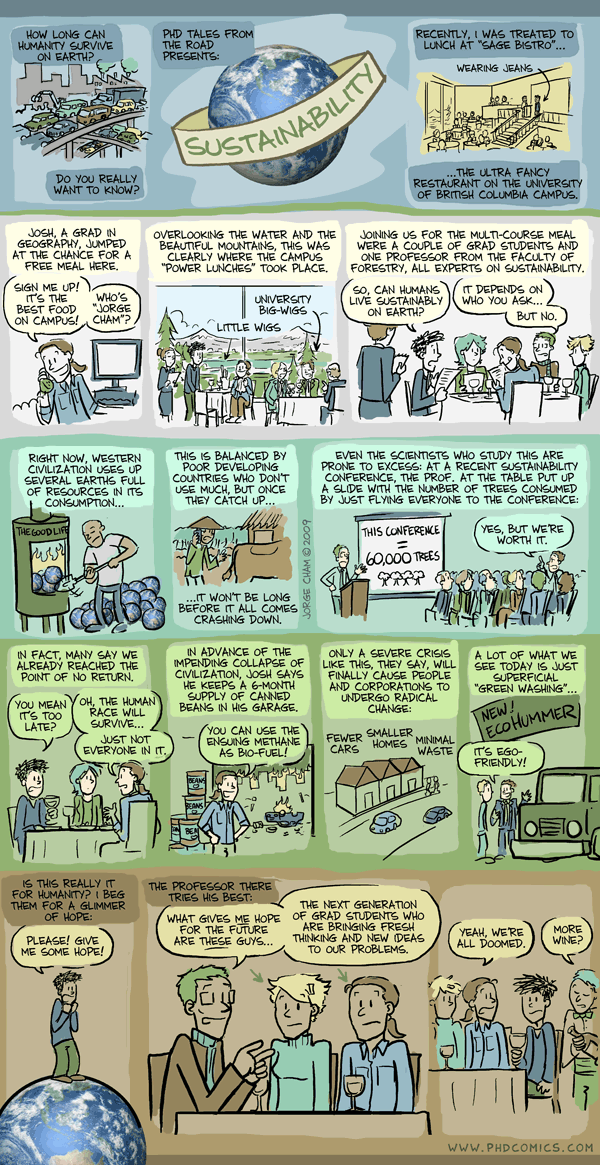
Even if they aren’t quite what was discussed on Friday, it’s still interesting stuff. Nelson’s argument is that if the only reason we have to live sustainably is the hope that environmental disaster will be averted, it’s unlikely that we’ll actually avert those disasters. Why? Because hope is a pretty weak argument when confronted by a continual news stream about how unsustainable western societies are and because many messages suggest disaster is inevitable.

It seems much of this argument stems from Nelson’s dissatisfaction with books like Jared Diamond’s Collapse which spends the vast majority of 500 pages discussing the demise of previous societies and what could go wrong now, then finishing with a 5 page section entitled Reasons for Hope.

Nelson’s dissatisfaction reminds me of William Cronon’s argument against the Grand Narratives of global environmental problems that I wrote about previously.

Cronon argued that global, ‘prophetic’ narratives are politically and socially inadequate because they don’t offer the possibility of individual or group action to address global problems. Such ‘big’ issues are hard for individuals to feel like they can do anything about.

Part of Cronon’s solution was the identification of ‘smaller’ (more focused) stories that individuals will be better able to empathise with. However, Cronon also played the hope card – suggesting that these more focused narratives offer individuals more hope than the global narratives.

Focusing on smaller issues closer to home may help – doesn’t hope become a stronger argument when the problems faced are less complex and the solutions are seemingly closer at hand? But Nelson seems to be suggesting that (as any ardent sports fan will tell you) it’s the hope that kills you.

“Instead of hope we need to provide young people with reasons to live sustainably that are rational and effective. We need to equate sustainable living, not so much with hope for a better future, but with basic virtues such as sharing and caring, which we already recognize as good in and of themselves, and not because of their measured consequences.”

Nelson’s is an ethical argument – that living sustainably should be portrayed as the ‘the right thing to do’, and that we should do it regardless of the consequences.

But then the question arises: how do we live sustainably? How do I know what the right thing to do is? Given a choice (on what printer paper to buy, for example) what decision to I make if I want to be sustainable? In order to make this choice we immediately need to start measuring the future consequences of our decisions. The future is an inherent part of the sustainability concept – it is about maintaining system processes or function into the future. So when we make our lifestyle decisions now, guided as they might be by the virtue of ‘doing the right thing’, we still need to have some idea about how we want the future to be, and which actions are more likely to get us there.

Nelson may be right – blind hope in a better future may prove counter productive given the current stream of global, prophetic, doomsaying narratives. But equally, just saying ‘do the right thing’ may be equally confusing for many people. Nelson isn’t arguing that this is all we should do, of course – he also suggests there is a “desperate need for environmental educators, writers, journalists and other leaders to work these [virtuous] ideas into their efforts”. It would be a good thing if living sustainably was more widely understood as ‘doing the right thing’. But this virtue will remain largely irrelevant if we don’t also work out how individuals and societies can live sustainably.

So what’s the result of all this thinking? It seems we should be focusing less on on doomsaying prophetic narratives (boiling seas bleaching coral reefs on continents thousands of miles away, stories of global warming when there’s a foot of snow outside, and so on) and more on what the individual person or group can do now, themselves, practically. In conjunction with the argument of acting virtuously with respect to sustainability, this focus may provide people with ‘rational and effective’ reasons, leaving them feeling more optimistic about the future and empowered to lead sustainable lives.

Update – 6th March
Okay, how about a couple of quick examples to go with that rhetoric? The cover story of this month’s National Geographic Magazine is a good one – Peter Miller looks at how we can start making energy savings (reducing CO2 emissions) around our own homes. And of course, I should have already pointed out the BBC’s Ethical Man as he works out how to keep his environmental impact to a minimum. Currently he’s attemting to traverse the USA without flying or driving. The ethics of Ethical Man are more implied than stated explicitly, but it’s another example of the sort of reporting is discussed above – showing how individuals can act now rather than merely hoping for a better future.

ESA 2009 Abstract

February 2009 seems to be the month of abstracts. Here’s another we just submitted to the 94th Ecological Society of America Annual Meeting, the theme of which is Ecological Knowledge and a Global Sustainable Society.

Local winter white-tailed deer density: Effects of forest cover pattern, stand structure, and snow in a managed forest landscape
James D. A. Millington, Michael B. Walters, Megan S. Matonis and Jianguo Liu
Michigan State University

Background/Question/Methods
White-tailed deer (Odocoileus virginianus) are a ‘keystone herbivore’ with the potential to cause tree regeneration failure and greatly affect vegetation dynamics, stand structure and ecological function of forests across eastern North America. In northern mixed conifer-hardwood forests, local winter-time deer populations are dependent on habitat characterized by patterns of forest cover that provide shelter from snow and cold temperatures (lowland conifer stands) in close proximity to winter food (deciduous hardwood stands). Stand structure may also influence winter spatial deer distribution. Consequently, modification of forest cover patterns and stand structure by timber harvesting may affect local spatial deer distributions, with potential ecological and economic consequences. Here, we ask if forest cover pattern and stand structure, and their interactions with snow depth, can explain winter deer density in the managed forests of the central Upper Peninsula of Michigan, USA. For each local winter deer density estimate (from fecal pellet counts) we calculate stand-level characteristics for surrounding ‘landscapes of influence’ of radius 200 m and 380 m. For these data, and modeled snow depth estimates, we use multivariate techniques to produce predictive models and to identify the most important factors driving local deer densities across our 400,000 ha study area.

Results/Conclusions
Distance to the nearest conifer stand consistently explains the most variance in univariate regression models. Deer densities are highest near lowland conifer stands in areas where the proportion of hardwood forest-cover is high but the mean tree diameter-at-breast-height is low. Multiple regression models including these factors explain up to 38% of variance in deer density and have up to a 68% chance of correctly ranking a site’s deer density (relative to other sites within our study area). We are unable to conclusively show that snow depth has a significant impact on winter deer density, but our data suggest that more detailed investigation into the combined effect of distance to lowland conifer and snow depth may prove fruitful. Our results quantify clear effects of stand structure and forest cover composition on the winter spatial distribution of white-tailed deer. We briefly discuss how these results can be used in an ecological-economic simulation model of a managed forest for tree regeneration risk assessment. Use of these results, and the simulation model, will help identify management practices that can decrease deer impacts and ensure the ecological and economic sustainability of forests in which deer browse is proving problematic for tree regeneration.

PEST or Panacea?

Although some may say blogging is dead, the editors at Nature think it’s good to blog. The Nature editors discuss the place of blogging in scientific discourse, focusing on the reporting of results from papers in press (i.e. accepted by a journal for publication but not actually in print yet). They suggest that if the results of an article in press are reported at a conference then they are fair game for discussion and blogging. And they argue that “[m]ore researchers should engage with the blogosphere, including authors of papers in press”.

I wish I had more papers in the in press pile. Unfortunately I’ve got more in the under review pile (see my previous post), but at least I’m adding to it. Earlier this week David Demeritt, Sarah Dyer and I submitted a manuscript to Transactions of the Institute of British Geographers. The paper discusses public engagement in science and technology and examines some of the practical challenges such a collaboration entails. One of the examples we use is the work I did during my PhD examining the communication of my model results with local stakeholders. It’s only just submitted so I’ll just post the abstract for now. As we get further along the review process toward the in press stage (with this and other papers) I’ll return to see if we can spark some debate.

David Demeritt, Sarah Dyer and James Millington
PEST or Panacea? Science, Democracy, and the Promise of Public Participation
Submitted Abstract
This paper explores what is entailed by the emerging UK consensus on the need for increased public engagement in science and technology, or PEST as we call it. Common to otherwise incompatible instrumental and de-ontological arguments for PEST is an associated claim that increased public engagement will also somehow make for ‘better’ science and science-based policy. We distinguish two different ways in which PEST might make such a substantive contribution, which we term ‘normative steering’ and ‘epistemic checking’. Achieving those different aims involves engaging with different publics in different ways to different ends. Accordingly, we review a number of recent experiments in PEST to assess the practical challenges in delivering on its various substantive promises. The paper concludes with some wider reflections on whether public engagement in science is actually the best way of resolving the democratic dilemmas to which PEST is addressed.

US-IALE 2009: Abstracts

The two abstracts I submitted to US-IALE 2009 have been accepted for (oral) presentation at the meeting. I’ll be presenting both on the work I’ve been doing here at CSIS and from my PhD. I’ve copied the initial abstracts below (these may change slightly) and I’ll post a full list of what everyone in CSIS is up to at the conference nearer the time. See you in Snowbird!

Modeling Interactions of Human and Natural Disturbances in a Managed Forest Landscape

James D.A. Millington, Michael B. Walters, Megan S. Matonis, Frank Lupi, Susan Chen, Kimberly R. Hall, Edward J. Laurent, Jianguo (Jack) Liu

As is often the case for coupled human and natural systems, the interactions between human and natural forest disturbances have the potential to produce complex system behavior. Spatially-explicit ecological-economic modeling provides a useful tool to investigate these phenomena in an integrated manner, revealing patterns and processes not observable by investigating the social and natural components separately. We present the development and initial results from such a model that examines the complex interactions among timber harvest, white-tailed deer browse and vegetation dynamics in a managed forest landscape in Michigan’s Upper Peninsula. This landscape has been experiencing low tree regeneration due to overabundant white-tailed deer, and changes in habitat for songbirds of conservation concern due to deer impacts and timber harvesting.

The multi-scale model uses input data on deer population, forest stand structure, tree regeneration, forest cover, habitat type and land ownership data collected at plot, stand, and landscape levels. Vegetation establishment, regeneration and growth are simulated using the USFS Forest Vegetation Simulator (FVS). Deer browse impacts are represented in FVS and parameterized by data we have collected on deer density and forest gap regeneration. As is common for many studies, our stand-level data for model initialization are incomplete across the 4,000 km2 study area. We show how we impute our stand-level data across the remainder of the study area using auxiliary variables including topography and remotely-sensed land cover.

Results show that distance to nearest lowland conifer stand, mean stand tree diameter-at-breast-height and the proportion of hardwood species in the surrounding local area are statistically significant predictors of deer density across the landscape (p < 0.01). These variables alone explain 40% of variance in deer density. Our initial model simulation results indicate complex spatial interactions between deer densities, stand structure and timber values across the managed forest landscape.

Investigating the Interaction of Land Use/Cover Change and Wildfire using Agent-Based Modelling
(Global Land Project symposium on agent-based modelling of land use effects on ecosystem processes and services)

James D.A. Millington, John Wainwright, Raul Romero-Calcerrada, George L.W. Perry and David Demeritt

Humans have a long history of activity in Mediterranean Basin landscapes. Spatial heterogeneity in these landscapes hinders understanding about the impacts of changes in human activity on ecological processes, such as wildfire. We present an Agent-Based Model (ABM) of agricultural land-use decision-making. This model is integrated with a spatially-explicit, state-and-transition Landscape Fire-Succession Model (LFSM) to investigate the relative importance of anthropic and ecological drivers of the wildfire regime.

The ABM considers two ‘types’ of land-use decision-making agent with differing perspectives; ‘commercial’ agents that are perfectly economically rational, and ‘traditional’ agents that represent part-time or farmers that manage their land because of its cultural, rather than economic, value. Results from the ABM indicate that land tenure configuration influences trajectories of land use change. However, simulations for various initial land-use configurations and compositions converge to similar states when land-tenure structure is held constant. For the scenarios considered, mean wildfire risk increases relative to the observed landscape.

The LFSM uses plant functional types to represent spatial and temporal competition for resources (predominantly water and light) in a rule-based modelling framework. Wildfire behaviour is represented using a cellular-automata approach. Results from the integrated ABM-LFSM indicate that fires ignited by human causes burned greater areas of shrubland than would be expected at random, and modelled lightning fires burned greater areas of forest land-cover types than would be expected at random.

We conclude by discussing our efforts to achieve a form of ‘stakeholder model validation’. This evaluation process involved taking the model and its results back for examination by the agricultural actors and decision-makers that aided our model conceptualization. We put this discussion in the context of recent calls for increased engagement between science and the public, highlighting some of the problems we encountered with this form of model evaluation.

Snowy UP Forests

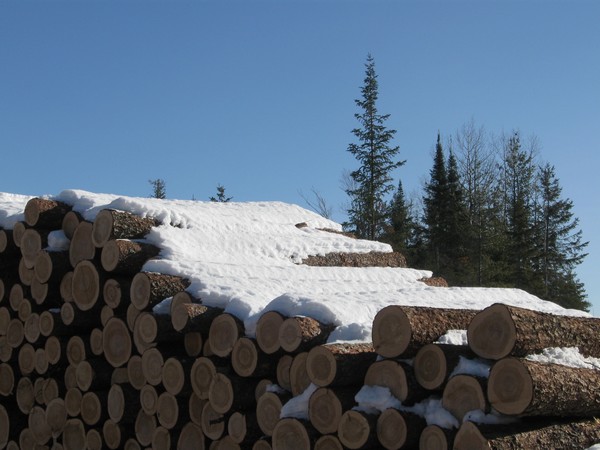
Cut logs waiting for collection in the snow
On Monday several other members of the EE model research team and I met with foresters from Plum Creek and AFM to give them an overview of what we’ve been working on over the past year or so. Megan (Forestry Master’s student) and I gave them the lowdown on what we’ve been doing with regards fieldwork and analysis of the resulting data, Susan (Natural Resources Master’s student) spoke briefly about her work looking at factors influencing the prices of timber sales, and Mike (Forestry Prof.) was on hand to help paint the overall picture.

The foresters we spoke with were interested in our progress to date and asked for more details on tree species-specific patterns we find in our regeneration data so that they might work to continue the sustainability of their forest stands. Megan and are I are likely taking a trip to the study area again in late April to revisit a few sites from last spring and summer, so we’ll visit again then.

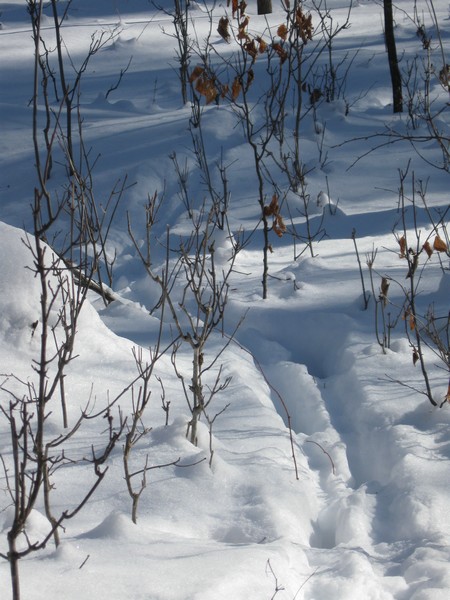
To get from one meeting to the other we drove through our study area. We wanted to see if we could find evidence of winter deer browse and generally get a feel for how the forests (and our study stands) look during the winter. We didn’t catch any deer in the act of browsing but, as the top picture below shows, we did see tracks and there were plenty of stunted maple saplings poking just above the snow nearby.

Deer tracks in the snow

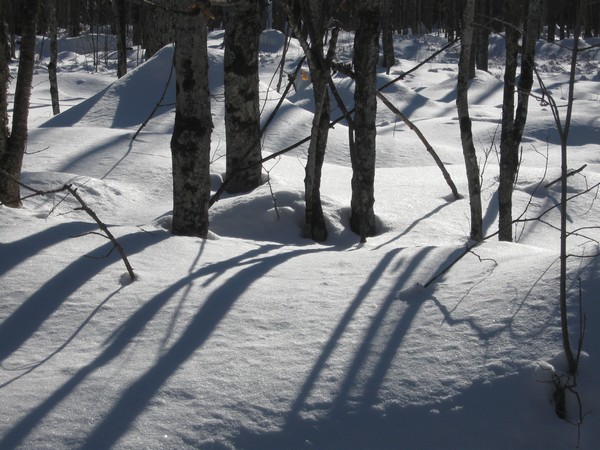
snow and shadows