Landscape Ecology paper In Press

We were informed this week that the paper I have been working on with Raul Romero Calcerrada and other colleagues at Universidad Rey Juan Carlos has been accepted by Landscape Ecology. I’ve copied the abstract below. It should be out later in 2008, but email me if you want a pre-print.

Currently I’m working on two paper with colleagues describing the construction and initial results of the model I constructed during my PhD research. We’re also submitting abstracts to the European Geophysics Union General Assembly 2008 on this and work related to the Landscape Ecology paper.

The abstract submitted with colleagues at CSIS has been accepted for poster presentation at the US-IALE meeting in Madison in April. Should be a good meeting. Also, the doi for Perry and Millington (2008) in PPEES now works.

Tomorrow I’m heading back to Europe for a couple of weeks. I have my PhD graduation ceremony next week (maybe I’ll post some photos of me looking scholarly/awkward in my academic dress/get-up), a couple days snowboarding in the Swiss Alps, and a couple of days working with Bruce Malamud at King’s following up on the work we published on US wildfire regimes in PNAS. Should be a fun couple of weeks!

GIS analysis of spatial patterns of wildfire human-caused ignition risk in the SW of Madrid (Central Spain) (In Press) Landscape Ecology

Raul Romero Calcerrada; Carlos J. Novillo Camacho; James DA Millington; Inmaculada Gomez-Jimenez

Abstract: The majority of wildfires in Spain are caused by human activities. However, much wildfire research has focused on the biological and physical aspects of wildfire, with comparatively less attention given to the importance of socio-economic factors. With recent changes in human activity and settlement patterns in many parts of Spain, potentially contributing to the increases in wildfire occurrence recently observed, the need to consider human activity in models of wildfire risk for this region are apparent. Here we use a method from Bayesian statistics, the Weights of Evidence (WofE) model, to examine the causal factors of wildfires in the south west of the Madrid region for two differently defined wildfire seasons. We also produce predictive maps of wildfire risk. Our results show that spatial patterns of wildfire ignition are strongly associated with human access to the natural landscape, with proximity to urban areas and roads found to be the most important causal factors. We suggest these characteristics and recent socio-economic trends in Spain may be producing landscapes and wildfire ignition risk characteristics that are increasingly similar to Mediterranean regions with historically stronger economies, such as California, where the urban-wildland interface is large and recreation in forested areas is high. We also find that the WofE model is useful for estimating future wildfire risk. We suggest the methods presented here will be useful to optimize time,
human resources and fire management funds in areas where urbanization is increasing the urban-forest interface and where human activity is an important cause of wildfire ignition.

Update 06/02/08: This paper is now online here and here.

IALE-IUFRO WG Website


A while back the ‘new’ IALE-IUFRO Working Group website launched, so I thought I’d highlight it here. During the IALE World Congress 2007 in Wageningen, a new IALE-IUFRO working group was approved and sanctioned by both IALE (International Association of Landscape Ecology) and IUFRO (International Union of Forestry Research Organizations):

Forestry was the first major field to recognize the importance of landscape ecology, and today foresters widely know, use, and even develop landscape ecology principles based on experience and science. Landscape ecology is an exciting field for researchers and managers together. In this sense, landscape ecology is viewed as the nexus of ecology, resource management, and land use planning. It is within this framework of synergy and integration that we envisaged this formal link between the two groups.

Thus, the IALE-IUFRO WG aims to collate landscape ecologists with an interest in forest science and ecology including studies and methods for monitoring, planning, designing, and managing forest ecosystems and landscapes. Through the website, members of IALE-IUFRO WG will be able to exchange experiences and share common needs and interests to build up on the strength of the network. This group can serve as an international platform for advocating and updating research and management on forest landscapes.

Global Land Project

The Global Land Project is a proposed joint research project for land systems for the International Geosphere-Biosphere Programme (IGBP) and the International Human Dimensions Programme (IHDP). It plans to build upon previous work and the research network developed during the Global Change and Terrestrial Ecosystems (GCTE) and Land Use/Cover Change (LUCC) projects. The GLP website states:

The Global Land Project Science Plan represents the research framework for the coming decade for land systems. This development of a research strategy is designed to better integrate the understanding of the coupled human-environment system. These integrated science perspectives reflect the recognition of the fundamental nature of how human activities on land are affecting feedbacks to the earth system and the response of the human-environment system to global change.

The GLP will evidently be an important component of CHANS research in the coming years. Of the three research ‘Nodal Offices’ around the world, one is located in Aberdeen, Scotland and will be essentially run by the folks at the Macaulay Institute. They have several workshop coming up in 2008, the titles which seem to suggest discussion of the sort of work that I often insist on espousing on this blog. In late February 2008 Workshop 1. will examine The design of integrative models of natural and social systems in land change science, and 2 later in the year Workshop will discuss Data and model integration for coupled models of land use change. As I write it looks like those interested in such matters can still apply to attend. Future workshops will examine:

  • Integration of the economic and spatial modelling of land use change
  • Representation of land systems in the modelling of ecosystem services
  • Economic, social and environmental valuation of land use systems

Also on the GLP website are a series of webcasts from previous workshops for all those that missed out on attending (like me). There are some pretty interesting presentation on there, and in a couple of days I think I’ll post about the recent Advances in Land Models as presented by Tom Veldkamp.

To Catch a Panda


One of the main research foci of CSIS is the interaction of policies, people, and Giant Panda habitat in China. Recently, Vanessa Hull, one of the CSIS PhD students, set off for the mountains of Sichuan province with the aim of catching and radio-collaring four Giant Pandas. Once collared, she’ll be tracking the movements of the Panda so that we might learn more about these endangered animal’s habitat preferences.

The MSU Newsroom have picked up on her current fieldwork and have set up a website detailing her work. Tracking and capturing individuals from this elusive species is easier said than done though. So that we can keep track of how successful (or otherwise) she is, Vanessa is posting excerpts from her journal online. A contemporary account of conservation research in the field, it promises to be interesting…

Sustainability Science: An Emerging Interdisciplinary Frontier

Sustainability. Integration. Interdisciplinary. These are the three words that stood out from Prof William C. Clark’s Rachel Carson Distinguished Lecture at MSU on Thursday and reflect the research we do at the the Center for Systems Integration and Sustainability.

Prof Clark discussed the recent emergence of ‘Sustainability Science’ as a field that is use-inspired (like health science or agricultural science), that is defined by the practical problems it addresses, that is focused on the scientific understanding of coupled human and natural systems (CHANS), and that integrates knowledge and research from multiple disciplines.

The definition of ‘sustainability’ has always been a tricky one – in part Clark suggested because it is a concept that is as broad as concepts such as ‘freedom’, ‘good’ and ‘bad’. What sustainability means depends on who is using the word and the context of the problem in which it is being used. Because sustainability science is use-inspired, what is to be sustained is defined by the the problem or issue being addressed. In one situation the objective might be examine how best to sustain a community’s cultural and social well-being, in another it might be the continuation of the life-supporting functions of an ecosystem, and in yet another it might the continued growth of the economy and the material well-being that affords. An idealist might argue that the objective should be to sustain all three examples, but in reality priorities will often need to be drawn up.

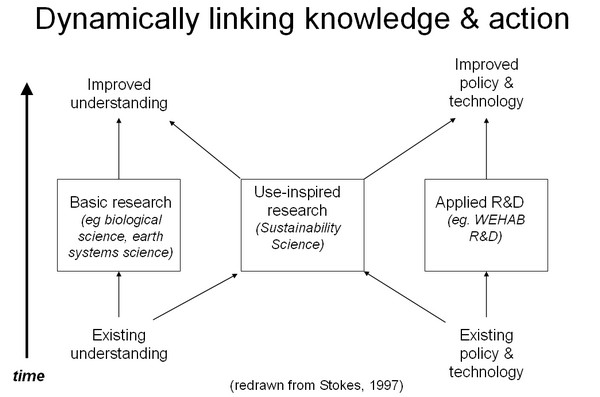
Clark used Stoke’s (1997) presentation of the four quadrants of the reasons to undertake research, highlighting that sustainability science falls into Pasteur’s Quadrant. Research in sustainability science is driven by both a quest for fundamental understanding and the consideration of the use to which the research will be put in the real world. Research with the goal of the former alone might be termed ‘Basic Research’ (e.g. physics – Bohr’s Quadrant), whereas the latter might be termed ‘Applied Research’ (e.g. engineering – Edison’s Quadrant). Through time, research in Pasteur’s Quadrant often results in a dialogue between the basic and the applied sciences, as demonstrated below.


The characterisation of sustainability science highlights that the domain of sustainability science is geo-historical. Place and history are important in defining both the problem to be examined and the solutions we might suggest. Prof Clark highlighted this, noting that a good knowledge of the environmental history of the location under study is important, and that such a history can be used in some ways as a laboratory provides data. But equally we need to remember that this history can be framed or contextualised itself – the narrative of an environmental history is unlikely to provide data that is as ‘objective’ as would be produced in a biology lab say.

Furthermore, the nature of geo-historical systems highlights the problems associated with a science that tries to be both applied and basic. How do we take use the knowledge gained from a given study to inform wider policy and decision making? Critics can argue that ‘it only happens in this particular place’, whereas advocates can argue that ‘it happens like this everywhere’. A balance between these stances will need to be struck. Multiple examples of processes, treatments, and outcomes in different places might be one way to approach this balance. Given that real-world systems are context-dependent, and that the problems sustainability science will study are value-laden, a certain level of subjectivity probably isn’t such a big deal anyway. The development of nomothetic generalizations in the same vein as the hard sciences may not be possible. However this situation, which implies uncertainty, will need to be acknowledged and understood by decision-makers.

Clark also discussed the ‘lessons for designing university-based knowledge systems for sustainability’. An article in the current issue of Futures highlights the issues faced by university departments and researchers wishing to perform sustainability science:

“The art of problem-based interdisciplinarity lies in the choice of problems that will be both academically and socially fruitful. Too heavy emphasis on the former leads to research that may successfully address problems within a particular field of study and make a contribution to the literature but that are of limited value or interest beyond the academy. Too much emphasis on the latter leads to work that is indistinguishable from consulting or pure advocacy work. Being problem-driven means starting from a problem or concern in society, but, in order to create the hybrid activity described above, this problem must be translated into a form that is amenable to issue-driven interdisciplinary research. Such translation is an indispensable prerequisite to obtaining funding from academic funding agencies and buy-in from academic collaborators, who have to be able to undertake research that will lead to publications in the outlets in which they need to publish in order to further their career prospects.”


To develop successfully Prof Clark suggested that the academy will need to maintain and engage strength in the foundation disciplines, support focused programs of ‘use-inspired basic research’ on core questions of sustainability science, build collaborative problem-solving programs, and create recognition and reward systems for those who develop and participate in such programs. The ‘publish or perish’ mantra also demands that there be suitable outlets for sustainability science research – the creation of the Sustainability Science section in PNAS is an indication that the importance, and uniqueness, of this emerging interdisciplinary field of study is becoming increasingly recognised.

There was so much more said and discussed during Prof Clark’s visit to MSU but that’s enough here for now. A copy of the powerpoint presentation used during the lecture can be downloaded from the CSIS website.

What does it mean to ‘be’ an expert? at RGS-IBG 2008

That man James Porter is busy at the Geography conferences these days. Alongside organising a session at the 2008 AAG on Private Science & Environmental Governance, he’s also organising a session at the 2008 RGS-IBG Annual Meeting on expertise and what it means to be an expert. Details below, abstract submissions are due by 16th January 2008.

I didn’t make it to the meeting last year but hope to in 2008…

Call for Papers:
(Re)Thinking Expertise: Spaces of Production, Performance and the Politics of Representation
RGS-IBG, Annual Meeting, 27 – 29 August 2008
London

What does it mean to ‘be’ an expert? Although social constructionism has identified similarities between science and other social practices, recently a controversial call for a “Third Wave” of science studies (Collins & Evans, 2002) has drawn attention to the problem of Extension – the infinite regress encountered when looking for techno-scientific advice if we can no-longer tell the difference between expert and lay-knowledge. Expertise has previously been understood to be the unyielding pursuit of authoritative knowledge that is honed through practice and enforced by political and academic institutions. In this sense, the professional identities presented to the outside world are carefully crafted so as to conform and exhibit ideological norms not dissimilar to Merton’s ideals. Such readings, however, arguably present an overly romantic, simplistic, and homogenous rendering of experts and their expertise. What is needed is examination of how experts’ identities are constructed (when and by whom), how they are negotiated between actors and institutions, the historical context in which they are played out, and ultimately how they function (or don’t) instrumentally to serve or suppress certain realities.

Expertise is arguably played out more visibly today than ever before, particularly with reference to the environment. Floods, hurricanes, infectious animal diseases, and a myriad of other concerns are captured graphically and broadcasted nightly into homes across the world. Each event and the subsequent response depicts the experts involved as either heroes or villains of these dramatised pieces – in both cases thrust into the limelight as representatives of their respective fields. Geographers are uniquely positioned to comment on this. They can provide theoretical depth and empirical evidence to shed light on the way expert identities are shaped, the role they serve, the impact on the democratization of knowledge, and the barriers they present to tackling environmental problems. We therefore invite papers addressing (though not limited to) the following questions:

  • Who constructs the image of environmental experts? How / where are these constructions enacted (i.e. technological, sociocultural, artefacts, etc.)?
  • Can representations be negotiated? If so, what role have academics played in shaping past perceptions and might hope to play in the future? What agency do these representations have?
  • What is the effect of these representations? Do they ever coincide or clash with the needs, understandings and views of actors (public, political, etc.)? Where are they successful and unsuccessful?
  • Do the representations come to in turn alter the landscape and shape an environment which conforms to the possible misguided representation itself? Does this lead to a snowballing of representations and hence crisis where ‘reality’ breaks?

Abstracts should be sent to James Porter (james.porter at kcl.ac.uk) and Joseph Hillier (joseph.hillier at ucl.ac.uk) by 16th January 2008.

More conference information here.

Rachel Carson Distinguished Lecture by William C. Clark

Professor William C. Clark, of Harvard University, will be giving the forthcoming Rachel Carson Distinguished Lecture “Sustainability Science: An Emerging Interdisciplinary Frontier”. The lecture is on Thursday December 6 2007 at 3:30 PM (with a reception to follow) in the Radiology Auditorium (on Service Road) at Michigan State University (for directions, visit the CSIS home page). The lecture is free and open to the public.

I’ll be there and will try to write something about it here in the future…

Dr. William C. Clark is the Harvey Brooks Professor of International Science, Public Policy, and Human Development in the John F. Kennedy School of Government at Harvard University. He is an international leader in Sustainability Sciences, co-chaired the National Research Council’s study “Our Common Journey: A Transition toward Sustainability”, and is editor of the Section on Sustainability Science for the Proceedings of U.S. National Academy of Sciences. His exceptional interdisciplinary research and other activities have been recognized by many prestigious honors and awards, such as membership in the National Academy of Sciences and the MacArthur Prize. Additional information about Dr. Clark, including representative publications, can be found at the CSIS home page.

Presented by the Center for Systems Integration and Sustainability, Department of Fisheries and Wildlife with support from the Office of the President; Office of the Provost; Office of the Vice President for Research and Graduate Studies; Graduate School; Environmental Science and Policy Program; College of Agricultural and Natural Resources; Michigan Agricultural Experimental Station; Center for Water Sciences; Sustainable Michigan Endowed Project; Science, Technology, Environment, and Public Policy Specialization; and Elton R. Smith Endowment.

25 Years of Landscape Ecology


This year marks the 25th anniversary of the establishment of the International Association for Landscape Ecology and the 20th anniversary of the first publication of the journal Landscape Ecology. To highlight these landmarks several guest editorials appear in the latest edition of the journal (which has swelled from around 250 pages per year to almost 1,400).

Jianguo Wu briefly describes how the field of landscape ecology was first envisioned by Carl Troll as the integration of geographic and ecological disciplines, defining it as:

“the study of the main complex causal relationships between the life communities and their environment” which “are expressed regionally in a definite distribution pattern (landscape mosaic, landscape pattern)” (Troll 1971).


As such, the other invited Editorials discuss the need to remain holistic. As I’ve mentioned before, reading about the vision of a holistic landscape ecology is one of the reasons I’ve ended taking the route I have. Zev Naveh emphasises the need for landscape ecology to be a ‘transdisciplinary science of landscape sustainability’, providing pragmatic information for decision-making and becoming become a ‘post-normal’ prognostic and normative science.

Paul Opdam continues this discussion, highlighting the need for landscape ecologists to develop skills and techniques for transferring knowledge from science to the world of the actors in policy, planning, design and management. This knowledge transfer will be most successful if based on a science that provides credibility, saliency and legitimacy by considering the integrations of landscape systems as a whole. Thus holistic nature will then contribute to decisions based on principles of sustainable management of our landscapes.

However, Marc Antrop highlights that this potential has yet to be fully realised. The practical applications of landscape ecology in planning and policy making remain inadequate, the main problem lying in the (poor) communication to non-landscape ecologists. Landscape ecology will continue to provide insight into the functioning of interacting social, ecological, economic, and environmental systems at the landscape level. If it does become more prescriptive, as these Editorials suggest it must, it will also begin to contribute more obviously directly to the sustainable management of the landscapes in which we live.

Call for Abstracts: Wildfires session at EGU 2008

As in previous years, I’m a co-convener of the Wildfires session at the 2008 European Geophysics Union General Assembly (along with Rosa Lasaponara, Luciano Telesca and Don McKenzie). We hope this year’s session will be as successful as ever, and are expecting the best papers presented to compose a special issue of Ecological Modelling. The call for abstracts is now open (copied below). Abstracts should be submitted at the conference website. Important deadlines are:

Abstract Submission: 14 January 2008
Financial Applications 07 December 2007
Pre-registration: 31 March 2008

Subject: Call for Abstracts: Wildfires session at EGU 2008

5 November 2007

Dear Colleagues [Apologies for cross-posting],

The European Geosciences Union (EGU) General Assembly 2008 is to be help from 13-18 April 2008 in Vienna, Austria. We invite you to participate in the session ‘Spatial and temporal patterns of wildfires: models, theory, and reality’ (NH8.4/BG2.16 – co-organized by the Natural Hazards & Biogeosciences divisions).

Session description:
Wildfires are the result of a large variety and number of interacting components, producing patterns that vary significantly both spatially and temporally. This session will examine models, theory, and empirical studies in wildfire research. We encourage submissions in any one or combination of these three main areas, and envision bringing together wildfire hazard managers, applied researchers, and theoreticians. Posters are also very much encouraged, as we plan to have both lively
oral and poster sessions.

The best papers will be considered for publication in a Special Issue of Ecological Modelling

ABSTRACT DEADLINE: 14 January 2008
Web site for submission: http://meetings.copernicus.org/egu2008/

Please note that the deadline for financial applications is 07 December 2007, and for pre-registration is 31 March 2008. We look forward to seeing you in Vienna. Please forward this message also to your colleagues.

With best regards,

Lasaponara, R. (Convener)
Telesca, L.; McKenzie, D.; Millington, J. (Co-conveners)

Lasaponara Rosa, PhD
Research on Remote Sensing and Signal Processing
CNR-IMAA
Italy
lasaponara at imaa.cnr.it

Luciano Telesca
Research on geoscience and Signal Processing
CNR-IMAA
Italy
luciano.telesca at imaa.cnr.it

Don McKenzie
Research Ecologist
Pacific WIldland Fire Sciences Lab
US Forest Service

Affiliate Professor
College of Forest Resources
CSES Climate Impacts Group
University of Washington

dmck at u.washington.edu
donaldmckenzie at fs.fed.us

James D.A. Millington, PhD
Research Associate
Center for Systems Integration and Sustainability
Michigan State University
jmil at msu.edu

W1: http://csis.msu.edu
W2: http://www.landscapemodelling.net

Private Science & Environmental Governance at the AAG

James Porter, a friend of mine from Geography at King’s College London, is co-convening a session at the 2008 Association of American Geographers Annual Meeting to address the issue of the increasing contribution of ‘private science’ to environmental decision-making and knowledge about the world around us. Sounds like it will be an interesting session – if I actually make it to the AAG next year I’ll have to swing by.

Submissions for the session are open until October 21st 2007. Abstracts and PIN numbers (obtained by registering your abstract online) should be sent to James Porter (james.porter at kcl.ac.uk) and Leigh Johnson (leighjohnson at berkeley.edu) Conference information here. Submit your abstract and get your PIN here.

Here’s the session details and call for papers in full:

Private Science, Environmental Governance & the Management of Knowledge
Association of American Geographers Annual Meeting, April 15-19, 2008
Boston, MA

In the US and UK, new forms of market-based, commercially driven, and politically relevant demands are restructuring the context of scientific research and the social norms and values therein. No longer can academic institutions expect the same levels of public support immortalized by Vannevar Bush; in recent decades we have seen the rapid ascent of private science or science for hire to fill the void. Science is now routinely contracted-out to the private sector to produce a range of products from Climate Forecast Predictions, flood modeling outputs, risk assessments, chemical tests, life-style drugs and myriad other products that find their way into public policy and regulatory decision-making. The appeal of this new form of scientific research is its cost-effectiveness, its embrace of strategic ignorance, and its flexibility in allowing clients to guide the design and outcome of the work produced.

Yet, environmental governance is shaped extensively by the use of scientific knowledge. In the context of governing citizens, regulating private enterprise, and guiding development, what happens when nature and science are conceptualized in terms of their commercial potential? Geographers are uniquely positioned to provide theoretical depth and empirical evidence to answer these questions. We seek papers addressing (though not limited to) the following questions:

  • How are commercial science, modeling, and assessments done in practice? What is lost and equally gained in this process? What is ignored in these new knowledge productions?
  • These questions open up room to consider the contested practice of translation: who chooses what is to be translated? Who does the translation? Does the quality of translation impact the nature of knowledge, and if so, how? How might unlikely allies become enrolled in the project?
  • Can we discern a particular set of preferred methodologies or instruments that are consistently deployed in the performance of private science? Are these characteristic of a particular neoliberal mode of governance?
  • If private science has come to dominate fact-making about nature, does this entail a transformation from the rule of (bureaucratic) experts? How do these new forms of knowledge gain authoritative status, if at all?
  • What are the implications for the subjects of governance?