US-IALE 2008 – Summary


A brief and belated summary of the 23rd annual US-IALE symposium in Madison, Wisconsin.

The theme of the meeting was the understanding of patterns, causes, and consequences of spatial heterogeneity for ecosystem function. The three keynote lectures were given by Gary Lovett, Kimberly With and John Foley. I found John Foley’s lecture the most interesting and enjoyable of the three – he’s a great speaker and spoke on a broader topic than the the others; Agriculture, Land Use and the Changing Biosphere. Real wide-ranging, global sustainability stuff. He highlighted the difficulties of studying agricultural landscapes because of the human cultural and institutional factors, but also stressed the importance of tackling these tricky issues because ‘agriculture is the largest disturbance the biosphere has ever seen’ and because of its large contribution to greenhouse gas emissions.

Presentations I was particularly interested in were mainly in the ‘Landscape Patterns and Ecosystem Processes: The Role of Human Societies’, ‘Challenges in Modeling Forest Landscapes under Climate Change’ and ‘Cross-boundary Challenges to the Creation of Multifunctional Agricultural Landscapes’ sessions.

In the ‘human societies’ session, Richard Aspinall discussed the importance of considering human decision-making at a range of scales and Dan Brown again highlighted the importance of human agency in spatial landscape process models. In particular, with regards modelling these systems using agent-based approaches he discussed the difficulty of model calibration at the agent level and stressed that work is still needed on the justification and evaluation phases of agent-based modelling.

The ‘modeling forest landscapes’ session was focused largely around use of the LANDIS and HARVEST models that were developed in and around Wisconsin. In fact, I don’t think I saw any mention of the USFS FVS at the meeting whilst I was there, largely because (I think) FVS has large data demands and is not inherently spatial. LANDIS and HARVEST work at more coarse levels of forest representation (grid cell compared to FVS’ individual tree) allowing them to be spatially explicit and to run over large time and space extents. We’re confident we’ll be able to use FVS in a spatially explicit manner for our study area though, capitalising on the ability of FVS to directly simulate specific timber harvest and economic scenarios.

The ‘multifunctional agricultural landscapes’ session had an interesting talk by Joan Nassauer on stakeholder science and the challenges it presents. Specific issues she highlighted were:
1. the need for a precise, operational definition of ‘stakeholder’
2. ambiguous goals for the use of stakeholders
3. the lack of a canon of replicable methods
4. ambivalence toward the quantification of stakeholder results

Other interesting presentations were given by Richards Hobbs and Carys Swanwick. Richard spoke about the difficulties of ‘integrated research’ and the importance of science and policy in natural resource management. He suggested that policy-makers ‘don’t get’ systems thinking or modelling, and that some of this may be down to the psychological profiles of the types of people that go into policy making. Such a conclusion suggests scientists need to work harder to bridge the gap to policy makers and do a better job of explaining the emergent properties of the complex systems they study. Carys Swanwick talked about the landscape character assessment, which was interesting for me having moved from the UK to the US about a year ago. Whilst ‘wilderness’ is an almost alien concept in the UK (and Europe as a whole), landscape character is something that is distinctly absent in the new world agricultural landscapes. Carys talked about the use of landscape character as a tool for conservation and management (in Europe) and the European Landscape Convention. It was a refreshing change from many of the other presentations about agricultural landscape (possibly just because I enjoyed seeing a few pictures of Blighty!).

Unfortunately the weather during the conference was wet which meant that I didn’t get out to see as much of Madison as I would have liked. Despite the rain we did go on the Biking Fieldtrip. And yes, we did get soaked. It was also pretty miserable weather for the other fieldtrip to and International Crane Foundation center and the Aldo Leopold Foundation (more on that in a future blog), but interesting nevertheless.

Other highlights of the conference for me were meeting the former members of CSIS and eating dinner one night with Monica Turner. I also got to meet up with Don McKenzie and some of the other ‘fire guys’, and a couple of people from the Great Basin Landscape Ecology lab where I visited previously. And now I’m already looking forward to the meeting next year in Snowbird, Utah (where I enjoyed the snow this winter).

XIII World Forestry Congress 2009


The call for papers for the XIII World Forestry Congress is now open. To be held in Buenos Aires, Argentina, in October 2009 the congress will address “the sustainable development of forests from a global and integral perspective”. Authors are invited to submit papers and posters expressing new ideas and providing information on experiences, theoretical models and interesting initiatives. Papers will be published in the Congress Proceedings and on the Congress’ official website.

Tackling Amazonian Rainforest Deforestation

This week’s edition of Nature devotes an editorial, a special report and an interview to the subject of tropical rainforests and their deforestation. The articles highlight both the proximate causes and underlying driving forces of tropical deforestation, and the importance of human activity as an agent of change (via fire for example), in these socio-ecological systems.

The editorial considers the economics of rainforest destruction, with regards to global carbon emissions. It suggests that deforestation must be integrated into international carbon markets, to reward those countries that have been able to control the removal of forest land (such as India and Costa Rica). Appropriate accounting of tropical rainforest carbon budgets is required however, and the authors point to the importance of carbon budget modelling and the monitoring of (via satellite imagery for example) change in rainforest areas over large spatial extents. Putting an economic price on ‘ecosystem services’ is key to this issue, and the editorial concludes:

One of the oddly positive effects of global warming is that it has given the world the opportunity to build a more comprehensive and inclusive economic model by forcing all of us to grapple with our impact on the natural environment. We are entering a phase in which new ideas can be developed, tested, refined and rejected as necessary. If we find just one that can beat the conventional economic measure of gross domestic product, and can quantify some of the basic services provided by rainforests and other natural ecosystems, it will more than pay for itself.


The special report focuses on the efforts of the Brazilian government to curb the rate of deforestation in the their Amazonian forests. The Brazilian police force is blockading roads, conducting aerial surveys and inspecting agricultural and logging operations, to monitor human activities on the ground. Brazilian scientists meanwhile are monitoring the situation from space, and have developed methodologies and techniques that are leading the way globally in the remote monitoring of forests. The Brazilian government is a keen advocate of the sort of economic approaches to the issues of rainforest destruction highlighted in the editorial outlined above, and sees this rigorous monitoring as key to be able to show how much carbon they can save by preventing deforestation.

Halting the removal of forest cannot simply be left to carbon trading alone, however, and local initiatives need to be pursued. To ensure the forest’s existence is sustainable, local communities need to be able make money for themselves without chopping down the trees – if they can do this it will be their in their interests NOT to remove forest. But developing this incentive has not been straightforward. For example, some researchers have have suggested that as commodity prices for crops such as soya beans have increased (possibly due to increased demand for corn-based ethanol in the US) deforestation has increased as a result. Although the price of soya beans may be a contributing factor to rainforest removal, Ruth DeFries (who will be visiting CSIS and MSU next week as part of the Rachel Carson Distinguished Lecture Series) suggests that it is not the main driver. Morton et al. found that during for the period 2001-04, conversion of forest to agriculture peaked in 2003. This situation makes it clear that there are both proximate causes and underlying driving forces of tropical deforestation. The Nature special report suggests:

If the international community is serious about tackling deforestation, it will probably need to use a hybrid approach: helping national governments such as Brazil to fund traditional policies for enforcement and monitoring and enabling communities to experiment with a market-based approach.


But how long do policy-makers have to discuss this and get these measures in place? One set of research suggests 55% of the Amazon rainforest could be removed over the next two decades, and the complexity of the rainforest system means that a ‘tipping point’ (i.e., an abrupt transition) beyond which the system might not recover (i.e., reforestation would not be possible). The Nature interview with Carlos Nobre highlights this issue – the interactions of climate change with soil moisture and the potential for fire indicate that the there is risk of rapid ‘savannization’ in the eastern to southeastern Amazon as the regional climate changes. When asked what the next big question scientists need to address in the Amazon is, Nobre replies that the role of human-caused fire will be key:

Fire is such a radical transformation in a tropical forest ecosystem that biodiversity loss is accelerated tremendously — by orders of magnitude. If you just do selective logging and let the area recover naturally, perhaps in 20–30 years only a botanist will be able to tell that a forest has been logged. If you have a sequence of vegetation fires going through that area, forget it. It won’t recover any more.


As I’ve previously discussed, considering the feedbacks and interactions between systems is important when examining landscape vulnerabilities to fire. Along with colleagues I have examined the potential effects of changing human activity on wildfire regimes in Spain (recently we had this paper published in Ecosystems and you can see more wildfire work here). However, the integrated study of socio-economic and ecological systems is still very much in its infancy. And the processes of landscape change in the northern Mediterranean Basin and the Amazonian rainforest are very different; practically inverse (increases in forest in the former and decreases in the latter). As always, plenty more work needs to be done on these subjects, and with the potential presence of ‘tipping points’, now is an important time to be doing it.

IALE-IUFRO WG Website


A while back the ‘new’ IALE-IUFRO Working Group website launched, so I thought I’d highlight it here. During the IALE World Congress 2007 in Wageningen, a new IALE-IUFRO working group was approved and sanctioned by both IALE (International Association of Landscape Ecology) and IUFRO (International Union of Forestry Research Organizations):

Forestry was the first major field to recognize the importance of landscape ecology, and today foresters widely know, use, and even develop landscape ecology principles based on experience and science. Landscape ecology is an exciting field for researchers and managers together. In this sense, landscape ecology is viewed as the nexus of ecology, resource management, and land use planning. It is within this framework of synergy and integration that we envisaged this formal link between the two groups.

Thus, the IALE-IUFRO WG aims to collate landscape ecologists with an interest in forest science and ecology including studies and methods for monitoring, planning, designing, and managing forest ecosystems and landscapes. Through the website, members of IALE-IUFRO WG will be able to exchange experiences and share common needs and interests to build up on the strength of the network. This group can serve as an international platform for advocating and updating research and management on forest landscapes.

Global Land Project

The Global Land Project is a proposed joint research project for land systems for the International Geosphere-Biosphere Programme (IGBP) and the International Human Dimensions Programme (IHDP). It plans to build upon previous work and the research network developed during the Global Change and Terrestrial Ecosystems (GCTE) and Land Use/Cover Change (LUCC) projects. The GLP website states:

The Global Land Project Science Plan represents the research framework for the coming decade for land systems. This development of a research strategy is designed to better integrate the understanding of the coupled human-environment system. These integrated science perspectives reflect the recognition of the fundamental nature of how human activities on land are affecting feedbacks to the earth system and the response of the human-environment system to global change.

The GLP will evidently be an important component of CHANS research in the coming years. Of the three research ‘Nodal Offices’ around the world, one is located in Aberdeen, Scotland and will be essentially run by the folks at the Macaulay Institute. They have several workshop coming up in 2008, the titles which seem to suggest discussion of the sort of work that I often insist on espousing on this blog. In late February 2008 Workshop 1. will examine The design of integrative models of natural and social systems in land change science, and 2 later in the year Workshop will discuss Data and model integration for coupled models of land use change. As I write it looks like those interested in such matters can still apply to attend. Future workshops will examine:

  • Integration of the economic and spatial modelling of land use change
  • Representation of land systems in the modelling of ecosystem services
  • Economic, social and environmental valuation of land use systems

Also on the GLP website are a series of webcasts from previous workshops for all those that missed out on attending (like me). There are some pretty interesting presentation on there, and in a couple of days I think I’ll post about the recent Advances in Land Models as presented by Tom Veldkamp.

Sustainability Science: An Emerging Interdisciplinary Frontier

Sustainability. Integration. Interdisciplinary. These are the three words that stood out from Prof William C. Clark’s Rachel Carson Distinguished Lecture at MSU on Thursday and reflect the research we do at the the Center for Systems Integration and Sustainability.

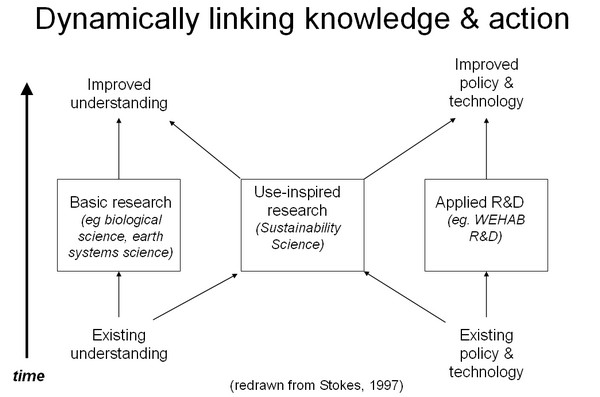
Prof Clark discussed the recent emergence of ‘Sustainability Science’ as a field that is use-inspired (like health science or agricultural science), that is defined by the practical problems it addresses, that is focused on the scientific understanding of coupled human and natural systems (CHANS), and that integrates knowledge and research from multiple disciplines.

The definition of ‘sustainability’ has always been a tricky one – in part Clark suggested because it is a concept that is as broad as concepts such as ‘freedom’, ‘good’ and ‘bad’. What sustainability means depends on who is using the word and the context of the problem in which it is being used. Because sustainability science is use-inspired, what is to be sustained is defined by the the problem or issue being addressed. In one situation the objective might be examine how best to sustain a community’s cultural and social well-being, in another it might be the continuation of the life-supporting functions of an ecosystem, and in yet another it might the continued growth of the economy and the material well-being that affords. An idealist might argue that the objective should be to sustain all three examples, but in reality priorities will often need to be drawn up.

Clark used Stoke’s (1997) presentation of the four quadrants of the reasons to undertake research, highlighting that sustainability science falls into Pasteur’s Quadrant. Research in sustainability science is driven by both a quest for fundamental understanding and the consideration of the use to which the research will be put in the real world. Research with the goal of the former alone might be termed ‘Basic Research’ (e.g. physics – Bohr’s Quadrant), whereas the latter might be termed ‘Applied Research’ (e.g. engineering – Edison’s Quadrant). Through time, research in Pasteur’s Quadrant often results in a dialogue between the basic and the applied sciences, as demonstrated below.


The characterisation of sustainability science highlights that the domain of sustainability science is geo-historical. Place and history are important in defining both the problem to be examined and the solutions we might suggest. Prof Clark highlighted this, noting that a good knowledge of the environmental history of the location under study is important, and that such a history can be used in some ways as a laboratory provides data. But equally we need to remember that this history can be framed or contextualised itself – the narrative of an environmental history is unlikely to provide data that is as ‘objective’ as would be produced in a biology lab say.

Furthermore, the nature of geo-historical systems highlights the problems associated with a science that tries to be both applied and basic. How do we take use the knowledge gained from a given study to inform wider policy and decision making? Critics can argue that ‘it only happens in this particular place’, whereas advocates can argue that ‘it happens like this everywhere’. A balance between these stances will need to be struck. Multiple examples of processes, treatments, and outcomes in different places might be one way to approach this balance. Given that real-world systems are context-dependent, and that the problems sustainability science will study are value-laden, a certain level of subjectivity probably isn’t such a big deal anyway. The development of nomothetic generalizations in the same vein as the hard sciences may not be possible. However this situation, which implies uncertainty, will need to be acknowledged and understood by decision-makers.

Clark also discussed the ‘lessons for designing university-based knowledge systems for sustainability’. An article in the current issue of Futures highlights the issues faced by university departments and researchers wishing to perform sustainability science:

“The art of problem-based interdisciplinarity lies in the choice of problems that will be both academically and socially fruitful. Too heavy emphasis on the former leads to research that may successfully address problems within a particular field of study and make a contribution to the literature but that are of limited value or interest beyond the academy. Too much emphasis on the latter leads to work that is indistinguishable from consulting or pure advocacy work. Being problem-driven means starting from a problem or concern in society, but, in order to create the hybrid activity described above, this problem must be translated into a form that is amenable to issue-driven interdisciplinary research. Such translation is an indispensable prerequisite to obtaining funding from academic funding agencies and buy-in from academic collaborators, who have to be able to undertake research that will lead to publications in the outlets in which they need to publish in order to further their career prospects.”


To develop successfully Prof Clark suggested that the academy will need to maintain and engage strength in the foundation disciplines, support focused programs of ‘use-inspired basic research’ on core questions of sustainability science, build collaborative problem-solving programs, and create recognition and reward systems for those who develop and participate in such programs. The ‘publish or perish’ mantra also demands that there be suitable outlets for sustainability science research – the creation of the Sustainability Science section in PNAS is an indication that the importance, and uniqueness, of this emerging interdisciplinary field of study is becoming increasingly recognised.

There was so much more said and discussed during Prof Clark’s visit to MSU but that’s enough here for now. A copy of the powerpoint presentation used during the lecture can be downloaded from the CSIS website.

Staying Together… for the Sake of the Environment?

I may be a little behind the times but I have finally begun to digg stuff. From now on if I digg something that I really like or think it is relevant to what I talk about on this blog I’ll post it directly from digg. Given the media interest in the most recent paper to come out of CSIS it seems appropriate that this be the first blog from digg:

“A married household actually uses resources more efficiently than a divorced household,” said Jianguo Liu, a sustainability expert with Michigan State University. He and fellow researcher Eunice Yu concluded that in 2005, in the United States alone, divorced households could have saved 38 million rooms, 73 billion kilowatt-hours of electricity and 627 billion gallons of water if their “resource-use efficiency” had been comparable to that of married households. Liu’s analysis of the environmental impact of divorce appears in this week’s online edition of Proceedings of the National Academy of Sciences. Besides the United States, Liu looked at 11 other countries, including Brazil, Costa Rica, Ecuador, Greece, Mexico and South Africa between 1998 and 2002. In the 11, if divorced households had combined to have the same average household size as married households, there could have been a million fewer households using energy and water in these countries. “People have been talking about how to protect the environment and combat climate change, but divorce is an overlooked factor that needs to be considered,” Liu said.

read more | digg story

An Integrated Fire Research Framework

Integrated, multi- and inter-disciplinary studies are becoming increasingly demanded and required to understand the consequences of human activity on the natural environment. In a recent paper, Sandra Lavorel and colleagues highlight the importance of considering the feedbacks and interactions between several systems when examining landscape vulnerabilities to fire. They present a framework for integrated fire research that considers the fire regime as the central subsystem (FR in the figure below) and two feedback loops, the first with consequences for atmospheric and biochemical systems (F1) and the second that represents ecosystems services and human activity (F2). It is this second feedback loop in their framework that my research focuses.


To adequately quantify the fire-related vulnerability of different regions of the world the authors suggest that a better understanding of the relative contributions of climate, vegetation and human activity to the fire regime is required. For example, they suggest that an examination of the statistical relationships between spatio-temporal patterns evident in wildfire regimes and data on ecosystem structure, land use and other socio-economic factors. We made a very similar point in our PNAS paper and hope to continue to use the exponent (Beta) of the power-law frequency-area relationship that is evident in many model and empirical wildfire regimes to examine these interactions. One statistical relationship that might be investigated is between Beta and the level of forest fragmentations, thought to be a factor confounding research on the effects of fire suppression of wildfire regimes.

But the effects of landscape fragmentation can also be examined in a more mechanistic fashion using dynamic simulation models. Lavorel et al. mention the impacts of agricultural abandonment on the connectivity of fuels in Mediterranean landscapes which are attributed, in conjunction with a drier than average climate, to the exceptionally large fires that burned there during the 1990s. My PhD research examined the impacts of agricultural land abandonment on wildfire regimes in central Spain. I’m currently working on writing this work up for publication, but I plan on continuing to develop the model to more explicitly represent the F2 feedbacks loop shown in the figure above.

The potential socio-economic consequences of changing fire regimes are an area with a lot of room to improve our understanding. For example, some regions of the world, such as the Canadian boreal forest, are transitioning from a net sink for carbon to a net source (due to emission during burning). If carbon sinks are considered in future emission trading systems, regions such as are losing a potential future economic commodity. Lavorel et al. also discuss the interesting subject of potential land conflict due to mismatches in the time scales between land planning and fire occurrence. In Indonesia for example, years which burn large areas force re-allocation of land development plans by local government. Often however the processes of developing these plans is not fast enough to forestall the exploitation by local residents of the new land available for occupation and use.

The need for increased research in this area is highlighted by the case studies for Alaskan and African savannah ecosystems presented by Lavorel et al. Whilst discussion of the wildfire regime and atmospheric/biochemical feedbacks can be discussed in detail, poor understanding of the ecosystem services/human activity feedbacks prevents such detailed discussion.

The framework Lavorel et al. present is a very useful way to conceptualise and plan for future research in this field. They suggest (p.47-48) that “Assessments of vulnerability of land systems to fire demand regional studies that use a systemic approach that focuses on the feedback loops described here” and “… will require engaging a collection of multiscale and interdisciplinary regional studies”. In many respects, I expect my future work to contribute to this framework, particularly with regards the human activity (F2) feedback loop.

alan greenspan on the future

I just listened to an interview with Alan Greenspan, former Chairman of the Board of Governors of the U.S. Federal Reserve, on BBC Radio Four (available to listen again online here). I just want to point out some quotes that interested me, the first regarding societal decisions that seem to echo some of Jared Diamond’s writing, and the second regarding our (in)ability to predict the future

“I think fundamentally societies have to make choices as to whether they want more material well being or more tranquillity. Regrettably I think we cannot have both. … That’s what I believe the evidence very conclusively indicates.”

“All you can basically know is whether probabilities are increasing or decreasing. We have no capability of looking into to the future and knowing for certain that certain things are going to happen.”

CHANS and the Risks of Modelling

In their recent review of Coupled Human and Natural Systems (CHANS), Liu et al highlight several facets of the integrated study of these systems;

  • Reciprocal Effects and Feedback Loops
  • Nonlinearity and Thresholds
  • Surprises
  • Legacy Effects and Time Lags
  • Resilience

Whilst the emphasis of the paper is on the emergence of complex patterns and processes not evident when human and natural systems are studied independently by social or natural scientists, for me the issue that should be highlighted is the importance of surprises and legacy effects when studying these systems. This goes back to what I have written before about the open, middle-numbered nature of these systems. In these systems history matters and events that occur outside the bounds of the system being studied can have an influence on system dynamics.

With this in mind, when I was recently asked where the risks lie in ecological-economic modelling (modelling that specifically considers the interactions of ecological and economic systems) I suggested we might consider three areas of risk:

  1. The production of a integrated model that is not accepted or valued by those we hope it would (whether that be other scientists, decision-makers or members of the society we are modelling). For example, the nature of producing a model that lies somewhere between ecology and economics and/or between science and management has the potential to be accepted by neither party in these dichotomies (as it is not perceived by others to be ‘real ecology’ or ‘real science’ for example). However, this can be avoided by ensuring continued collaboration between economists and ecologists, and between scientists and managers, throughout the modelling process to ensure understanding or model structure.
  2. The production of a model that is not fully integrated but is rather an ecological model used to examine various economic scenarios. In this case, the study remains integrated (examining the interactions between economic and ecological systems) but the model is not (as feedbacks back from the ecological systems into the economic system, for example in terms of prices and costs, are not fully accounted for). Alternatively, if the modelling process is understood to be iterative, then this initial reduced version of the model may simply be a single step in the complete ecological-economic modeling process.
  3. Because of legacy effects, surprises etc, a misplaced confidence in what the model can accurately predict may arise. This is also related to the question of the limited capacity to validate models of complex ecological systems given limited empirical data. Again, this may be prevented by continued collaboration between scientist and manager to ensure the structure and limitations of a model are understood, and if a range of model results are predicted for different scenarios (in order to demonstrate the variability in potential outcomes).

The study of CHANS will become increasingly important in the future. But if political decisions are to be made based on the outcome of the knowledge gained, the risks present in the study (and specifically the modelling) of these systems must be minimized and accounted for.