Global Land Project

The Global Land Project is a proposed joint research project for land systems for the International Geosphere-Biosphere Programme (IGBP) and the International Human Dimensions Programme (IHDP). It plans to build upon previous work and the research network developed during the Global Change and Terrestrial Ecosystems (GCTE) and Land Use/Cover Change (LUCC) projects. The GLP website states:

The Global Land Project Science Plan represents the research framework for the coming decade for land systems. This development of a research strategy is designed to better integrate the understanding of the coupled human-environment system. These integrated science perspectives reflect the recognition of the fundamental nature of how human activities on land are affecting feedbacks to the earth system and the response of the human-environment system to global change.

The GLP will evidently be an important component of CHANS research in the coming years. Of the three research ‘Nodal Offices’ around the world, one is located in Aberdeen, Scotland and will be essentially run by the folks at the Macaulay Institute. They have several workshop coming up in 2008, the titles which seem to suggest discussion of the sort of work that I often insist on espousing on this blog. In late February 2008 Workshop 1. will examine The design of integrative models of natural and social systems in land change science, and 2 later in the year Workshop will discuss Data and model integration for coupled models of land use change. As I write it looks like those interested in such matters can still apply to attend. Future workshops will examine:

  • Integration of the economic and spatial modelling of land use change
  • Representation of land systems in the modelling of ecosystem services
  • Economic, social and environmental valuation of land use systems

Also on the GLP website are a series of webcasts from previous workshops for all those that missed out on attending (like me). There are some pretty interesting presentation on there, and in a couple of days I think I’ll post about the recent Advances in Land Models as presented by Tom Veldkamp.

To Catch a Panda


One of the main research foci of CSIS is the interaction of policies, people, and Giant Panda habitat in China. Recently, Vanessa Hull, one of the CSIS PhD students, set off for the mountains of Sichuan province with the aim of catching and radio-collaring four Giant Pandas. Once collared, she’ll be tracking the movements of the Panda so that we might learn more about these endangered animal’s habitat preferences.

The MSU Newsroom have picked up on her current fieldwork and have set up a website detailing her work. Tracking and capturing individuals from this elusive species is easier said than done though. So that we can keep track of how successful (or otherwise) she is, Vanessa is posting excerpts from her journal online. A contemporary account of conservation research in the field, it promises to be interesting…

Sustainability Science: An Emerging Interdisciplinary Frontier

Sustainability. Integration. Interdisciplinary. These are the three words that stood out from Prof William C. Clark’s Rachel Carson Distinguished Lecture at MSU on Thursday and reflect the research we do at the the Center for Systems Integration and Sustainability.

Prof Clark discussed the recent emergence of ‘Sustainability Science’ as a field that is use-inspired (like health science or agricultural science), that is defined by the practical problems it addresses, that is focused on the scientific understanding of coupled human and natural systems (CHANS), and that integrates knowledge and research from multiple disciplines.

The definition of ‘sustainability’ has always been a tricky one – in part Clark suggested because it is a concept that is as broad as concepts such as ‘freedom’, ‘good’ and ‘bad’. What sustainability means depends on who is using the word and the context of the problem in which it is being used. Because sustainability science is use-inspired, what is to be sustained is defined by the the problem or issue being addressed. In one situation the objective might be examine how best to sustain a community’s cultural and social well-being, in another it might be the continuation of the life-supporting functions of an ecosystem, and in yet another it might the continued growth of the economy and the material well-being that affords. An idealist might argue that the objective should be to sustain all three examples, but in reality priorities will often need to be drawn up.

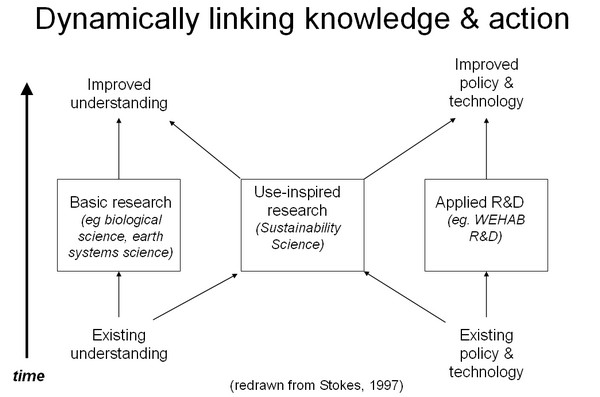
Clark used Stoke’s (1997) presentation of the four quadrants of the reasons to undertake research, highlighting that sustainability science falls into Pasteur’s Quadrant. Research in sustainability science is driven by both a quest for fundamental understanding and the consideration of the use to which the research will be put in the real world. Research with the goal of the former alone might be termed ‘Basic Research’ (e.g. physics – Bohr’s Quadrant), whereas the latter might be termed ‘Applied Research’ (e.g. engineering – Edison’s Quadrant). Through time, research in Pasteur’s Quadrant often results in a dialogue between the basic and the applied sciences, as demonstrated below.


The characterisation of sustainability science highlights that the domain of sustainability science is geo-historical. Place and history are important in defining both the problem to be examined and the solutions we might suggest. Prof Clark highlighted this, noting that a good knowledge of the environmental history of the location under study is important, and that such a history can be used in some ways as a laboratory provides data. But equally we need to remember that this history can be framed or contextualised itself – the narrative of an environmental history is unlikely to provide data that is as ‘objective’ as would be produced in a biology lab say.

Furthermore, the nature of geo-historical systems highlights the problems associated with a science that tries to be both applied and basic. How do we take use the knowledge gained from a given study to inform wider policy and decision making? Critics can argue that ‘it only happens in this particular place’, whereas advocates can argue that ‘it happens like this everywhere’. A balance between these stances will need to be struck. Multiple examples of processes, treatments, and outcomes in different places might be one way to approach this balance. Given that real-world systems are context-dependent, and that the problems sustainability science will study are value-laden, a certain level of subjectivity probably isn’t such a big deal anyway. The development of nomothetic generalizations in the same vein as the hard sciences may not be possible. However this situation, which implies uncertainty, will need to be acknowledged and understood by decision-makers.

Clark also discussed the ‘lessons for designing university-based knowledge systems for sustainability’. An article in the current issue of Futures highlights the issues faced by university departments and researchers wishing to perform sustainability science:

“The art of problem-based interdisciplinarity lies in the choice of problems that will be both academically and socially fruitful. Too heavy emphasis on the former leads to research that may successfully address problems within a particular field of study and make a contribution to the literature but that are of limited value or interest beyond the academy. Too much emphasis on the latter leads to work that is indistinguishable from consulting or pure advocacy work. Being problem-driven means starting from a problem or concern in society, but, in order to create the hybrid activity described above, this problem must be translated into a form that is amenable to issue-driven interdisciplinary research. Such translation is an indispensable prerequisite to obtaining funding from academic funding agencies and buy-in from academic collaborators, who have to be able to undertake research that will lead to publications in the outlets in which they need to publish in order to further their career prospects.”


To develop successfully Prof Clark suggested that the academy will need to maintain and engage strength in the foundation disciplines, support focused programs of ‘use-inspired basic research’ on core questions of sustainability science, build collaborative problem-solving programs, and create recognition and reward systems for those who develop and participate in such programs. The ‘publish or perish’ mantra also demands that there be suitable outlets for sustainability science research – the creation of the Sustainability Science section in PNAS is an indication that the importance, and uniqueness, of this emerging interdisciplinary field of study is becoming increasingly recognised.

There was so much more said and discussed during Prof Clark’s visit to MSU but that’s enough here for now. A copy of the powerpoint presentation used during the lecture can be downloaded from the CSIS website.

Staying Together… for the Sake of the Environment?

I may be a little behind the times but I have finally begun to digg stuff. From now on if I digg something that I really like or think it is relevant to what I talk about on this blog I’ll post it directly from digg. Given the media interest in the most recent paper to come out of CSIS it seems appropriate that this be the first blog from digg:

“A married household actually uses resources more efficiently than a divorced household,” said Jianguo Liu, a sustainability expert with Michigan State University. He and fellow researcher Eunice Yu concluded that in 2005, in the United States alone, divorced households could have saved 38 million rooms, 73 billion kilowatt-hours of electricity and 627 billion gallons of water if their “resource-use efficiency” had been comparable to that of married households. Liu’s analysis of the environmental impact of divorce appears in this week’s online edition of Proceedings of the National Academy of Sciences. Besides the United States, Liu looked at 11 other countries, including Brazil, Costa Rica, Ecuador, Greece, Mexico and South Africa between 1998 and 2002. In the 11, if divorced households had combined to have the same average household size as married households, there could have been a million fewer households using energy and water in these countries. “People have been talking about how to protect the environment and combat climate change, but divorce is an overlooked factor that needs to be considered,” Liu said.

read more | digg story

Rachel Carson Distinguished Lecture by William C. Clark

Professor William C. Clark, of Harvard University, will be giving the forthcoming Rachel Carson Distinguished Lecture “Sustainability Science: An Emerging Interdisciplinary Frontier”. The lecture is on Thursday December 6 2007 at 3:30 PM (with a reception to follow) in the Radiology Auditorium (on Service Road) at Michigan State University (for directions, visit the CSIS home page). The lecture is free and open to the public.

I’ll be there and will try to write something about it here in the future…

Dr. William C. Clark is the Harvey Brooks Professor of International Science, Public Policy, and Human Development in the John F. Kennedy School of Government at Harvard University. He is an international leader in Sustainability Sciences, co-chaired the National Research Council’s study “Our Common Journey: A Transition toward Sustainability”, and is editor of the Section on Sustainability Science for the Proceedings of U.S. National Academy of Sciences. His exceptional interdisciplinary research and other activities have been recognized by many prestigious honors and awards, such as membership in the National Academy of Sciences and the MacArthur Prize. Additional information about Dr. Clark, including representative publications, can be found at the CSIS home page.

Presented by the Center for Systems Integration and Sustainability, Department of Fisheries and Wildlife with support from the Office of the President; Office of the Provost; Office of the Vice President for Research and Graduate Studies; Graduate School; Environmental Science and Policy Program; College of Agricultural and Natural Resources; Michigan Agricultural Experimental Station; Center for Water Sciences; Sustainable Michigan Endowed Project; Science, Technology, Environment, and Public Policy Specialization; and Elton R. Smith Endowment.

An Integrated Fire Research Framework

Integrated, multi- and inter-disciplinary studies are becoming increasingly demanded and required to understand the consequences of human activity on the natural environment. In a recent paper, Sandra Lavorel and colleagues highlight the importance of considering the feedbacks and interactions between several systems when examining landscape vulnerabilities to fire. They present a framework for integrated fire research that considers the fire regime as the central subsystem (FR in the figure below) and two feedback loops, the first with consequences for atmospheric and biochemical systems (F1) and the second that represents ecosystems services and human activity (F2). It is this second feedback loop in their framework that my research focuses.


To adequately quantify the fire-related vulnerability of different regions of the world the authors suggest that a better understanding of the relative contributions of climate, vegetation and human activity to the fire regime is required. For example, they suggest that an examination of the statistical relationships between spatio-temporal patterns evident in wildfire regimes and data on ecosystem structure, land use and other socio-economic factors. We made a very similar point in our PNAS paper and hope to continue to use the exponent (Beta) of the power-law frequency-area relationship that is evident in many model and empirical wildfire regimes to examine these interactions. One statistical relationship that might be investigated is between Beta and the level of forest fragmentations, thought to be a factor confounding research on the effects of fire suppression of wildfire regimes.

But the effects of landscape fragmentation can also be examined in a more mechanistic fashion using dynamic simulation models. Lavorel et al. mention the impacts of agricultural abandonment on the connectivity of fuels in Mediterranean landscapes which are attributed, in conjunction with a drier than average climate, to the exceptionally large fires that burned there during the 1990s. My PhD research examined the impacts of agricultural land abandonment on wildfire regimes in central Spain. I’m currently working on writing this work up for publication, but I plan on continuing to develop the model to more explicitly represent the F2 feedbacks loop shown in the figure above.

The potential socio-economic consequences of changing fire regimes are an area with a lot of room to improve our understanding. For example, some regions of the world, such as the Canadian boreal forest, are transitioning from a net sink for carbon to a net source (due to emission during burning). If carbon sinks are considered in future emission trading systems, regions such as are losing a potential future economic commodity. Lavorel et al. also discuss the interesting subject of potential land conflict due to mismatches in the time scales between land planning and fire occurrence. In Indonesia for example, years which burn large areas force re-allocation of land development plans by local government. Often however the processes of developing these plans is not fast enough to forestall the exploitation by local residents of the new land available for occupation and use.

The need for increased research in this area is highlighted by the case studies for Alaskan and African savannah ecosystems presented by Lavorel et al. Whilst discussion of the wildfire regime and atmospheric/biochemical feedbacks can be discussed in detail, poor understanding of the ecosystem services/human activity feedbacks prevents such detailed discussion.

The framework Lavorel et al. present is a very useful way to conceptualise and plan for future research in this field. They suggest (p.47-48) that “Assessments of vulnerability of land systems to fire demand regional studies that use a systemic approach that focuses on the feedback loops described here” and “… will require engaging a collection of multiscale and interdisciplinary regional studies”. In many respects, I expect my future work to contribute to this framework, particularly with regards the human activity (F2) feedback loop.

CHANS Science Paper

In this week’s issue of Science Jack Liu, Director of CSIS (and my boss), and colleagues present a review of recent research on Coupled Human And Natural Systems (CHANS). Using six case studies from around the world the paper discusses these coupled systems with regards spatial, temporal and organisational units, nonlinear dynamics and feedback loops between systems, the importance of history within these sytems, and aspects of their resilience and heterogeneity. We’ll be discussing the paper within the center next week so maybe I’ll have some more insightful comments then. For now, here’s the abstract:

Integrated studies of coupled human and natural systems reveal new and complex patterns and processes not evident when studied by social or natural scientists separately. Synthesis of six case studies from around the world shows that couplings between human and natural systems vary across space, time, and organizational units. They also exhibit nonlinear dynamics with thresholds, reciprocal feedback loops, time lags, resilience, heterogeneity, and surprises. Furthermore, past couplings have legacy effects on present conditions and future possibilities.

Complexity of Coupled Human and Natural Systems
Jianguo Liu , Thomas Dietz, Stephen R. Carpenter, Marina Alberti, Carl Folke, Emilio Moran, Alice N. Pell, Peter Deadman, Timothy Kratz, Jane Lubchenco, Elinor Ostrom, Zhiyun Ouyang, William Provencher, Charles L. Redman, Stephen H. Schneider, William W. Taylor
Science 14 September 2007
Vol. 317. no. 5844, pp. 1513 – 1516
DOI: 10.1126/science.1144004
Also online here`

Oekologie #8

Welcome to the 8th issue of Oekologie, the travelling blog carnival of the best ecology and environmental science blog posts from the past month. Although the summer is often the time that ecologists and environmental scientists are out in the field doing what they love most (fieldwork) this didn’t stop some of us from posting stories that grabbed our attention.

Several of posts this month discussed the ecology of mammals, some more positive than others. Talking about Yellowstone’s Ecology of Fear, Jeremy at The Voltage Gate highlighted the benefits of the re-introduction of wolves to the National Park and that the restoration of historic ecosystems is possible. GrrlScientist notes that the egg-laying mammal Attenborough’s long-beaked echidna (named after Sir David Attenborough) is not extinct as was previously thought, and Tim at Walking the Berkshires emphasised the successes of the Khoadi Hôas Conservancy in Namibia for the conservation of elephant populations. Though problems remain, Tim suggests that it is possible for humans and elephants to exist side-by-side. In a great post over at Laelaps, Brian is less optimistic however about the management and survival prospects for the Saiga antelope (Saiga tatarica).

More concerned with the The Other 95%, Kevin discusses the benefits for crabs moulting their exoskeleton (other than simply allowing them to grow). Concerning the plant world, Jennifer at The Infinite Sphere presents the invasive Purple Loosestrife and the trade-offs associated with controlling the plants with herbicides, and at Seeds Aside Laurent suggests a game for the next time you’re strolling through a meadow.

Lorne at Geek Counterpoint presents a review of the Storm World by Chris Mooney, pointing out the social aspects of the scientific study of the climate and hurricanes;

“Mooney also takes a long, critical look at how scientists communicate (or don’t) to the public, and how the media handles what information they can get their hands on.”

Finally, considering some of the larger issues, Mike at 10,000 Birds examines the ecological basis for conservation. Part of a larger series called Protect the Commons, he highlights the need to remember the fragile connections between things and to understand that “all is of a part”

That’s it for this month – check Oekologie #9 at Fish Feet next month. Remember to submit your best posts here.

Fuel Efficient Collaboration

In a current thread on the <a href="
https://listserv.umd.edu/cgi-bin/wa?A0=ecolog-l&#8221; target=”_blank” class=”regular”>ECOLOG-L listserv there’s a debate going on about the environmental impacts of academics travelling to conferences in far-off places to discuss the environmental state of the world (the current case being this week’s ESA conference in San Jose). On correspondent suggested we might be better off taking better advantage of the internet and teleconferencing, as suggested by E.O. Wilson. Several people have responded noting the virtues of physically attending meetings including the opportunities to meet face-to-face with potential collaborators, funders and students and to see presentations of data that may not be published for a couple of years hence.

Another correspondent suggested that delegates consider the form of transport they take to reach the meeting – trains are commonly held as being more fuel efficient than planes for example. This led me to the Fuel Efficiency in Transportation page on the ubiquitous wikipedia. Assuming this page is correct, it suggests that generally;

  1. Cycling (653 mpg) is more efficient than walking (235 mpg)
  2. European trains (500 mpg) are considerably more fuel efficient than planes (67 mpg)
  3. Planes (67 mpg) are actually more fuel efficient than the average US car (36 mpg), but less efficient than a hyprid such as the Toyota Prius (77 mpg)
  4. Travel by the average US car (36 mpg) is of comparable efficiency to travel on an Amtrak intercity train (39 mpg)
  5. Travel by Steamboat (12 mpg) or Helicopter (4 mpg) is only for those who don’t give a jot about carbon emissions

Here mpg = miles per gallon of gasoline, and these are rough comparisons for the average occupancy of the vehicle which don’t really consider things like the distance travelled. There are many other considerations that need to be taken in these comparisons as James Strickland shows in his examination of the numbers.

Of course, the problem with this discussion is that the two most important factors that people consider when deciding how to travel are not accounted for: Time and Money. Flying internationally (and in many cases on short-haul too) is, in general, more efficient in both time and money than travelling by train (though some would say less fun). I can see currently that the advantages mentioned above for attending a conference in person do make it preferable to teleconferencing or online conferences. Maybe if ecologists really want to be environmentally friendly when meeting to discuss how the natural environment works they’ll need to go that one step further and embrace meetings in virtual words such as Second Life. Businesses are now experimenting with virtual spaces where remote workers come together to collaborate, and whilst it may take time to perfect and get used to this way of ‘meeting’ it seems like an option for the future. Whilst ESA 2007 is held in sunny a San Jose, maybe ESA 2010 be held in a sunny simulated city…