Sustainability Science: An Emerging Interdisciplinary Frontier

Sustainability. Integration. Interdisciplinary. These are the three words that stood out from Prof William C. Clark’s Rachel Carson Distinguished Lecture at MSU on Thursday and reflect the research we do at the the Center for Systems Integration and Sustainability.

Prof Clark discussed the recent emergence of ‘Sustainability Science’ as a field that is use-inspired (like health science or agricultural science), that is defined by the practical problems it addresses, that is focused on the scientific understanding of coupled human and natural systems (CHANS), and that integrates knowledge and research from multiple disciplines.

The definition of ‘sustainability’ has always been a tricky one – in part Clark suggested because it is a concept that is as broad as concepts such as ‘freedom’, ‘good’ and ‘bad’. What sustainability means depends on who is using the word and the context of the problem in which it is being used. Because sustainability science is use-inspired, what is to be sustained is defined by the the problem or issue being addressed. In one situation the objective might be examine how best to sustain a community’s cultural and social well-being, in another it might be the continuation of the life-supporting functions of an ecosystem, and in yet another it might the continued growth of the economy and the material well-being that affords. An idealist might argue that the objective should be to sustain all three examples, but in reality priorities will often need to be drawn up.

Clark used Stoke’s (1997) presentation of the four quadrants of the reasons to undertake research, highlighting that sustainability science falls into Pasteur’s Quadrant. Research in sustainability science is driven by both a quest for fundamental understanding and the consideration of the use to which the research will be put in the real world. Research with the goal of the former alone might be termed ‘Basic Research’ (e.g. physics – Bohr’s Quadrant), whereas the latter might be termed ‘Applied Research’ (e.g. engineering – Edison’s Quadrant). Through time, research in Pasteur’s Quadrant often results in a dialogue between the basic and the applied sciences, as demonstrated below.
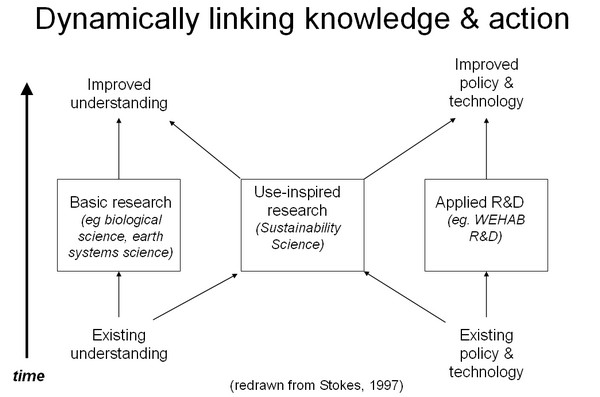

The characterisation of sustainability science highlights that the domain of sustainability science is geo-historical. Place and history are important in defining both the problem to be examined and the solutions we might suggest. Prof Clark highlighted this, noting that a good knowledge of the environmental history of the location under study is important, and that such a history can be used in some ways as a laboratory provides data. But equally we need to remember that this history can be framed or contextualised itself – the narrative of an environmental history is unlikely to provide data that is as ‘objective’ as would be produced in a biology lab say.

Furthermore, the nature of geo-historical systems highlights the problems associated with a science that tries to be both applied and basic. How do we take use the knowledge gained from a given study to inform wider policy and decision making? Critics can argue that ‘it only happens in this particular place’, whereas advocates can argue that ‘it happens like this everywhere’. A balance between these stances will need to be struck. Multiple examples of processes, treatments, and outcomes in different places might be one way to approach this balance. Given that real-world systems are context-dependent, and that the problems sustainability science will study are value-laden, a certain level of subjectivity probably isn’t such a big deal anyway. The development of nomothetic generalizations in the same vein as the hard sciences may not be possible. However this situation, which implies uncertainty, will need to be acknowledged and understood by decision-makers.

Clark also discussed the ‘lessons for designing university-based knowledge systems for sustainability’. An article in the current issue of Futures highlights the issues faced by university departments and researchers wishing to perform sustainability science:

“The art of problem-based interdisciplinarity lies in the choice of problems that will be both academically and socially fruitful. Too heavy emphasis on the former leads to research that may successfully address problems within a particular field of study and make a contribution to the literature but that are of limited value or interest beyond the academy. Too much emphasis on the latter leads to work that is indistinguishable from consulting or pure advocacy work. Being problem-driven means starting from a problem or concern in society, but, in order to create the hybrid activity described above, this problem must be translated into a form that is amenable to issue-driven interdisciplinary research. Such translation is an indispensable prerequisite to obtaining funding from academic funding agencies and buy-in from academic collaborators, who have to be able to undertake research that will lead to publications in the outlets in which they need to publish in order to further their career prospects.”


To develop successfully Prof Clark suggested that the academy will need to maintain and engage strength in the foundation disciplines, support focused programs of ‘use-inspired basic research’ on core questions of sustainability science, build collaborative problem-solving programs, and create recognition and reward systems for those who develop and participate in such programs. The ‘publish or perish’ mantra also demands that there be suitable outlets for sustainability science research – the creation of the Sustainability Science section in PNAS is an indication that the importance, and uniqueness, of this emerging interdisciplinary field of study is becoming increasingly recognised.

There was so much more said and discussed during Prof Clark’s visit to MSU but that’s enough here for now. A copy of the powerpoint presentation used during the lecture can be downloaded from the CSIS website.

sponsor a (s)mile

I’ve been watching Ewan McGregor and Charlie Boorman on their epic motorcycle adventure all the Long Way Down from John O’Groats in Scotland through Europe and Africa to Cape Town, South Africa. It’s like a 21st century lads version of Michael Palin’s jolly jaunts around the world and follows on from their last trip from London to New York the (wrong) Long Way Round. Another inspirational set of characters to give one itchy feet…

One of the charities they’re associated with and raising money for on their trip is UNICEF. On their way through Africa the boys visited places where UNICEF are working, like in Ethiopia where they are still clearing land mines from previous wars and educating local children and families about the dangers that remain.

You can support this work by sponsoring a mile of Ewan and Charlie’s route. All of the money raised supports the UNICEF Long Way Down Fund to help children affected by conflict, poverty and HIV/AIDS in Africa. For example, £1 will buy six sachets of peanut butter paste that is used to treat children with malnutrition. Checkout the map – I’ve sponsored mile 114.

What does it mean to ‘be’ an expert? at RGS-IBG 2008

That man James Porter is busy at the Geography conferences these days. Alongside organising a session at the 2008 AAG on Private Science & Environmental Governance, he’s also organising a session at the 2008 RGS-IBG Annual Meeting on expertise and what it means to be an expert. Details below, abstract submissions are due by 16th January 2008.

I didn’t make it to the meeting last year but hope to in 2008…

Call for Papers:
(Re)Thinking Expertise: Spaces of Production, Performance and the Politics of Representation
RGS-IBG, Annual Meeting, 27 – 29 August 2008
London

What does it mean to ‘be’ an expert? Although social constructionism has identified similarities between science and other social practices, recently a controversial call for a “Third Wave” of science studies (Collins & Evans, 2002) has drawn attention to the problem of Extension – the infinite regress encountered when looking for techno-scientific advice if we can no-longer tell the difference between expert and lay-knowledge. Expertise has previously been understood to be the unyielding pursuit of authoritative knowledge that is honed through practice and enforced by political and academic institutions. In this sense, the professional identities presented to the outside world are carefully crafted so as to conform and exhibit ideological norms not dissimilar to Merton’s ideals. Such readings, however, arguably present an overly romantic, simplistic, and homogenous rendering of experts and their expertise. What is needed is examination of how experts’ identities are constructed (when and by whom), how they are negotiated between actors and institutions, the historical context in which they are played out, and ultimately how they function (or don’t) instrumentally to serve or suppress certain realities.

Expertise is arguably played out more visibly today than ever before, particularly with reference to the environment. Floods, hurricanes, infectious animal diseases, and a myriad of other concerns are captured graphically and broadcasted nightly into homes across the world. Each event and the subsequent response depicts the experts involved as either heroes or villains of these dramatised pieces – in both cases thrust into the limelight as representatives of their respective fields. Geographers are uniquely positioned to comment on this. They can provide theoretical depth and empirical evidence to shed light on the way expert identities are shaped, the role they serve, the impact on the democratization of knowledge, and the barriers they present to tackling environmental problems. We therefore invite papers addressing (though not limited to) the following questions:

  • Who constructs the image of environmental experts? How / where are these constructions enacted (i.e. technological, sociocultural, artefacts, etc.)?
  • Can representations be negotiated? If so, what role have academics played in shaping past perceptions and might hope to play in the future? What agency do these representations have?
  • What is the effect of these representations? Do they ever coincide or clash with the needs, understandings and views of actors (public, political, etc.)? Where are they successful and unsuccessful?
  • Do the representations come to in turn alter the landscape and shape an environment which conforms to the possible misguided representation itself? Does this lead to a snowballing of representations and hence crisis where ‘reality’ breaks?

Abstracts should be sent to James Porter (james.porter at kcl.ac.uk) and Joseph Hillier (joseph.hillier at ucl.ac.uk) by 16th January 2008.

More conference information here.

Private Science & Environmental Governance at the AAG

James Porter, a friend of mine from Geography at King’s College London, is co-convening a session at the 2008 Association of American Geographers Annual Meeting to address the issue of the increasing contribution of ‘private science’ to environmental decision-making and knowledge about the world around us. Sounds like it will be an interesting session – if I actually make it to the AAG next year I’ll have to swing by.

Submissions for the session are open until October 21st 2007. Abstracts and PIN numbers (obtained by registering your abstract online) should be sent to James Porter (james.porter at kcl.ac.uk) and Leigh Johnson (leighjohnson at berkeley.edu) Conference information here. Submit your abstract and get your PIN here.

Here’s the session details and call for papers in full:

Private Science, Environmental Governance & the Management of Knowledge
Association of American Geographers Annual Meeting, April 15-19, 2008
Boston, MA

In the US and UK, new forms of market-based, commercially driven, and politically relevant demands are restructuring the context of scientific research and the social norms and values therein. No longer can academic institutions expect the same levels of public support immortalized by Vannevar Bush; in recent decades we have seen the rapid ascent of private science or science for hire to fill the void. Science is now routinely contracted-out to the private sector to produce a range of products from Climate Forecast Predictions, flood modeling outputs, risk assessments, chemical tests, life-style drugs and myriad other products that find their way into public policy and regulatory decision-making. The appeal of this new form of scientific research is its cost-effectiveness, its embrace of strategic ignorance, and its flexibility in allowing clients to guide the design and outcome of the work produced.

Yet, environmental governance is shaped extensively by the use of scientific knowledge. In the context of governing citizens, regulating private enterprise, and guiding development, what happens when nature and science are conceptualized in terms of their commercial potential? Geographers are uniquely positioned to provide theoretical depth and empirical evidence to answer these questions. We seek papers addressing (though not limited to) the following questions:

  • How are commercial science, modeling, and assessments done in practice? What is lost and equally gained in this process? What is ignored in these new knowledge productions?
  • These questions open up room to consider the contested practice of translation: who chooses what is to be translated? Who does the translation? Does the quality of translation impact the nature of knowledge, and if so, how? How might unlikely allies become enrolled in the project?
  • Can we discern a particular set of preferred methodologies or instruments that are consistently deployed in the performance of private science? Are these characteristic of a particular neoliberal mode of governance?
  • If private science has come to dominate fact-making about nature, does this entail a transformation from the rule of (bureaucratic) experts? How do these new forms of knowledge gain authoritative status, if at all?
  • What are the implications for the subjects of governance?

let’s go nuts!


Let’s go Lansing Lugnuts that is. Last night I went to my first Minor League Baseball game. I’ve been to a couple of Major League games before, but on a nice summers’ evening it was about time to find out more about what goes on in the lower echelons of the game that has always intrigued me. When I was about 8 my uncle brought me back a Red Socks baseball and pennant from a business trip. Maybe that got it started. One of my favourite writers Stephen Jay Gould was a huge baseball fan and used the apparent extinction of the .400 batting average as an adroit metaphor in one of his books to discount the idea of evolutionary progress with humans at the pinnacle in. And of course there are the parallels with cricket.

The lower levels of professional sport rarely get heard above the din and clamour for the biggest and best teams. The FA Premiership is now the richest football league in the world and followed avidly by many fans around the world. Its transition from a league with a reputation of violence and hooliganism to one of the most marketable sporting brands in the world has come via a change in attitude and facilities. I have a vivid memory from one of my first trips to a Bristol City game in the late 1980’s (again, I must have been about 8 – I hasten to add City are not, unfortunately, in the Premiership). I needed to use a bathroom so Dad took me to the ‘Gents’ where I was confronted simply by a 10 foot wall painted black with a gutter of urine running along the bottom. The smell was ‘colourful’ as was the language around me. It was intense to say the least. How this experience has effected me later personal development I can only guess – Mum certainly didn’t approve of me going along. But the violent and abusive behaviour that once embodied watching the game is no longer tolerated and the terraces have been replaced by more manageable and comfortable rows of covered seating (and more hygienic toilets).

Apparently a similar change has occurred in the minor leagues of baseball. In the game programme was a piece about the rise in popularity of Minor League games. Season attendances in every season since 2000 have been placed in the top 10 since the leagues began and in 2006 the current record was set at 41.7 million fans. That’s more than the NBA, and more than the NFL and NHL combined, each year. Fifth Third Field in Dayton Ohio has sold out every game since it opened in 2000. But the continuing growth has come since the 1990’s and a similar attitude toward the game as has changed football in the UK. And the programme article described a lady faced by a similar toilet experience as my childhood one – it’s certainly not like that now. The emphasis has shifted toward entertainment and whilst the minor league game hasn’t changed, the crowds have. In family-friendly America this means kids. And lots of ’em.

So whilst the high pitched screaming wasn’t so good for my ears, the $9 seat in the third row along the first base line was good for my wallet and got me close to those 90 mph pitches. I have got to say though, even with my uneducated eye, the quality of play wasn’t quite up there with, say, the SF Giants. The Lugnuts gave up 4 runs in the first inning and it wasn’t looking good. But then South Bend gave up 5 in the second and from there on we cruised to victory (8-5). Highlights from ‘the game’ for me included a Lugnuts batter snapping his bat over his knee (golfer style) after he struck out with the bases loaded, and the genius sack race ‘run’ by some ‘hefty’ women from the crowd between 8th and 9th innings. I was less impressed that they wouldn’t refill my plastic beer glass when buying a second and that I HAD to have a new one. Grrr…


Regardless of the quality of play it was a good night. And seemingly the growth of Minor League Baseball is good for the cities in which the teams are located. Oldsmobile Park is leading the much needed regeneration of the waterfront area of downtown Lansing. After the game, the fireworks reflected in the windows of the old Ottawa Power Station (above) that has lain empty for over a decade. Regeneration is needed in Michigan of all places in the States, where the decline of the American auto industry has hit hard. With manufacturing in sharp decline the state and the city need to turn to alternative industries for income and regeneration. The dollars spent in the stadium are now helping to boost the local economy, and give this part of town something to build around for the future. So, let’s go nuts!

Critical Realism for Environmental Modelling?

As I’ve discussed before, Critical Realism has been suggested as a useful framework for understanding the nature of reality (ontology) for scientists studying both the environmental and social sciences. The recognition of the ‘open’ and middle-numbered nature of real world systems has led to a growing acceptance of both realist (and relativist – more on that in a few posts time) perspectives toward the modelling of these systems in the environmental and geographical sciences.

To re-cap, the critical realist ontology states that reality exits independently of our knowledge, and that it is structured into three levels: real natural generating mechanisms; actual events generated by those mechanisms; and empirical observations of actual events. Whilst mechanisms are time and space invariant (i.e are universal), actual events are not because they are realisations of the real generating mechanisms acting in particular conditions and contingent circumstances. This view seems to fit well with the previous discussion on the nature of ‘open’ systems – identical mechanisms will not necessarily produce identical events at different locations in space and time in the real world.

Richards initiated debate on the possibility of adopting a critical realist perspective toward research in the environmental sciences by criticising emphasis on rationalist (hypothetico-deductive) methods. The hypothetico-deductive method states that claims to knowledge (i.e. theories or hypotheses) should be subjected to tests that are able to falsify those claims. Once a theory has been produced (based on empirical observations) a consequence of that theory is deduced (i.e. a prediction is made) and an experiment constructed to examine whether the predicted consequences are observed. By replicating experiments credence is given to the theory and knowledge based upon it (i.e. laws and facts) is held as provisional until evidence is found to disprove the theory.

However, critical realism does not value regularity and replication as highly as rationalism. The separation of real mechanisms from empirical observations, via actual events, means that “What causes something to happen has nothing to do with the number of times we have observed it happening”. Thus, in the search for the laws of nature, a rationalist approach leaves open the possibility of the creation of laws as artefacts of the experimental (or model) ‘closure’ of the inherently open system it seeks to represent (more on model ‘closure’ next time).

The separation of the three levels of reality means that whilst reality exists objectively and independently, we cannot observe it. This separation causes a problem – how can science progress toward understanding the true nature of reality if the real world is unobservable? How do critical realists assess whether they have reached the real underlying mechanisms of a system and can stop studying it?

Whilst critical realism offers reasons for why the nature of reality makes the modelling of ‘open’ systems tricky for scientists, it doesn’t seem to provide a useful method by which to overcome the remaining epistemological problem of knowing whether a given (simulation) model structure is appropriate. In the next few posts I’ll examine some of these epistemological issues (equifinality, looping effects, and affirming the consequent) before switching to examine some potential responses.

Agent-Based Modelling for Interdisciplinary Geographical Enquiry

Bruce Rhoads argued that;

“The time has come for geography to fulfil its potential by adopting a position of intellectual leadership in the realm of interconnections between human and biophysical systems.”

Many areas of scientific endeavour are currently attempting to do the same and interdisciplinarity has become a big buzzword. Modelling has become a common tool for this interdisciplinary study (for example ecological-economic models), with several different approaches available. Increases in computing power and the arrival of object-oriented programming have led to the rise of agent-based modelling (also termed individual-based and discrete element).

In their latest paper in Geoforum, Bithell et al. propose this form of modelling, with its “rich diversity of approaches”, as an opportune way to explore the interactions of social and environmental processes in Geography. The authors illustrate the potential of this form of modelling by providing outlines of individual-based models from hydrology, geomorphology, ecology and land-use change (the latter of which I have tried to turn my hand to). The advantages of agent-based modelling, the authors suggest, include the ability to represent

  1. agents as embedded within their environment,
  2. agents as able to perceive both their internal state and the state of their environment
  3. agents that may interact with one another in a non-homogeneous manner
  4. agents that can take action to change both their relationships with other agents and their environment
  5. agents that can retain a ‘memory’ of a history of past events.

However the development of these representation can be a challenging task as I found during my PhD modelling exploits, and requires a ‘diversity of resources’. When representing human agents these resources include past population censuses, surveys and interviews of contemporary populations, and theoretical understanding of social, cultural and economic behaviour from the literature. In my modelling of a contemporary population I used interviews and theoretical understanding from the literature and found that, whilst more resource intensive, actually going to speak with those being represented in the model was by far more useful (and actually revealed the deficiencies of accepted theories).

In their discussion, Bithell et al. consider the problems of representing social structures within and an individual-based model suggesting that;

“simulation of social structure may be a case of equipping model agents with the right set of tools to allow perception of, and interaction with, dynamic structures both social and environmental at scales much larger than individual agents”.

Thus, the suggestion is that individually-based models of this type may need some form of hierarchical representation.

Importantly I think, the authors also briefly highlight the reflexive nature of agent-based models of human populations. This reflexivity occurs of the model is embedded within the society which it represents, thus potentially modifying the structure of system it represents. This situation has parallels with Hacking’s ‘looping effect’ that I’ll write about more another time. Bithell et al. suggest that this reflexive nature may, in the end, limit the questions that such models can hope meaningfully address. However, this does not prevent them from concluding;

“The complex intertwined networks of physical, ecological and social systems that govern human attachment to, and exploitation of, particular places (including, perhaps, the Earth itself) may seem an intractable problem to study, but these methods have the potential to throw some light on the obscurity; and, indeed, to permit geographers to renew their exploration of space–time geographies.”

memories of a British coastal landscape


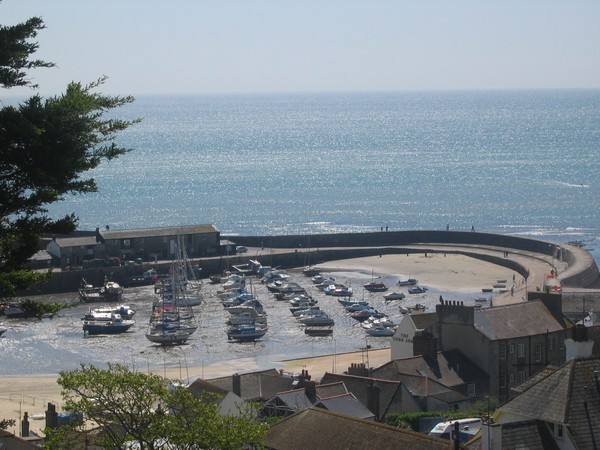
Before my impending departure to the States I’ve been out and about visiting a few places that I won’t see for a while. This week, I took my Grandmother back to the town where she grew up on the English south coast – Lyme Regis in Dorset. I’d never been and she hadn’t been back for a while so it was a trip down both new and old memory lanes.


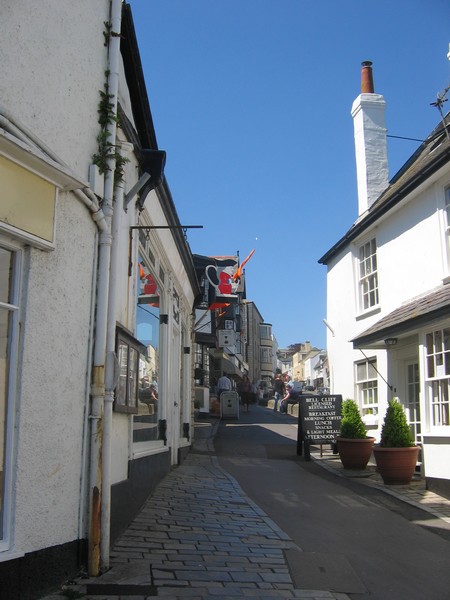
And what steep lanes. Apparently they used drag cargo up Cobb Road from ships docked in ‘the Cobb’. They realised it was a bit much like hard work up these steepled slopes and stopped a fair while ago. But there were other war-time stories about the inclines; run-away trucks with failed breaks, careening down narrow lanes toward the sea-front, their landings cushioned not by a sandy beach but by the solid walls of the old coal merchants (it seems it’s still happening these days too). Line upon line of American soldiers snaking up and down Broad Street outside the old Regent Cinema (then The New Thing In town). Apparently it remains quintessentially British today – tea and biscuits from a china cups and saucers before taking your seats (aside the fact it shows the latest Hollywood block-busters of course).


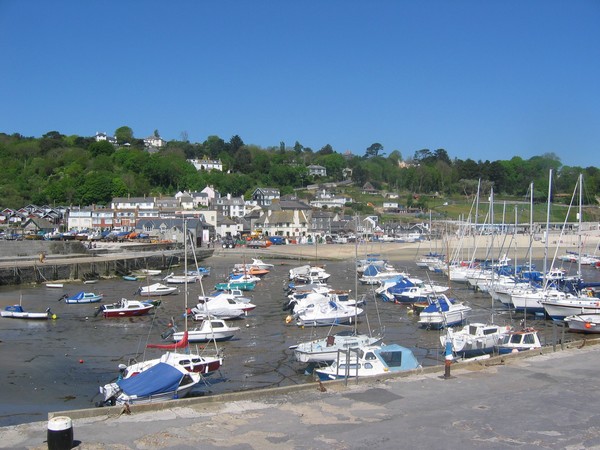
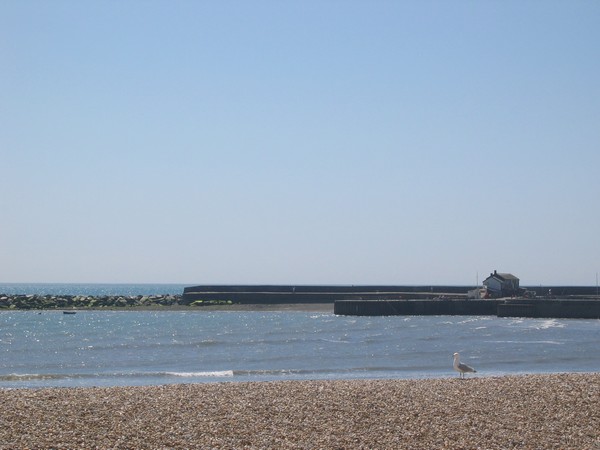
The vertiginous topography has not only caused rapid runaway of trucks, but also the rapid (and creeping) runaway of the soil. Efforts to manage and reduce land slippage are being undertaken in parallel with a £17 million coastal defence and harbour improvement scheme. Whilst understanding that it is necessary if they want to save their sea-front industry (which has changed from sea-trading and fishing to sea-swimming and tourism), locals aren’t happy about the large new shingle banks that provide the needed protection. Sand has accumulated in the harbour over recent years and has now been joined by a nice sandy beach imported from France.


Alongside visiting the sea-side we had tea and cake at some old friend’s house – all in all a good day stocking up on memories of the British coastal landscape before I jet off across the pond.

EGU 2007 Poster

I’m not attending the European Geophysics Union General Assembly this year as I have done the past couple. However, I do have a poster there (today, thanks to Bruce Malamud for posting it) on some work I have been doing with Raul Romero Calcerrada at Universidad Rey Juan Carlos in Madrid, Spain. We have been using various spatial statistical modelling techniques to examine the spatial patterns and causes (including both socioeconomic and biophysical) of wildfire ignition probabilities in central Spain. The poster abstract is presented below and we’re working on writing a couple of papers related to this right now.

Spatial analysis of patterns and causes of fire ignition probabilities using Logistic Regression and Weights-of-Evidence based GIS modelling
R. Romero-Calcerrada, J.D.A. Millington
In countries where more than 95% of wildfires are caused by direct or indirect human activity, such as those in the Iberian Peninsula, ignition risk estimation must consider anthropic influences. However, the importance of human factors has been given scant regard when compared to biophysical factors (topography, vegetation and meteorology) in quantitative analyses of risk. This disregard for the primary cause of wildfires in the Iberian Peninsula is owed to the difficulties in evaluating, modelling and representing spatially the human component of both fire ignition and spread. We use logistic regression and weights-of-evidence based GIS modelling to examine the relative influence of biophysical and socio-economic variables on the spatial distribution of wildfire ignition risk for a six year time series of 508 fires in the south west of the Autonomous Community of Madrid, Spain. We find that socioeconomic variables are more important than biophysical to understand spatial wildfire ignition risk, and that models using socioeconomic data have a greater accuracy than those using biophysical data alone. Our findings suggest the importance of socioeconomic variables for the explanation and prediction of the spatial distribution of wildfire ignition risk in the study area. Socioeconomic variables need to be included in models of wildfire ignition risk in the Mediterranean and will likely be very important in wildfire prevention and planning in this region.