Rajasthan

OK, so I’m back from gallivanting and just beginning to get my brain back up to speed to after some well-needed mental free-wheeling. Well, actually, maybe free-wheeling isn’t the best phrase – rather, I needed to get my head out of my thesis and back into the real world.

Travelorphan

And what better place to escape from the ivory tower than to Rajasthan, northern India, former jewel in the crown. Here, my theoretical assumptions were confronted and summarily dismissed by the harsh practical realities of people struggling to survive amongst a billion countrymen all sharing a common, upwardly mobile, dream. Western rationalism met Eastern mysticism. Swirling scarlet saris, spiced sauces, sweet (and sour) smells sharply contrasted pale personal computing, drab digital logic and the dreary desk-bound slog of ‘writing-up’. Confronting a hoard of fare-seeking rickshaw drivers is quite a different problem to attempting to find a single bug amongst several hundred lines of code (though a similar level of patience is useful). Needless to say this diligent young PhD scholar took a few days to get up to speed…

Travelorphan

However, once the common ground had been found (“My name? James… Yes, that’s right like James Bond…”, “I’m from England… Yes, that’s right we beat those Canadians in the cricket last week…”) everything went swimmingly. Upon meeting some young street cricketers in Jaisalmer during the second week it was beginning to feel much more like home. The game was just like I remember my summertime street-cricket – same rules (“6 and out”), same characters (tempestuous batsmen, earnest bowlers and lackadaisical fielders) – just a little hotter and dustier than the suburbs of Bristol.

Travelorphan

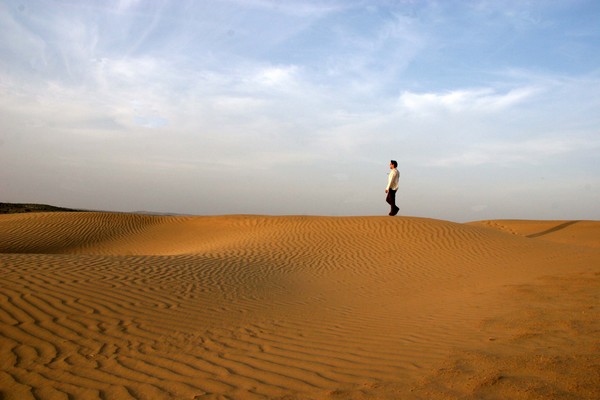
Our ‘safari’ into the Desert National Park aboard chapatti eating camels was an opportunity to get away from the mayhem – a silent night’s sleep under the stars was welcome. But even in this more remote and inhospitable environment the population size and pressure continues to grow. The government has improved water supplies recently but even now there seems to be pressure on the limited resources.
Travelorphan

Further south, the lake-side towns of Udaipur and Dungapur were much more relaxed than the manic Jaipur and Jodhpur. Here we had time to swim, and I to find out just how unforgivingly hard marble can be when when one lands on it back first. The grand finale of our tour was the majestic and ethereal Taj Mahal. It diffuses light like a cloud. And, I am adamant, it looks bigger the further you are away from it. Then it was back to Delhi for fond farewells and enlightening twilight conversations on the nature of being, reincarnation, Karma, Reike… Thanks to all the guys for their hospitality and the fun in Delhi.

Travelorphan

I decided not to take my camera with me – I wanted to free myself of as much technical paraphernalia as possible. So all the pics here are thanks to Erin – permalinks to the others she’s posted are listed below. Now, back to some work and preparations for my viva and impending departure for CSIS at MSU.

Picture Links:
Jaisalmer Sunset
Taj
Jaisalmer Fort
Henna
Pickpocket
Shooting Stars
Blessings
Flying James
Sunglasses
Train Station
Cricket
Shoes
Dancing
Palace View
Dancing2
Chapati
Dancing3
Jaisalmer

Rajasthani Pictures

A missed bus gives me a couple of minutes to get online to point you in the direction of Erin’s blog (http://travelorphan.blogspot.com) for some pictures of our Rajasthani gallivating (i.e. the pictures posted on March 29 2007 – permanent URLs to follow in a later post).

Briefly: Busy Delhi (no belly yet), Gangaur festival in Jaipur, lakeside downtime in Pushkar, Fort and pool in Jodhpur, street-cricket in Jaisalmer, camelback desert safari near Khuri, and now on to Udaipur, Bundi, Agra and Delhi (via this unintended stop-over in Jodhpur). More soon…

PhD Thesis Completed

So, finally, it is done. As I write, three copies of my PhD Thesis are being bound ready for submission tomorrow! I’ve posted a short abstract below. If you want a more complete picture of what I’ve done you can look at the Table of Contents and read the online versions of the Introduction and Discussion and Conclusions. Email me if you want a copy of the whole thesis (all 81,000 words, 277 pages of it).

So just the small matter of defending the thesis at my viva voce in May. But before that I think it’s time for a celebratory beer on the South Bank of the Thames in the evening sunshine…

Modelling Land-Use/Cover Change and Wildfire Regimes in a Mediterranean Landscape

James D.A. Millington
March 2007

Department of Geography
King’s College, London

Abstract
This interdisciplinary thesis examines the potential impacts of human land-use/cover change upon wildfire regimes in a Mediterranean landscape using empirical and simulation models that consider both social and ecological processes and phenomena. Such an examination is pertinent given contemporary agricultural land-use decline in some areas of the northern Mediterranean Basin due to social and economic trends, and the ecological uncertainties in the consequent feedbacks between landscape-level patterns and processes of vegetation- and wildfire-dynamics.

The shortcomings of empirical modelling of these processes are highlighted, leading to the development of an integrated socio-ecological simulation model (SESM). A grid-based landscape fire succession model is integrated with an agent-based model of agricultural land-use decision-making. The agent-based component considers non-economic alongside economic influences on actors’ land-use decision-making. The explicit representation of human influence on wildfire frequency and ignition in the model is a novel approach and highlights biases in the areas of land-covers burned according to ignition cause. Model results suggest if agricultural change (i.e. abandonment) continues as it has recently, the risk of large wildfires will increase and greater total area will be burned.

The epistemological problems of representation encountered when attempting to simulate ‘open’, middle numbered systems – as is the case for many ‘real world’ geographical and ecological systems – are discussed. Consequently, and in light of recent calls for increased engagement between science and the public, a shift in emphasis is suggested for SESMs away from establishing the truth of a model’s structure via the mimetic accuracy of its results and toward ensuring trust in a model’s results via practical adequacy. A ‘stakeholder model evaluation’ exercise is undertaken to examine this contention and to evaluate, with the intent of improving, the SESM developed in this thesis. A narrative approach is then adopted to reflect on what has been learnt.

Characterizing wildfire regimes in the United States

This post is my second contribution to JustScience week, and follows on from the first post yesterday.

During my Master’s Thesis I worked with Dr. Bruce Malamud to examine wildfire frequency-area statistics and their ecological and anthropogenic drivers. Work resulting from this thesis led to the publication of Malamud et al. 2005

We examined wildfires statistics for the conterminous United States (U.S.) in a spatially and temporally explicit manner. Using a high-resolution data set of 88,916 U.S. Department of Agriculture Forest Service wildfires over the time period 1970-2000 to consider wildfire occurrence as a function of biophysical landscape characteristics. We used Bailey’s ecoregions as shown by Figure 1A below.

Figure 1.

In Bailey’s classification, the conterminous U.S. is divided into ecoregion divisions according to common characteristics of climate, vegetation, and soils. Mountainous areas within specific divisions are also classified. In the paper, we used ecoregion divisions to geographically subdivide the wildfire database for statistical analyses as a function of ecoregion division. Figure 1B above shows the location of USFS lands in the conterminous U.S.

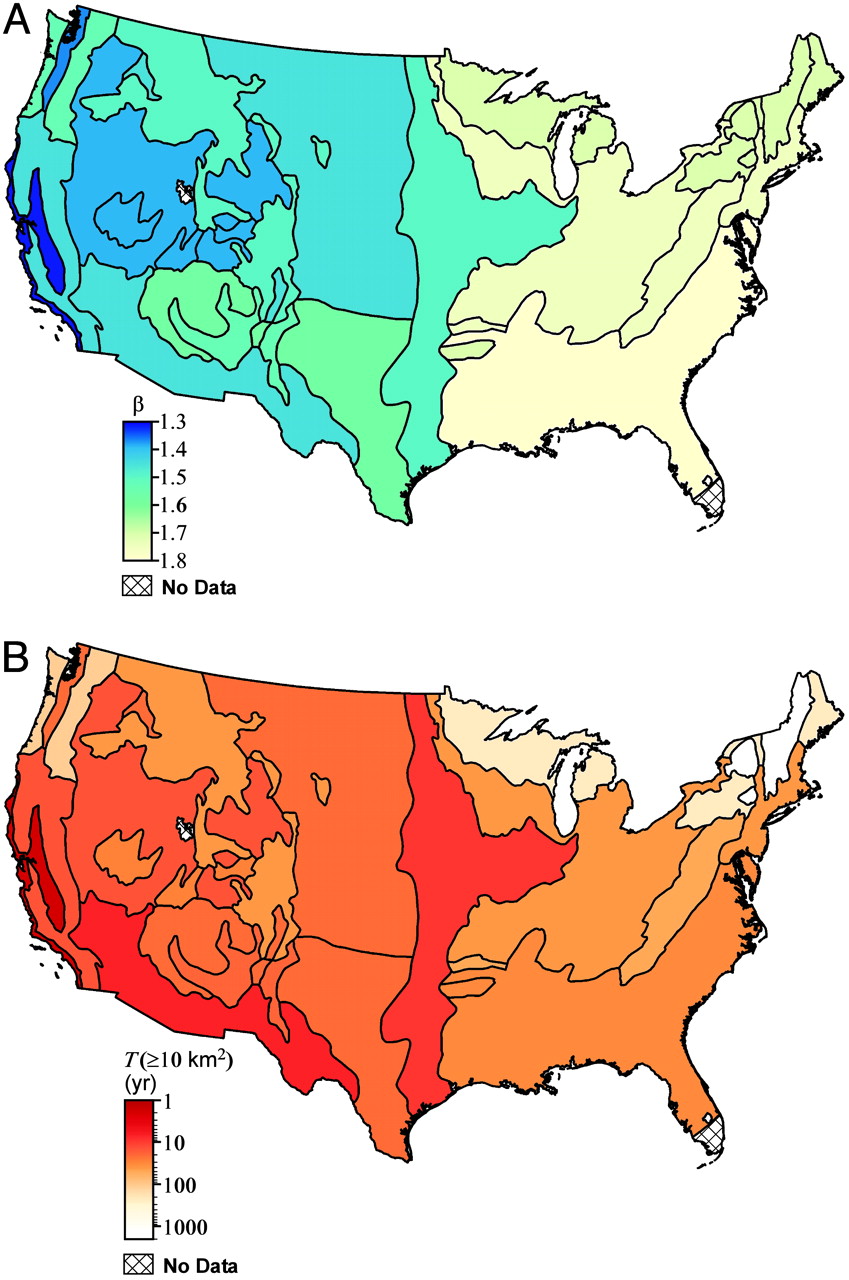
We found that wildfires exhibit robust frequency-area power-law behaviour in the 18 different ecoregions and used power-law exponents (normalized by ecoregion area and the temporal extent of the wildfire database) to compare the scaling of wildfire-burned areas between ecoregions. Normalizing the relationships allowed us to map the frequency-area relationships, as shown in Figure 2A below.

Figure 2.

This mapping exercise shows a systematic change east-to-west gradient in power-law exponent beta values. This gradient suggests that the ratio of the number of large to small wildfires decreases from east to west across the conterminous U.S. Controls on the wildfire regime (for example, climate and fuels) vary temporally, spatially, and at different scales, so it is difficult to attribute specific causes to this east-to-west gradient. We suggested that the reduced contribution of large wildfires to total burned area in eastern ecoregion divisions might be due to greater human population densities that have increased forest fragmentation compared with western ecoregions. Alternatively, the gradient may have natural drivers, with climate and vegetation producing conditions more conducive to large wildfires in some ecoregions compared with others.

Finally, this method allowed us to calculate recurrence intervals for wildfires of a given burned area or larger for each ecoregion (Figure 2B above). In turn this allowed for the classification of wildfire regimes for probabilistic hazard estimation in the same vein as is now used for earthquakes.

Read the full paper here.

Technorati Tags: , , , ,

Just Science Week

OK, so after a little deliberation I’ve signed up for Just Science week. In a response to the strong anti-science presence on the internet (global warming denialists, creationists, the anti-vaccination movement etc.), starting 5th February science bloggers will post about science only, with at least one post per day for the whole week. Issues which are favoured by anti-scientific groups (creationism, global warming, etc.) will be either avoided, or discussed without reference to anti-scientific positions.

The rationale behind this is that many science bloggers end up spending a fair amount of time combating the misinformation spread by anti-science groups at the expense of blogging about actual science. I generally don’t want to get embroiled in these sorts of arguments – I’ll leave it to those with much stronger feelings on the subject, know more about it and are generally much more organised.

What I am more interested in is the relationship between science and policy- and decision-making, specifically from modelling/environmental/resource management perspectives. I’m with Allen et al. (2001 p.484):


“The postmodern world may be a nightmare for … normal science (Kuhn 1962), but science still deserves to be privileged, because it is still the best game in town. … [Scientists] need to continue to be meticulous and quantitative. But more than this, we need scientific models that can inform policy and action at the larger scales that matter. Simple questions with one right answer cannot deliver on that front. The myth of science approaching singular truth is no longer tenable, if science is to be useful in the coming age.”

Just this week I’ve been considering how the recent work emerging from Demos, the UK thinktank, relates to my PhD research (more on this and this in the future no doubt). The Prometheus blog is great source of inspiration and for this sort of discussion too. But, in the interests of Just Science week I’ll try to steer clear of that stuff and focus on some my work on wildfire regimes (that I haven’t talked about in much detail here but have outlined on my website), recent publication in the environmental modelling literature, and also I’m thinking maybe a post on the Geography of Science (seeing as I am Geographer at heart…)

Generative Landscape Science

A paper from the recent special issue of Professional Geographer (and discussed briefly here) of particular interest to me, as it examines and emphasises an approach and perspective similar to my own, was that by Brown et al. (2006). They suggest that a generative landscape science, one which considers the implications microscale processes for macroscale phenomena, offers a complementary approach to explanation via other methods. Such an approach would combine ‘bottom-up’ models of candidate processes, believed to give rise to observed patterns, with empirical observations, predominantly through individual-based modelling approaches such as agent-based models. There are strong parallels between modelling in a generative landscape science approach and the pattern-oriented modelling of agent-based systems in ecology discussed by Grimm et al. (1995). As a result of the theory-ladeness of data (Oreskes et al. 1994) and issues of equifinality (Beven 2002) landscape modellers often find themselves encountering an ‘interesting’ issue (as Brown et al. put it):


“we may understand well the processes that operate on a landscape, but still be unable to make accurate predictions about the outcomes of those processes.”

Thus, whilst pattern-matching of (model and observed) system-level properties from models of microscale interactions may be useful for examining and explaining system structure, it does not imply prediction is necessarily possible. There is a distinction between pattern-matching for validation (sensu Oreskes and Beven) and pattern-matching for understanding (via strong inference), but it is a fine line. If we say, “Model 1 uses structure A and Model 2 uses structure B, Model 1 reproduces observed patterns at multiple scales more accurately than Model 2, so Model 1 is more like reality, and therefore we understand reality better”, we’re still left with the problems of equifinality.

And so (rightly IMHO) in turn, Brown et al. suggest that whilst the use of pattern-matching exercises to evaluate and interpret models will be useful, we should wary of an over-emphasis on these techniques at the expense of intuition and deduction. This perspective partly contributed to my investigation of the use of ‘stakeholder assessment’ to evaluate the landscape change model I’ve been developing as part of my PhD.

In conclusion Brown et al. suggest a generative component (i.e. exploiting individual- and process-based modelling approaches) in landscape science will help;

  • develop and encode explanations that combine multiple scales
  • evaluate the implicaitons of theory
  • identify and structure needs for empirical investigation
  • deal with uncertainty
  • highlight when prediction may not be a reasonable goal

This modelling approach adopts perspective that is characteristic of recent attitudes toward the uses and interpretation of models arising recently in other areas of simulation modelling (e.g. Beven in hydrology and Moss and Edmonds in social science) and is also resonant with perspectives arising from critical realism (without explicitly discussing ontology). As such their discussion is illustrative of recent trends environmental and social simulation with some good modelling examples from Elk-Wolf population dynamics in Yellowstone National Park, and places the discussion in a context and forum in which individuals with backgrounds in Geography, GIScience and Landscape Ecology can all associate.

Reference
Daniel G. Brown, Richard Aspinall, David A. Bennett (2006)
Landscape Models and Explanation in Landscape Ecology—A Space for Generative Landscape Science?
The Professional Geographer 58 (4), 369–382.
doi:10.1111/j.1467-9272.2006.00575.x

Technorati Tags: , , , , , , ,

Spring Conferences

The preliminary program and schedule of sessions for the 2007 AAG (Association of American Geographers) National Meeting in San Francisco, April 17-21, is now available online.

It looks like I should have some time during April, and several colleagues from King’s Geography Dept. are going to San Francisco, so it might be good to go. Unfortunately, I wasn’t banking on having the opportunity so I haven’t submitted anything to present.

The alternative would be to go to the EGU (European Geophysics Union) General Assembly 2007 in Vienna, Austria, 15 – 20 April. I’m second author on a poster due to be displayed there:

Spatial analysis of patterns and causes of fire ignition probabilities using Logistic Regression and Weights-of-Evidence based GIS modelling
Romero-Calcerrada, R. and Millington, J.D.A
Session NH8.04/BG1.04: Spatial and temporal patterns of wildfires: models, theory, and reality (co-organized by BG & NH)

I’ll have a think about it…

Technorati Tags: , , , , , ,

RGS-IBG 2007 Call for papers

The on-line registration procedure for abstract submission for the Royal Geographical Society (with IBG) Annual International Conference 2007 is now ready and the call for papers has begin.

The conference has the theme “Sustainability and Quality of Life” and is to be held at the RGS-IBG and Imperial College in London, from 28-31 August 2007 with the first papers being presented on 29 August.

Details of accepted sessions can be found here (scroll to bottom to view .pdf version of all sessions) and details of how to submit an abstract found here. All abstracts need to be received on-line by the revised deadline of Thursday 1 March 2007 (previously advertised as 14 February 2007).

The RGS Postgraduate Forum will be sponsoring the following sessions:

  • Postgraduate Research
    (Sponsored by the PGF)
  • Postgraduate Research in Urban Geography
    (Jointly sponsored by the Urban Geography Research Group and the PGF)
  • Postgraduate Research in Applied Quantitative Geography
    (Jointly sponsored by the Quantitative methods Research Group and the PGF)
  • Postgraduate Research on Planning, the environment and sustainable development
    (Jointly sponsored by the Planning and Environment Research Group and the PGF)

Each of these session is designed to provide postgraduate students at any stage of their career, the opportunity to present their research and obtain constructive feedback in a supportive environment.

Landscapes as Kaleidoscopes

A recent special issue of The Professional Geographer focuses specifically on the integration of theory and methods from Landscape Ecology and Geographic Information Science (GIScience). Entitled “Landscape Form, Process and Function: Coallescing Geographic Frontiers”, the six papers arose from the Centennial meeting of the 2004 Association of American Geographers and span the application-theory (e.g. Mast and ChambersMalanson et al. respectively) and the GIScience-Landscape Ecology (e.g. Southworth et al.Young and Aspinall respectively) spectra.

The general message is that the integration of method and theory GIScience and Landscape Ecology offers the opportunity to better examine and understand the interactions of pattern, process and landscape change. Concluding the special issue, Young and Aspinall use the metaphor of landscapes as kaleidoscopes;


“… a kaleidoscope serves as an engaging metaphor in this context because of its visualization of fragments, shreds, patches, and filaments that create a host of mosaics. A kaleidoscope creates these and other patterns and then shifts them, changing one set of forms into another, by altering colors and the locations of edges, thereby changing the appearances, sizes, and spatial distributions of the fragments. This device captures some of the complexity and shifting dynamics of the forms that characterize the Earth’s land surfaces. It would be difficult, but feasible, to record, measure, and otherwise describe those changes taking place within a kaleidoscope. It might even be possible to predict future patterns, or at least bracket the possible forms and patterns that could occur by tracking changes through time. Rather than a person creating these patterns by rotating a colorful tube, however, it is the landscape-forming and landscape-transforming processes that do so in reality.”

But in the majority of contemporary landscapes it is people rotating the landscape. Those landscape-forming and landscape-transforming processes are people-driven. The emphasis in this special issue is still largely presented from a formal (spatial) scientific perspective in the tradition of American Landscape Ecology, emphasising technical and philosophical approaches for examining patterns and processes. Given Professional Geographer is the forum and journal of the Association of American Geographers this is understandable and these approaches will surely improve and enhance our ability to examine and understand landscape change. However, landscape is an intrinsically holistic concept and change is often due to the interplay of both biophysical and human causes. Alongside furthering our technical abilities to study changing landscapes we need to continue to develop innovative approaches that consider the more humanistic side of landscape change and integrate them with the technical tools. Computer models, satellite imagery and the tools of GIScience are and will continue to be useful to monitor, evaluate and project change in their own right, but increasingly we need to find and develop ways that incorporate and include the humans turning the kaleidoscope.

country of citizenship?

What nationality do you say you are when you’re in a foreign country and people ask you where you’re from? Not such a straightforward question for people from the UK – for example, 48% of people living in England describe themselves as British versus 27% in Scotland and 35% in Wales. In the UK 50% of people regard themselves as as either English, Scottish, Welsh or Irish only, just less than a third as British only, and the remainder giving different combinations of British and other nationalities. (And this all disregards the tricky questions of ethnicity and religion)

Personally I’d say I would fall in this last category, I’m British-English. When in Britain I’m English. As I move further away I become less English and more British. I probably become more European the further I move away from Europe too. That’s understandable isn’t it? – as the spatial distance increases the spatial resolution of your answer increases. If pressed you can become more precise.

But why the two, British AND English? Well, I feel British, my culture and history are British, and I can move freely around these isles and feel at home. But I still recognise there are differences between the countries, culturally and socially. But also, I think (for me at least) sport is important. Sport is important to me in its own right but I think it also reflects quite well one of the reasons I would distinguish my Englishness from my Britishness. There are great rivalries between the Football and Rugby teams of England, Scotland, Wales and N. Ireland. Sport generates pride in your team, and when your team represents your ‘nation’ you have pride in that place. The Six Nations is a fantastic tournament and a prime example of this. When England are in the World Cup, England goes crazy. Whilst I’ve never been there during a World Cup I’m sure the fervour is less ardent in Scotland when England are competing but Scotland aren’t… At the Olympics we compete as Great Britain (that’s OK none of us would get very far individually!?) but we don’t enter a GB Soccer team. The individual Football Associations are worried that their status as footballing nations would be weakened if a GB team were ever fielded. It looks like there’s going to be a GB team for the 2012 Olympics in London, but I’d doubt many ‘real’ football fans will be too interested.

But what about where I’m from legally? I was filling out a form this week in which there were four boxes regarding the legal status of where I come from (this is what got me thinking about all this). Four boxes:

1. City of Birth:
2. Country of Birth:
3. Country of Citizenship:
4: Country of legal permanent residence:

The first was straightforward (Bristol), as was the second really (England). But the final two were a little more tricky. The immigration cards you get on an aeroplane usually ask for your nationality. But my country of citizenship? Is Britain a country? Isn’t the “United Kingdom of Great Britain and Northern Ireland” the official name of this country? Can I be UK-ish? And my country of legal permanent residence? England? Britain? UK? I found some help here and filled out the boxes.

So what is my “country of citizenship”? I don’t think I have one. It’s a question that doesn’t work if you’re a British citizen.

Categories: , , , ,