25 Years of Landscape Ecology


This year marks the 25th anniversary of the establishment of the International Association for Landscape Ecology and the 20th anniversary of the first publication of the journal Landscape Ecology. To highlight these landmarks several guest editorials appear in the latest edition of the journal (which has swelled from around 250 pages per year to almost 1,400).

Jianguo Wu briefly describes how the field of landscape ecology was first envisioned by Carl Troll as the integration of geographic and ecological disciplines, defining it as:

“the study of the main complex causal relationships between the life communities and their environment” which “are expressed regionally in a definite distribution pattern (landscape mosaic, landscape pattern)” (Troll 1971).


As such, the other invited Editorials discuss the need to remain holistic. As I’ve mentioned before, reading about the vision of a holistic landscape ecology is one of the reasons I’ve ended taking the route I have. Zev Naveh emphasises the need for landscape ecology to be a ‘transdisciplinary science of landscape sustainability’, providing pragmatic information for decision-making and becoming become a ‘post-normal’ prognostic and normative science.

Paul Opdam continues this discussion, highlighting the need for landscape ecologists to develop skills and techniques for transferring knowledge from science to the world of the actors in policy, planning, design and management. This knowledge transfer will be most successful if based on a science that provides credibility, saliency and legitimacy by considering the integrations of landscape systems as a whole. Thus holistic nature will then contribute to decisions based on principles of sustainable management of our landscapes.

However, Marc Antrop highlights that this potential has yet to be fully realised. The practical applications of landscape ecology in planning and policy making remain inadequate, the main problem lying in the (poor) communication to non-landscape ecologists. Landscape ecology will continue to provide insight into the functioning of interacting social, ecological, economic, and environmental systems at the landscape level. If it does become more prescriptive, as these Editorials suggest it must, it will also begin to contribute more obviously directly to the sustainable management of the landscapes in which we live.

detroit river vs the thames

I’ve been busy recently. Those comments on the CHANS Science paper will follow soon, promise.

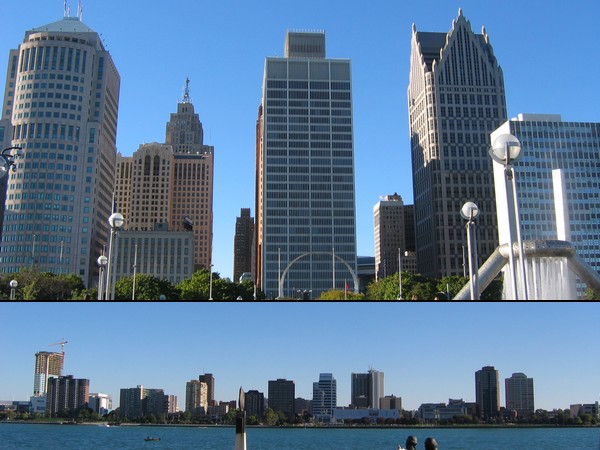
For now here is a grossly unfair, and probably invalid, comparison (but this is how it felt just looking whilst stood there). On one side of Detroit River is its namesake, Detroit, Michigan (top). On the other side lies Windsor, Ontario (bottom).


Looking across the river, whilst stood on the US side after walking through the large office blocks built when the city was at the centre of the automotive world, it felt a little like looking out at Rotherhithe from the Isle of Dogs. But Detroit and GM aren’t doing quite as well as Canary Wharf and I doubt whether the Windsor-Rotherhithe comparison is fair either. Anyway…

More vaguely interesting pics on the pictures page soon.

The Role for Landscape Ecology in Poverty Relief

In the latest issue of Landscape Ecology, Louis Iverson suggests landscape ecologists have a role in poverty relief. Reviewing SachsThe End of Poverty: Economic Possibilities for our Time, Iverson believes the book ‘should motivate additional research and implementation of principles within landscape ecology into this critical arena’ and argues that landscape ecologists‘can provide expertise to efficiently use funds to the greatest value and to research sustainable, integrated pathways to development’. After discussing several aspects of the current state of the global poverty problem (poverty statistics, water scarcity, Millennium Development Goals, environmental constraints on development), Iverson suggests landscape ecologists can contribute to these issues by;

  1. Modelling the impacts and possible mitigation of climate change on water and agricultural production, especially in the most vulnerable zones with high levels of extreme poverty
  2. Creating innovative, landscape-level systems for efficient water use, agricultural production, and infrastructure in the zones of extreme poverty
  3. Working towards sustainable management of ecosystems, especially fragile ecosystems, that are deteriorating due to human pressures
  4. Assisting in planning for urban growth that also sustains agriculture productivity using appropriate water, soil, and food management systems
  5. Building models of low-cost but sustainable means of protection against natural or technological disasters, especially storms, floods, and droughts (climate-related disasters)
  6. Designing infrastructure and energy improvements in developing countries with maximum positive human impact and minimum negative environmental impact
  7. Working to better understand the diseases of the poor and spatial and temporal relationships of these diseases
  8. Working to understand how over-consumption and excessive wealth contributes to environmental degradation and poverty elsewhere in the global landscape, and propose/model remedial solutions
  9. Developing partnerships with ecologists, economists, landscape architects, wildlife managers, and land managers in developing countries that make a difference
  10. Seeking out students from poor countries who can provide direct linkages to projects back in their home countries
  11. Assisting in land-use and urban planning efforts where practical and feasible, focusing on improving conditions for slum dwellers
  12. Working to help influence decision-makers to realize that investments toward the goals outlined above are well spent and the right thing to do


More inspiration, if it were needed, to continue this field of research…

bristol balloon fiesta

I just spotted that this weekend is Bristol’s Annual International Balloon Fiesta, Europe’s biggest. The night glows are always good fun – check the video below from last year:


If the wind is in the right direction the balloons drift across the city and land somewhere between Bristol and Bath. Sometimes they don’t make it – I remember when I was about 7 or 8 a balloon landed on my primary school field as we were walking to school in the morning (they take off twice a day, the first at dawn). Pretty exciting! I’ve never taken a hot air balloon ride but I think I’ll have to one day. It looks like graceful way to travel, looking out over the West Country landscape.

The Wilderness Ideal

One evening whilst sitting on a deck overlooking a tranquil lake in the wilds of the UP’s northern hardwood forests, I began reading William Cronon’s contributions to the volume he edited himself; Uncommon Ground. The book has been around for a decade and more but it is only recently that I came across a copy in a secondhand book store. It seems apt that I considered what it had to say about the ‘social construction’ of nature in a setting of the type that has long intrigued me. Maybe the view of a landscape which confronted me is another of the reasons I am doing what I am right now. I have had pictures of these large wilderness landscapes on the walls of my mind, and elsewhere, for a while.

Cronon examines “the trouble with wilderness” with reference to the Edenic ideal that underlay it from the beginning. Wordsworth and Thoreau were in bewildered or lost awe of the sublime landscapes they travelled, but by the time John Muir came to the Sierra Nevada the landscape was an ecstasy. Whilst Adam and Eve may have been driven from the garden out into the wilderness, the myth was now ‘the mountain as cathedral’ and sacred wilderness was a place to worship God’s natural world. Furthermore, as the American frontier diminished with time and technology,

“wilderness came to embody the national frontier myth, standing for the wild freedom of America’s past and and seeming to represent a highly attractive natural alternative to the ugly artificiality of modern civilization. … Ever since the nineteenth century, celebrating wilderness has been an activity mainly for well-to-do city folks. Country people generally know far too much about working the land to regard unworked land as their ideal.” (p.78)

Cronon suggests that there is a paradox at the heart of the Wilderness ideal, this conception that true nature must also be wild and that humans must set aside areas of the world for it to remain pristine. As Cronon puts it, this paradox is that “The place where we are is the place where nature is not”. Taking this logic to its extreme results in the need for humans to kill themselves in order to preserve the natural world;

“The absurdity of this proposition flows from the underlying dualism it expresses. … The tautology gives us no way out: if wild nature is the only thing worth saving, and if our mere presence destroys it, then the sole solution to our own unnaturalness, the only way to protect sacred wilderness from profane humanity, would seem to be suicide. It is not a proposition that seems likely to produce very positive or practical results.” (p.83)

I’ll say. But Cronon is not saying that protected wilderness areas are themselves undesirable things, of course not. His point is about the idea of Wilderness. As a response he suggests that rather than thinking of nature as ‘out there’, we need to learn how to bring the wonder we feel when in the wilderness closer to home. We need to abandon the idea of the tree in the garden as artificial and the tree in the wilderness as natural. If we see both trees as natural, as wild, then we will be able to see nature and wildness everywhere; in the fields of the countryside, between the cracks in the city pavement, and even in our own cells.

“If wildness can stop being (just) out there and start being (also) in here, if it can start being as humane as it is natural, then perhaps we can get on with the unending task of struggling to live rightly in the world – not just in the garden, not just in the wilderness, but in the home that encompasses both” (p.90)

Sitting on that deck looking out over the lake it was clear that landscapes such as the one I was in aren’t the idealised, pristine, wilderness that they may be portrayed as in books, photographs and travel brochures. Just as in studying its nature I have come to understand a little better the uncertainties of the scientific method that is supposed to bring facts and truth, so I think have come to better understand the place of human needs within these ‘wild’ landscapes. As naive as it is to think that science might offer the absolute truth (it can’t, but it is still the best game in town to understand the world around us), thinking humans are inseparable from nature seems equally foolish.

In the introduction to a book on natural resource economics (which has mysteriously vanished from my bookshelf), an author describes a similar situation. As a young man he wanted to study the environment in order that he might save it from destructive hands of humans. But in time he came to realise this was unrealistic and that better would be to study the means by which humans use the ‘natural world’ to harvest and produce the resources we need to live. Economics is concerned with the means by which we allocate, and create value from, resources. Just as it is important to understand how ‘nature’ works, it is also important to understand how a world in which humans are a natural component works, and how it can continue to function indefinitely.

Landscape Ecology and Ecological Economics have grown out of this understanding. Whilst theories and models about the natural world independent of humans remain necessary, increasingly important are theories and models that consider the interaction between the social, economic and biophysical components of the natural world. These tools might help us get on with the task of living sustainably in the place which humans should naturally call home.

Buy on Amazon

Homogenization of the northern U.S. Great Lakes Forests

An email sitting in my inbox this morning directed me toward an article in the latest issue of Landscape Ecology that directly addresses one of the issues I touched on in Saturday’s post; the ‘Maple-ization’ of the western UP Northern Hardwood forests via selective forest harvest and the resulting feedbacks with whitetailed deer populations.

Lisa Schulte and colleagues examined the regional-scale impacts of human land use in the northern U.S. Great Lakes region. They found an overall loss of forestland, lower forest species diversity, functional diversity, and structural complexity compared to pre-Euro-American settlement forests.

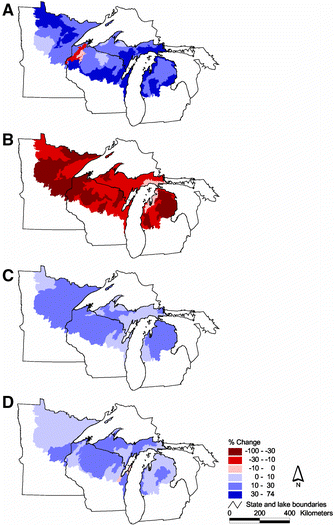
Generally, they found evidence of shifts from evergreen conifer (-27.0%) to deciduous hardwood (+22.8%) species between pre-Euro-American settlement and the present time. Specifically, they found marked increases in Aspen (+12.8%) and Maple (+10.1%) and decreases in Pine (-17.5%) and Hemlock (-11.3%) across the area as a whole. However, increases in northern hardwood species were not uniform, and Beech and Birch have decreased (~4% each).


A figure from their paper (above) maps the change in ecoregion characteristics for (A) the extent of open vegetation, (B) dominance of conifers, (C) dominance of aspen (combined Populus tremuloides and P. grandidentata), and (D) dominance of maple (combined Acer saccharum and A. rubrum).

In their discussion the authors (p.1100-01) go on to describe the issues present in our study area;

“Although forests have largely been reestablished across northern portions of the region [following destructive logging in the late 19th century], these forests are on a new trajectory of change rather than recovery toward pre-Euro-American conditions . We attribute lack of recovery to legacies associated with the initial, severe land use conversion, the persistent over-abundance of a keystone herbivore (white-tailed deer), and related management practices that are inattentive to processes that historically promoted vegetation diversity within the region.

The excessive deer abundance at present is a feedback of regional forest management; whitetailed deer at high densities are now regarded as a major threat to forest biodiversity and regeneration in the region and elsewhere (Rooney et al. 2004). The commercial logging that is now the most frequent and widespread forest disturbance across the region largely fails to mimic either the local or landscape effects of the historically prevalent disturbances of windthrow and fire (Mladenoff et al. 1993; Scheller and Mladenoff 2002). Rather, current practices of aspen clearcutting and single-tree selection in maple stands continues to foster this divergence and simplification of the forests by largely favoring their regeneration over a greater diversity of tree species (Crow et al. 2002).”

As I discussed just the other day, we’ll be using the model we’re currently developing to examine spatial scenarios directly related to this issue. For example one aim is to examine scenarios of forest management that allow the recreation of historical herbivore disturbance via spatial patterns of vegetation whilst ensuring the future economic sustainability of the forests.

Reference
Schulte, L.A., Mladenoff, D.J., Crow, T.R., Merrick, L.C., and Cleland, D.T. (2007) Homogenization of northern U.S. Great Lakes forests due to land use Landscape Ecology 22:7 1089-1103

Usefulness of Spatial Landscape Models

Turner et al.’s discussion about the usefulness of spatial models in land management is now a bit of a classic (written in 1995) but it had also been a while since I read it. Re-reading it after coming back from a trip to our study area, many of the paper’s points resonated with what people (many of them natural resource managers) I met with were saying.

Turner et al. suggest that (p.13) “Models that integrate ecological and economic components so that the models can be used to explore both sets of consequences simultaneously are even more valuable [than ecological alone]”. This is the driving rationale for our research project. As it was succinctly put by one potential landowner in the study area, models of this kind will contribute to the development of plans that are based on an ecological approach but backed up with economic justification.

Given the hierarchical nature of landscape ecological processes and the importance of human activity on those processes, Turner et al. highlight (p.15) that “Land ownership has a large impact on management decisions, and a useful contribution of spatially explicit models is the ability to explore the effects of management by various owners within a mosaic of public and private lands.” With a range land owners, including the state and private industrial companies, the UP study area is in this position and the model we are developing will be able to directly consider the impacts of different land owner management strategies for the landscape as a wider region. Thus, one of the driving questions of the research is “how should timber be harvested across space and time in multiple land ownerships to ensure a sustainable landscape?”

One of the most striking things I was told on my trip was that the most useful thing our model would be able to do for land managers would be if it could get people to sit down together to come up with a coherent, sustainable management plan. Again, the links with Turner et al. are clear (p.15); “Communication between land managers and ecologists remains an important challenge, and spatially explicit models have the potential to create a common working framework.”

However, not only is the communication and collaboration side of the research a challenge, but so too is the technical side of things. Turner et al. highlight the issue of data quality; the model will only be as good as the data used and the accurate up-to-date spatial data bases required are expensive to produce. Furthermore, the quality of the data will determine the modeller’s ability to parameterizes the model at a given spatial resolution and extent. I’m currently reviewing the data that has been collected over the past few years by the research group at CSIS regarding the interactions between deer density, tree regeneration and bid habitat, but also the data managed and made available by Michigan’s Department of Natural Resources. Producing an accurate representation of deer population dynamics and movement across the landscape is certainly going to be a challenge. Next, the relationships between deer browse pressure and vegetation regeneration need to be specified and parameterized. The estimates of deer population and location can then be combined with these relationships to dynamically represent the interactions across space.

Once the model is up and running we will be able to examine spatial scenarios of forest management to assess both ecological and economic sustainability. For example, with regard to the appropriate location of mesic confer regeneration “…increasing the [mesic confer] component is expected to increase the number of individuals of conifer-associated bird species. And over time reduce productivity of the summer deer range and expand areas potentially suitable for deer during winter, resulting in a smaller deer herd dispersed over a larger wintering area (Doepker et al, 2001) in turn resulting in less browsing pressure in WUP forests. The eventual size, configuration, contiguousness and/or juxtaposition of restored habitats to existing or historical mesic conifer habitats and winter deer-yards on non-MDNR lands (public and private) may affect the success of these outcomes” (DNR 2004). Right now this confer regeneration is not going well and areas of maple forest are increasing.

Economically, the model should be able to show how different harvest rotations and management plans by private industrial land owners can ensure the most productive use of their land whilst ensuring both ecological and economic sustainability of the landscape. And not only for single landowners. The model should be useful to examine how actions of neighbouring land under differing ownership can work in concert. For example, if the private industrial goal is intensive harvest, maybe the primary objective of the state should be to ensure conifer cover. But the question then is what are the spatial implications of this? Is there any point in confer regeneration (which provides thermal cover for deer in the winter) if the distance between state and corporate land is large and deer cannot move from thermal cover to find food?

These are the sorts of questions and challenges to which spatial landscape models can be applied, and which we are aiming to tackle. Right now though, it’s time to concentrate on the technical development of the model and the representation of the spatio-temporal deer-vegetation interactions.

Reference
Turner, M.G., Arthaud, G.J., Engstrom, R.T, Hejl, S.J., Liu, J., Loeb, S. & McKelvey, K. (1995) Usefulness of Spatially Explicit Population Models in Land Management Ecological Applications, 5:1 12-16.

US-IALE 2008 – Call for Symposium Proposals

United States Regional Association of the International Association for Landscape Ecology (US-IALE) 23rd Annual Symposium
April 6-10, 2008
Madison, Wisconsin
Landscape Patterns and Ecosystem Processes

Call for Symposium Proposals
Proposals for symposia will be accepted at any time before September 7. If you are interested in submitting a proposal, please contact the Program Chair, Sarah Goslee. The proposal should include a symposium title, objective, a list of speakers and titles in the order in which you wish them to occur, and the length of each talk (including questions). Talks in symposia need not be the standard 20-minute length, but we ask that you arrange your schedule so that there is a transition on the hour. Please send your proposal to ialeProgram@gmail.com with the subject line “Symposium Proposal”. Once the symposium s accepted, each speakers will be required to submit an abstract following the procedure for regular abstracts (which will be due November 2).

This year we will also accept symposium proposals which include time for relevant talks drawn from the pool of regular submissions. These additional talks will be chosen by the Program Committee with the approval of the symposium organizer. Please note in your proposal whether you are willing to include additional presentations.

All presenters, whether presenting in a symposium, oral or poster session, must register by the early registration deadline or their presentations may be dropped from the program. The early registration deadline will be March 6, 2008. Acceptance letters will be sent out no later than the end of December to allow for plenty of time to meet this requirement. Please contact the Program Chair at ialeProgram@gmail.com with any questions.

Further information at the 2008 US-IALE Annual Symposium homepage

Initial Michigan UP Ecological Economic Modelling Webpage


We now have a very basic webpage online, (very) briefly outlining the Michigan UP Ecological-Economic Modeling project. This is just so that we have an online presence for now – in time we will develop this into a much more comprehensive document detailing the model, its construction and use. Hopefully, at some point in the future we’ll also mount a version of the model online. I’ll keep you posted on the online development of the project.

The Importance of Land Tenure

The Economist today highlighted some recent work by Dr Thomas Elmqvist of Stockholm University. Using a combination of Landsat satellite imagery and interviews and surveys with locals in Madagascar, they examined whether human population densities or land tenure systems were more important for determining patters of tropical deforestation.

“From the Landsat images they were able to distinguish areas of forest loss, forest gain and stable cover. Different parts of Androy exhibited different patterns. The west showed a continuous loss. The north showed continuous increase. The centre and the south appeared stable. Damagingly for the population-density theory, the western part of the region, the one area of serious deforestation, had a low population density.

This is not to say that a thin population is bad for forests; the north, where forest cover is increasing, is also sparsely populated. But what is clear is that lots of people do not necessarily harm the forest, since cover was stable in the most highly populated area, the south.

The difference between the two sparsely populated regions was that in the west, where forest cover has dwindled, neither formal nor customary tenure was enforced. In the north—only about 20km away—land rights were well defined and forest cover increased. As with ocean fisheries, so with tropical forests, everybody’s business is nobody’s business.”

Land tenure (spatial) structure was one of the variables I examined in my agent-based model of agricultural land-use decision-making in Spain. I found that whilst the neighbourhood effects were evident in patterns of land-use due to land tenure, market conditions were the primary driver of change (NB land-use/cover change in the traditional Mediterranean landscape I examined is of a markedly different type).