US-IALE 2010 Notes

The 25th US-IALE annual meeting I attended in Athens, Georgia, a couple of weeks ago was notable for the presence of so many important figures in the field of landscape ecology. Several gave interesting plenary talks and the Presidents Symposium had presentations by many of the previous US-IALE Presidents and past editors of the journal Landscape Ecology. I also attended interesting presentations and discussion in the wildfire symposium and elsewhere.

Plenary Presentations
In the introductory plenary Profs. Richard Forman, Gary Barrett and Monica Turner gave their views on the origins and state of the field. Forman described his PhD work, rooted in the theory of island biogeography, in a Pine barrens landscape. He told how he suddenly realised he had been ignoring the context of his ‘islands’ and decided to look at how he might consider his study area as a landscape of patches arranged in a mosaic. He also talked about the ‘ecumenicalism of landscape ecology’ and how it is an important field for the development of interdisciplinary human-environment research.

Barrett spoke about the importance of the Allerton Park meeting in 1983 and the relationship of landscape ecology to the LTER network. He highlighted that landscape ecology is a ‘meeting point of [ecological] theory and application’ and the creation of the journal Ecological Applications (but also noted the creation 27 years earlier of the Journal of Applied Ecology).

Turner, the organiser of the very first US-IALE meeting, pointed out how similar current research themes are to those of 25 years ago. Questions still of relevance to landscape ecology include those about the relative importance of different drivers of ecological patterns and the importance of heterogeneity for driving ecosystem processes and species interactions.

Of the other plenary presentations, I found Joe Tainter’s presentation very interesting. His ‘big’ talk discussed the rise and fall of civilisations from the perspective of social and cultural complexity and Energy Return On Energy Investment (EROEI). He highlighted that sustaining complex societies requires a high EROEI and used the Roman and Byzantine Empires as examples to illustrate this. He stressed that sustainability is an active condition of problem solving – the capacity for which must itself be sustained – and questioned whether renewable energy resources (such as solar and wind power) have sufficient EROEI to allow us to do that in the future.

Presidents Symposium
In the Presidents Symposium, Jianguo Wu provided a pluralistic and hierarchical perspective of landscape ecology. Wu argued that the goal of landscape ecology should not just be about reporting on landscapes but about changing them. He also argued that the human landscape is the ‘most operational spatial scale for sustainability science’. He highlighted the formation of two new sections in the landscape ecology journal; ‘Landscape Ecology in Review’ and ‘Landscape Ecology in Practice’.

These issues were taken up later in the same session by Paul Opdam who discussed the transfer of pattern-process knowledge to society (as he wrote about with Joan Iverson Nassauer). He argued that there are three ways to do this; i) by asking questions about how our scientific knowledge is used in practice by planners, managers and stakeholders, ii) developing methods by testing them in practice, and iii) co-producing knowledge with non-scientists. He also argue that practical application of knowledge is the key methods for the ‘learning scientist’ and that research along these lines would be welcomed in the Landscape Ecology in Practice section of the journal.

Wildfire Symposium
The wildfires session contained some familiar faces. Rachel Loehman and Maureen Kennedy presented progress on their wildfire-related models and Don McKenzie outlined his efforts to take much of the recent work towards a coherent ‘theory of landscape fire’. The key elements to this theory he suggested would be energy, regulation (management) and scaling. In particular he emphasizes that we need to work hard on understanding the importance of landscape memory and the legacy of previous wildfire events on future ones.

Particularly encouraging to see was the work by Paul Hessburg and Nick Povak on self-organization and wildfire scaling in California (using data for 1950-2007). They argued that broken-stick regression is needed to represented their wildfire frequency-area data, as scale free power-law behaviour is only present across about two orders of magnitude in the medium size fires. At the lower end of the frequency-area distribution (smaller, frequent fires) they suggested bottom-up controls on the wildfire regime due to insects, stand dynamics and topography, and at the upper end of the frequency-area distribution (larger, infrequent fires) they suggested top-down controls on the wildfire regime due to climate and geology. This work examining the drivers of different wildfire regime scaling statistics certainly seems to be the way to go.

Other Discussions
My presentation seemed to go down well and I got some interesting questions. Frederik Doyon of Université du Québec en Outaouai was particularly interested in our work in the mixed hardwood-conifer forests of Michigan. Also in my session, Maria Santos presented her work comparing culture and ecology between the Mediterranean oak woodland landscapes of Portugal and California. We discussed some of the links between her work and my PhD research.

All round it was a good meeting with some interesting discussions in the various plenary session, symposia and in the pub. Here’s to another 25 years of US-IALE.

US-IALE 2010 Preparation

Next week is the Twenty-fifth Anniversary Symposium of the US chapter of the International Association of Landscape Ecology (US-IALE). I’ll be in attendance in Athens, Georgia and am currently working on my presentation, entitled Ecological-economic modeling for sustainable forest management (scheduled for Thursday 8th, 2.20pm in room T/U). In the context of our larger modelling project I’ll present work we’ve published, stuff we’re still working on, and the initial results from putting it all together.

Several symposia have been organised and I plan to be at those that consider landscape ecology and wildfires, bioenergy and land-use change, and climate change and landscape connectivity. Particularly interesting should be Don McKenzie’s presentations on ecosystem energetics and scaling laws in the wildfire symposium and Paul Opdam’s presentations on Natura 2000 and the role of landscape ecology in the climate change symposium. Two of the plenary addresses I’d like to catch are Collapse and Sustainability: Lessons from History (Joseph A Tainter) and Linking Renaissance Ecologists with Citizen Scientists to Advanced Scientific Research and Literacy (Carol Brewer).

As usual CSIS has a strong presence at US-IALE this year with seven presentations, including the insights of Jack Liu and Wu Yang into the challenges and opportunities for landscape ecology and conservation in coupled human natural research, the analysis by Andres Vina and Xiaodong Chen of the potential conservation benefits that might be offset by natural disasters, Mao-Ning Tuanmu’s work on Giant Panda habitat and the work by Pete Esselman and Dana Infante on the National Assessment of the Status of Fish Habitat. The full list of CSIS presentations is below.

It’s shaping up to be a good couple of days! I’ll try to tweet and blog some thoughts as they arise during the conference and maybe reflect on things afterwards also.

CSIS Presentations at US-IALE 2010
6th April
Are conservation benefits offset by natural disasters? — The case of the May 12, 2008 Wenchuan Earthquake. Andrés Viña, Xiaodong Chen, Wei Liu, et al.

Coupling human and natural systems: Challenges and opportunities for landscape ecologists. Jianguo Liu

The spatial framework and results of the initial National Assessment of the Status of Fish Habitat. Peter C Esselman, Dana M Infante, et al.

7th April
Effects of human-environment relationships on the spatiotemporal dynamics of giant panda habitat. Mao-Ning Tuanmu, Wei Liu, Andrés Viña, et al.

8th April
Ecological-economic modeling for sustainable forest management. James D A Millington, Michael B Walters, Megan S Matonis, et al.

Mechanisms for effective conservation in coupled human-natural systems. Wu Yang, Wei Liu, Mao-Ning Tuanmu, et al.

Patterns and drivers of reforestation: A case study in the Qinling Mountains, China. Yu Li, Andrés Viña, Jianguo Liu

Bird Occupancy Modelling

Birds have been given short shrift in my posts blog posts about the Michigan UP ecological-economic modelling project. It’s not that we have forgotten about them, it’s just that before we got to incoporating them into our modelling there were other things to deal with first. Now that we’ve made progress on modelling deer distribution it’s time to turn our attention to how we can represent the potential impacts of forest management on bird habitat so that we might better understand the tradeoffs that will need to be negotiated to achieve both economic and ecological sustainability.

Ovenbird (Seiurus aurocapillus)

One of the things we want to do is link our bird-vegetation modelling with Laila Racevskis‘ assessment of the economic value of bird species she did during her PhD research. Laila assessed local residents’ willingess-to-pay for ensuring the conservation of several bird species of concern in our study area. If we can use our model to examine the effects of different timber management plans (each yielding different timber volumes) on the number of bird species present in an area we can use Laila’s data to examine the economic tradeoffs between different management approaches. The first thing we need to do to achieve this is be able to estimate how many bird species would be present in a given forest stand.

Right now the plan is to estimate the presence of songbird species of concern in forest stands by using the data Ed Laurent collected during his PhD research at MSU. To this end I’ve been doing some reading on the latest occupancy modelling approaches and reviewing the literature on its application to birds in managed forests. Probably the most popular current approach was developed recently by Darryl Mackenzie and colleagues – it allows the the estimation of whether a site is occupied by a given species or not when we know that our detection is imperfect (i.e. when we know we have false negative observations in our bird presence data). The publication of some nice overviews of this approach (e.g. Mackenzie 2006) plus the development of software to perform the analyses are likely to be at the root of this popularity.

The basic idea of the approach is that if we are able to make multiple observations at a site (and if we assume that bird populations and habitat do not change between these observations) we can use the probability of each bird observation history at a site across all the sites to form a model likelihood. This likelihood can then be used to estimate the parameters using any likelihood-based estimation procedure. Covariates can be used to model both the probability of observation and detection (i.e. we can account for factors that may have hindered bird observation such a wind strength or the time of day). I won’t go into further detail here because there’s an excellent online book that will lead you through the modelling process, and you can download the software and try it yourself.

Two recent papers have used this approach to investigate bird species presence given different forest conditions. DeWan et al. 2009 used Mackenzie’s occupancy modelling approach to examine impacts of urbanization on forest birds in New York State (they do a good job of explaining how they apply Mackenzie’s approach to their data and study area). DeWan considered landscape variables such as perimeter-area ratios of habitat patches and proximity to urban area to create occupancy models for 9 birds species at ~100 sites. They found that accounting for imperfect bird detection was important and that habitat patch “perimeter-area ratio had the most consistent influence on both detection probability and occupancy” (p989).

In a slightly different approach Smith et al. 2008 estimated site occupancy of the black-throated blue warbler (Dendroica caerulescens) and ovenbird (Seiurus aurocapillus) in 20 northern hardwood-conifer forest stands in Vermont. At each bird observation site they had also collected stand structure variables including basal area, understory density and tree diameters (in contrast to DeWan et al who only considered landscape-level variables). Smith et al. write their results “demonstrate that stand-level forest structure can be used to predict the occurrence of forest songbirds in northern hardwood-conifer forests” (p43) and “suggest that the role of stand-level vegetation may have been underestimated in the past” (p36).

Our approach will take the best aspects from both these studies; the large sample size of DeWan et al. with the consideration of stand-level variables like Smith et al. More on this again soon I expect.

The Omnivores’ Trifecta: A feast of ideas

This week I went to a seminar presented by Dr Richard Bawden of the Systemic Development Institute, Australia. This was the first event in MSU’s “conversation about our food future”. It turned out to be much more interesting than I had hoped; Bawden is an engaging and charismatic speaker who presented a thoughtful perspective on what he termed ‘The Omnivores’ Trifecta’: Agriculture, Food and Health and the Systemic Relationships between them. He covered a hearty spread of ideas, so I’ll recap his most interesting points in bite-sized pieces:

i) Bawden suggested that Agriculture, Food and Health (A-F-H) when considered separately are not a system. But by understanding each as a discourse (i.e. as a subject for “formal discussion of debate”) they become viewed in a systemic perspective.

ii) At the intersection of these three subjects are four very important (sub-)discourses which Bawden termed the “engagement discourse subsystem”. These are: business, lay citizens, governance, and experts.

iii) Bawden proposed that it is the profound differences in episteme (worldview) between these discourse ‘subsystems’ that are at the heart of the majority of the conflicts across the A-F-H system and the environment in which it is situated.

iv) These epistemic differences are so profound as to be polemic. Bawden bemoaned this fact and highlighted that “Dialectic yields to Polemic“. He emphasised that dialectics are the only way forward to forge a world in common and that polemics prevent deliberation, debate and kill democracy.

v) To illustrate these points Bawden used the case of Australian agriculture since the mid-20th century. He described this case as being characteristic of many messy, wicked problems and argued that reductionist science alone was insufficient to bring resolution (and hence is why he founded the Systemic Development Institute). During this argument he quoted Beck but questioned whether we have reached second modernity. Bawden argued that the “culture of technical control” still prevails within current modernist society has an episteme that privileges fact over value, analysis over synthesis, individualism over communalism, teaching over learning and productionism over sustainablism.

vi) On these last two dichotomies, Bawden suggested that the question of what is to be sustained (and therefore what sustainability is) is a moral question not a technical one.

vii) He proposed that higher education is about learning differently not learning more; the ability to look the world and make sense of it for oneself (and then take action in response) is what characterises a good education. Awareness of the presence of different worldviews is key to this ability. Furthermore, Bawden argued that the complete learner will be prepared to enter a form of learning that the academy is currently unable to provide because it is too reductionist. This learning would require critical reflection of one’s own worldview, as Jack Mezirow has proposed.

viii) Bawden then presented the diagram that synthesises his message (see below). This diagram describes the “integrated process of the critical learning system” and shows how perceiving, understanding, planning and acting are connected within our rational experience of the world and how they are linked to the intuitive facets of learning.


Quite the feast of ideas eh? I’m still digesting them and might be for a while. But the key message I take away from this is a post-normal one; in learning about human-environment interactions and to solve current wicked problems, inter-epistemic as well as inter-disciplinary work will be needed. Although different scientific disciplines such as ecology, biology, and chemistry have different terminology and conventions, they share a worldview – the one that favours facts over values and aims to subsume empirical observations into universal laws and theories. Other worldviews are available. Inter-epistemic human-environment study would seek to cross the boundaries between worldviews, recognize that reductionist science is only one way to understand the world and is unlikely provide complete answers to wicked problems, and emphasise dialectics over polemics.

‘Mind, the Gap’ paper in press

I hoped it would be quicker than previous papers, but the review process of the ‘Mind, the Gap’ manuscript I worked on with John Wainwright hasn’t been particularly fast. I guess that’s just how it goes with special issues. I’ll discuss some of the topics we touch on in the paper in a future post. For now here’s the abstract – look out for the full paper on the ESPL website in the next couple of months.

Mind, the Gap in Landscape-Evolution Modelling
John Wainwright and James Millington
Earth Surface Processes and Landforms (Forthcoming)

Abstract
Despite an increasing recognition that human activity is currently the dominant force modifying geomorphic landscapes, and that this activity has been increasing through the Holocene, there has been little integrative work to evaluate human interactions with geomorphic processes. We argue that agent-based models (ABMs) are a useful tool for overcoming the limitations of existing, highly empirical approaches. In particular, they allow the integration of decision-making into process-based models and provide a heuristic way of evaluating the compatibility of knowledge gained from a wide range of sources, both within and outwith the discipline of geomorphology. The application of ABMs to geomorphology is demonstrated from two different perspectives. The SPASIMv1 (Special Protection Area SIMulator version 1) model is used to evaluate the potential impacts of land-use change – particularly in relation to wildfire and subsequent soil conditions – over a decadal timescale from the present day to the mid-21st century. It focuses on the representation of farmers with traditional versus commercial perspectives in central Spain, and highlights the importance of land-tenure structure and historical contingencies of individuals’ decision making. CYBEROSION, on the other hand, considers changes in erosion and deposition over the scale of at least centuries. It represents both wild and domesticated animals and humans as model agents, and investigates the interactions of them in the context of early agriculturalists in southern France in a prehistoric context. We evaluate the advantages and disadvantages of the ABM approach, and consider some of the major challenges. These challenges include potential process scale mis-matches, differences in perspective between investigators from different disciplines, and issues regarding model evaluation, analysis and interpretation. If the challenges can be overcome, this fully-integrated approach will provide geomorphology a means to conceptualize soundly the study of human-landscape interactions.

Twitter is quicker (but thinner)

If you look at my blog posts over the last few months you might notice they’ve been becoming a less frequent. It can take time to write a post, and time has been hard to come by recently. I don’t expect time to be any more readily available in the near future, so from now on I’ll be posting my latest observations and thoughts on Twitter. Twitter, you see, is quicker. But it’s also thinner, and so from time-to-time I’ll be back here on my blog to get deeper into certain ideas and issues (or if I simply need more than 140 characters). If you don’t like Twitter and don’t want to follow me, my two latest tweets will always be at the top of this blog.

Now, I know a blog post about tweeting that complains about insufficient time to post blogs might seem absurd, but hopefully in the longer term the tweets and the blogs will prove an economic way to separate my more wheaty thoughts and observations from the chaffier ones…

Follow me on Twitter

Holiday Publications!

Update January 2010: This paper is now online with doi 10.1016/j.foreco.2009.12.020.

I received some good news this morning as I prepared to head back to the UK for the holidays. The paper I started writing back in January examining the white-tailed deer distribution in our managed forest landscape (the analysis for which inspired posts on Bayesian and ensemble modelling) has been accepted for publication and is ‘In Press’! I’ve copied the abstract below.

Another piece of publications news I received a while back is that the paper I co-authored with Raul Romero-Calcerrada and others modelling socioeconomic data to understand patterns of human-caused wildfire ignition risk has now officially been published in Ecological Modelling.

Happy Holidays everyone!

Effects of local and regional landscape characteristics on wildlife distribution across managed forests (In Press) Millington, Walters, Matonis, and Liu Forest Ecology and Management

Abstract
Understanding impacts of local and regional landscape characteristics on spatial distributions of wildlife species is vital for achieving ecological and economic sustainability of forested landscapes. This understanding is important because wildlife species such as white-tailed deer (Odocoileus virginianus) have the potential to affect forest dynamics differently across space. Here, we quantify the effects of local and regional landscape characteristics on the spatial distribution of white-tailed deer, produce maps of estimated deer density using these quantified relationships, provide measures of uncertainty for these maps to aid interpretation, and show how this information can be used to guide co-management of deer and forests. Specifically, we use ordinary least squares and Bayesian regression methods to model the spatial distribution of white-tailed deer in northern hardwood stands during the winter in the managed hardwood-conifer forests of the central Upper Peninsula of Michigan, USA. Our results show that deer density is higher nearer lowland conifer stands and in areas where northern hardwood trees have small mean diameter-at-breast-height. Other factors related with deer density include mean northern hardwood basal area (negative relationship), proportion of lowland conifer forest cover (positive relationship), and mean daily snow depth (negative relationship).The modeling methods we present provide a means to identify locations in forest landscapes where wildlife and forest managers may most effectively co-ordinate their actions.

Keywords: wildlife distribution; landscape characteristics; managed forest; ungulate herbivory; northern hardwood; lowland conifer; white-tailed deer

Plant Now and Use Sustainably

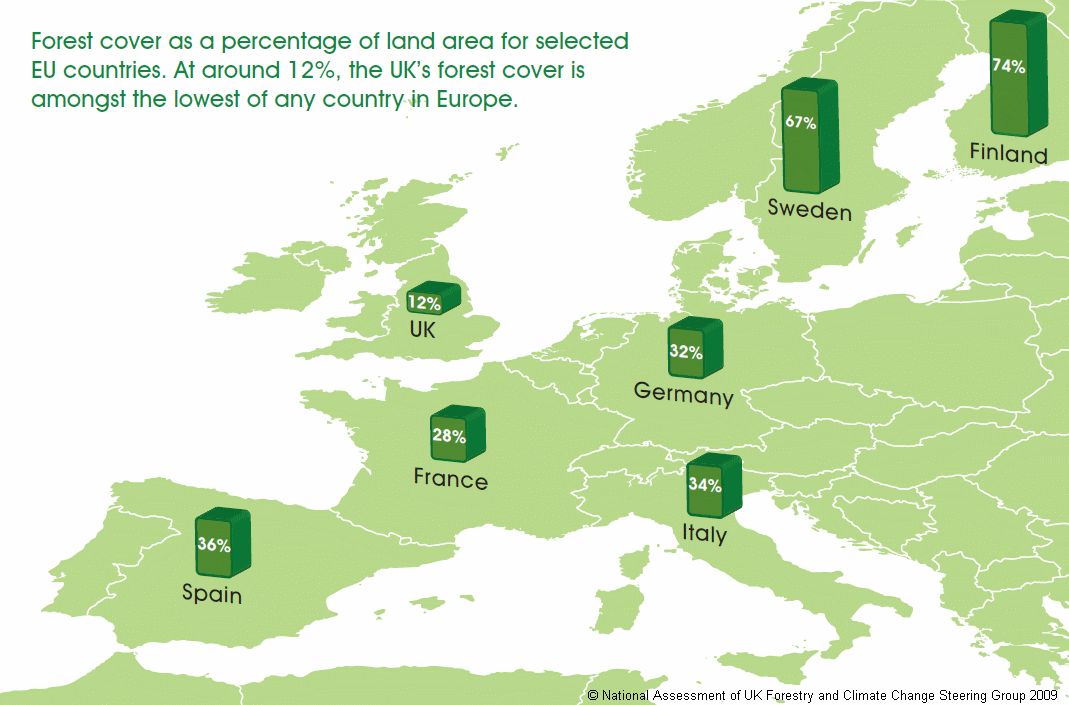
In the climate change debate there’s been a lot of talk about current Amazonian rainforest deforestation, but I’ve heard much less about the role of the UK’s forests for carbon sequestration. Given the relative size of the UK to the Amazonian rainforest that’s not so surprising – The Nature Conservancy suggests the area of rainforest cut down each year (20 million hectares) is the same as the combined area of England, Scotland and Wales. The estimated 5000 years it took [.pdf] to go from 75% of the UK covered by forests and woodlands to the current 12% just doesn’t compare.


Recently, however, the case been made for increasing UK forest and woodland cover as a form of climate change mitigation. This summer the UK Low Carbon Transition Plan identified woodland creation as a cost-effective way of mitigating climate change and recognised the importance of supporting tree-planting initiatives. More recently, the National Assessment of UK Forestry and Climate Change Steering Group has provided its response to the IPCC Fourth Assessment Report and argues there is a clear need for more woodlands.


One of the main findings of this initial assessment was that an increase in woodland area of 23,000 ha per year over the next 40 years could abate 10% of UK 2050 greenhouse gas emissions. With echos of the recommendation from the Stern Review on the Economics of Climate Change to ‘Act now or pay later’, the key message from this assessment is ‘Plant now and use sustainably’. The long maturation times of forest systems means that it may take take 50–100 years for actions to pay off.

Being such a long-standing investment it’s vital that the benefits of planted woodlands and forests are not outweighed by negative impacts on biodiversity, food security, landscape and water supply. From this stand-point there is much to be done and the assessment recommends that “further scientific and socio-economic analysis is required to enable the UK to achieve the full [climate] adaptation and mitigation potential of forestry” and that “clear, robust, research programmes will be needed to underpin the changes of forestry policy and practice which are required to meet the new and challenging circumstances”.

A question that immediately springs to my mind is where these woodlands should be placed to maximise their carbon sequestration payoff while minimising negative impacts on other aspects of the landscape. For example, if arable agricultural land is to be converted, how will biodiversity be affected by the removal of hedgerows? What would this conversion of agricultural land mean for local economies? Which species will benefit in terms of habitat connectivity and which will lose out? Addressing questions like these will be important as forest policy moves toward returning UK forest cover area near levels seen elsewhere in Europe.

Putting decison-making in context

A while back I wrote about how it takes all sorts to make a world and why we need to account for those different sorts in our models of it. One of the things that I highlighted in that post was the need for mainstream economics to acknowledge and use more of the findings from behavioural economists.

One of the examples I used in the draft of the book chapter I have been writing for the second edition of Wainwright and Mulligan’s Environmental Modelling was the paper by Tversky and Kahneman, The Framing of Decisions and the Psychology of Choice. They showed how the way in which a problem is framed can influence human decision-making and causes problems for rational choice theory. In one experiment Tversky and Kahneman asked people if they would buy a $10 ticket on arriving at the theatre when finding themselves in two different situations:

i) they find they have lost $10 on the way to the theatre,
ii) they find they have lost their pre-paid $10 ticket.

In both situations the person has lost the value of the ticket ($10) and under neoclassical economic assumptions should behave the same when deciding whether to buy a ticket when arriving at the theatre. However, Tversky and Kahneman found that people were more likely to buy a ticket in the first situation (88%) than buying a (replacement) ticket in the second (46%). They suggest this behaviour is due to human ‘psychological accounting’, in which we mentally allocate resources to different purposes. In this case people are less willing to spend money again on something they have already allocated to their ‘entertainment account’ than if they have lost money which they allocate to their ‘general expenses account’.

More recently, Galinsky and colleagues examined how someone else’s irrational thought processes can influence our own decision-making. In their study they asked college students to take over decision-making for a fictitious person they had never met (the students were unaware the person was fictitious).

In one experiment, the volunteers watched the following scenario play out via text on a computer screen: the fictitious decision-maker tried to outbid another person for a prize of 356 points, which equaled $4.45 in real money. The decision-maker started out with 360 points, and every time the other bidder upped the ante by 40 points, the decision-maker followed suit. Volunteers were told that once the decision-maker bid over 356 points, he or she would begin to lose some of the $12 payment for participating in the study.

When the fictitious decision-maker neared this threshold, the volunteers were asked to take over bidding. Objectively, the volunteers should have realized that – like the person who makes a bad investment in a ‘fixer-upper’ – the decision-maker would keep throwing good money after bad. But the volunteers who felt an identification with the fictitious player (i.e., those told by the researchers that they shared the same month of birth or year in school) made almost 60% more bids and were more likely to lose money than those who didn’t feel a connection.

Are we really surprised that neoclassical economic models often fall down? Accounting for seemingly irrational human behaviour may make the representation of human decision-making more difficult, but increasingly it seems irrational not to do so.

Initial Michigan Forest Simulation Output

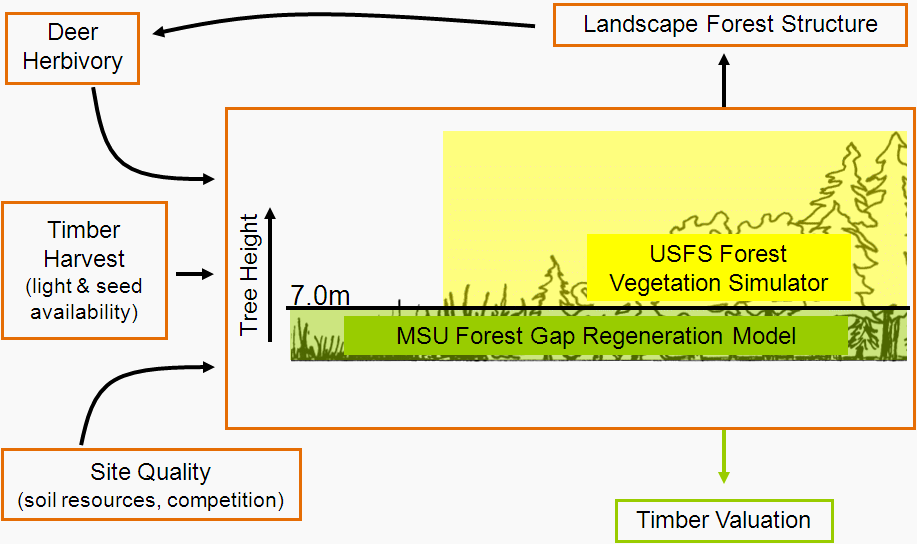
It’s taken a while but finally the model that I came to Michigan State to develop is producing what seems to be sensible output. Just recently we’ve brought all the analyses on the data that were collected in the field into a coherent whole. We’ll use this integrated model to investigate best approaches for forest and wildlife management to ensure ecological and economic sustainability. This post is a quick overview of what we’ve got at the moment and where we might take it. The image below provides a simplified view of the relationship of the primary components the model considers (a more detailed diagram is here).


The main model components I’ve been working on are the deer distribution, forest gap regeneration and tree growth and harvest sub-models. Right now we’re still in the model testing and verification stage but soon we hope to be able start putting it to use. Here’s a flow chart representing the current sequence of model execution (click for larger image):


As I’ve posted several times about the deer distribution modelling (here, here, and here for example) and because the integration of FVS with our analyses is more a technical than scientific issue, I’ll focus on the forest gap regeneration sub-model.

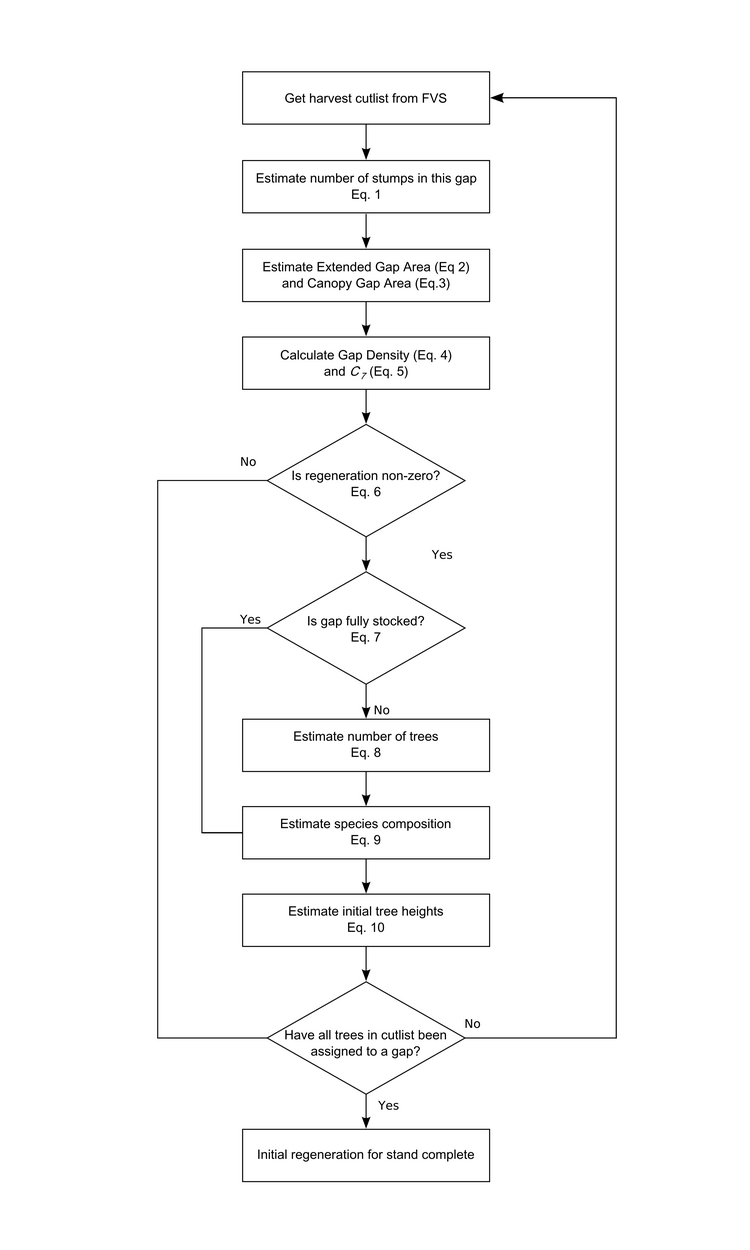
Most of the forest gap regeneration analyses used the data Megan Matonis collected during her two summers in the field (i.e., forest). During her fieldwork Megan measured gap and tree regeneration attributes such as gap size, soil and moisture regime, time since harvest, deer density, and sapling heights, density and species composition. Megan is writing up her thesis right now but we’ve also managed to find time to do some extra analyses on her data for the gap regeneration sub-model. Here’s the flow chart representing the model sequence to estimate initial regeneration in gaps created by a selection harvest in a forest stand (click for larger image):


In our gap regeneration sub-model we take a probabilistic approach to estimate the number and species of the first trees to reach 7m (this is the height at which we pass the trees to FVS to grow). The interesting equations for this are Eqs. 6 – 9 as they are responsible for estimating regeneration stocking (i.e. number of trees that regenerate) and the species composition of the regenerating trees. Through time the effects of the results of these equations will drive future forest composition and structure and the amount of standing timber available for harvest.

The probability that any trees regenerate in a gap is modelled using a generalized linear mixed model with a stand-level random intercept drawn from a normal distribution. The probability is a function of canopy gap area and deer browse category (high or low; calculated as a function of deer density in the stand).

If there are some regenerating trees in the gap, we use a logistic regression to calculate the probability that the gap contains as many (or more) trees as could fit in the gap when all the trees are 7m (and is therefore ‘fully stocked’). The probability is a function of canopy openness (calculated as a function of canopy gap area), soil moisture and nutrient conditions and deer density. If the gap is not fully stocked we sample the number of trees using from a uniform distribution.

Finally, we assign each tree to a species by estimating the relative species composition of the gap. We do this by assuming there are four possible species mixes (derived from our empirical data) and we use a logistic regression to calculate the probability that the gap has each of these four mixes. The probability of each mix is a function of soil moisture and nutrient conditions, canopy gap area, and stand-level basal area of Sugar Maple Ironwood. Currently we have parameterised the model to represent five species (Sugar Maple, Red Maple, White Ash, Black Cherry and Ironwood).

As the flow chart suggests, there is a little more to it than these three equations alone but hopefully this gives you a general idea about how we’ve approached this and what the important variables are (look out for publications in the future with all the gory details). For example, at subsequent time-steps in the simulation model we grow the regenerating trees until they reach 7m and also represent the coalescence of the canopy gaps. I haven’t integrated the economic sub-model into the program yet but that’s the next step.

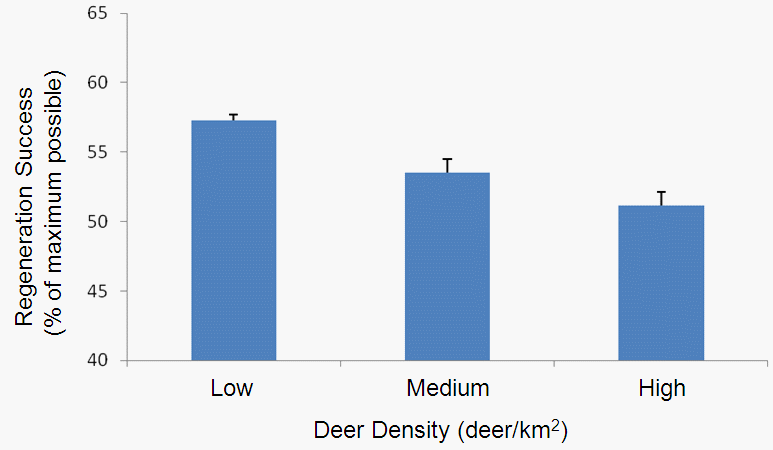
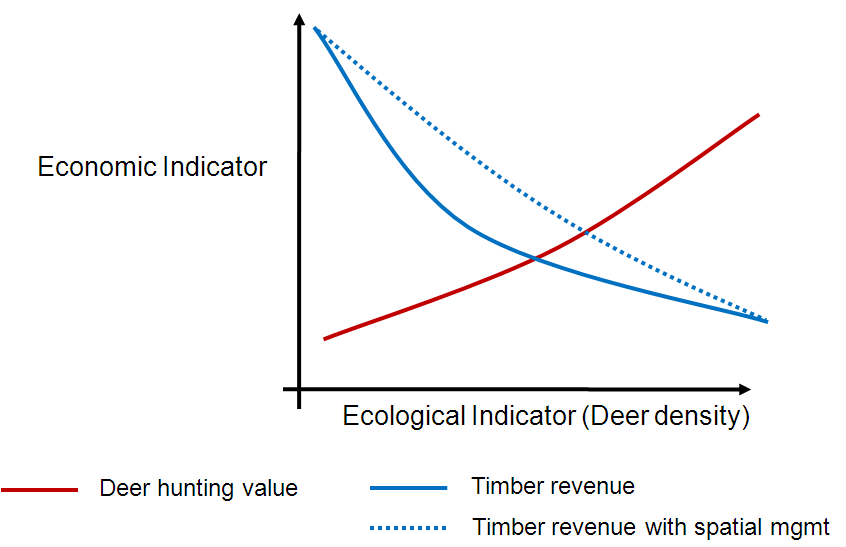
So what can we use the model for? One question we might use the model to address is, ‘how does change in the deer population influence northern hardwood regeneration, timber revenue and deer hunting value?’ For example, in one set of initial model runs I varied the deer population to test how it affects regeneration success (defined as the number of trees that regenerate as a percentage of the maximum possible). Here’s a plot that shows how regeneration success decreases with increasing deer population (as we would expect given the model structure):


Because we are linking the ecological sub-models with economic analyses we can look at how these differences will play out through time to examine potential tradeoffs between ecological and economic values. For example, because we know (from our analyses) how the spatial arrangement of forest characteristics influences deer distribution we can estimate how different forest management approaches in different locations influences regeneration through time. The idea is that if we can reduce deer numbers in a given area immediately after timber harvest we can give trees a chance to survive and grow above the reach of deer – moving deer spatially does not necessarily mean reducing the total population (which would reduce hunting opportunities, an important part of the local economy). The outcomes may look something like this:


We plan to use our model to examine scenarios like this quantitatively. But first, I need to finish testing the model…