Global Change Blog

This week I discovered a new blog that looks worth following for anyone interested in human-environment interactions, sustainability, or CHANS. The Global Change blog intends to explore big questions about society and environmental change, such as:

  • How do personal choices and values play a role in this conversation?
  • What do the natural sciences have to say about the way our world is changing?
  • What do the social sciences and humanities have to say about the ways that the social and the cultural intersect with questions surrounding environment?
  • How can we address environmental and social challenges at the same time?
  • How is environmentalism changing in response to these pressures?
  • What’s the role of higher education in facilitating sustainability and environmental literacy?

So far the blog has posted a mix of thoughtful original writing (for example on reasons why people don’t engage climate change) and brief highlights of other work. Hope they keep it coming!

Autumnal Upper Peninsula


Some pictures from a trip we took to Michigan’s Upper Peninsula earlier this month (fun rather than fieldwork for once).

The road to Paradise (Michigan)

Ship on Whitefish Bay

Whitefish Point, where many ships like that above have foundered.

Challenges for Ecological Modelling

Pressing contemporary ecological issues emphasise questions about how we should go about modelling ecological systems. In their preface to the latest volume of Ecological Modelling, Solidoro et al. suggest three main challenges for modellers with regards to applied environmental problems:

“A first challenge is to meet the legitimate expectations of the scientific community and society, providing solid expertise, reliable tools and critical interpretation of model results. Many questions need an answer here and now, and sometime[s] there is no point in saying ‘there are not enough data, information, knowledge’. To ask for more time, or to declare that no rigorous scientific conclusion can be drawn, will simply made those people needing an answer turn and look for someone else – qualified or not – willing to provide a suggestion. We have to be rigorous, to remind of limits and approximations implicit in any model and of uncertainties (and errors) implicit in any prediction. Nevertheless, if a model has to be made and/or used, ‘who if not us’, and ‘when if not now?’

A second challenge is neither generating false expectations, by promising what cannot be achieved, nor permitting others to do that, or to put such expectations on modelling. Within a society which regards magicians more than scientists, sometimes it might seem a good idea to wear a magician hat. However, modellers are not magicians, and models are not crystal bowls. And, once lost, it would be very hard to gain scientific credibility again.

A third point to remember is that the goal is knowledge, and models are only instruments. Even if its role in science is more central than in the past, ecological modelling should keep on staying open to contamination and to interbreeding with other scientific fields. Obviously, this includes confrontation with data and with the knowledge of people who collect them. Surely, it is true that reality is not the data but what data stand for, however experimental observations still remain the only link between theory and reality.”

The first point above is largely consistent with those I highlighted in my recent book review for Landscape Ecology (now in print); when data and understanding are sparse, modellers may just need to scale-back their modeling aims and objectives. When faced with pressing environmental issues we may need to settle for models that work – models that we can use to help make decisions rather than those that ‘prove’ (quantitatively) specific aspects of system function or ecological theory. In such a situation it may well be the case that ‘no rigorous scientific conclusion’ can be made in the short-term (when decisions are required) and, as the second point above implies, we shouldn’t try to disguise that. But that doesn’t mean people ‘needing an answer’ should be forced to look elsewhere (unless of course the answer they are looking for is 42).

Rather than focusing on the scientific results (numbers) of the model as a product, modellers in this situation might seek to captialise on the use of the process of modelling as a means to facilitate consensus-building and decision-making by providing a platform for communication about (potentially complex) systems interactions. Alternatively, they may use a model to foster better understanding about potential outcomes by examining how modelled systems behave qualitatively under different scenarios. Accurate quantitative predictions can be very persuasive, but when resources are in short supply we may not have the luxury of being able to produce them.

Solidoro et al. (2009) Challenges for ecological modelling in a changing world: Global Changes, Sustainability and Ecosystem Based Management Ecological Modelling 220(21) 2825-2827 doi:10.1016/j.ecolmodel.2009.08.018

Conference Deadlines

Those interested in landscape modelling might want to be aware of the deadlines for LANDMOD 2010 and US-IALE 2010.

LANDMOD 2010
LANDMOD 2010 will be held at SupAgro in Montpellier, France, February 3rd to 5th 2010.

The 2010 international conference on integrative landscape modelling will gather leading scientists in each of the main disciplines dealing with ecosystems and landscape simulation and management, complex dynamic modelling and assessment of vulnerability, resilience and adaptation of agro- and eco-systems under human influence.

The main objectives of the conference are:

  • To discuss the objectives, priorities and expectations when modelling the functioning of landscapes;
  • To share experience about landscape modelling and to identify major existing conceptual and technological gaps;
  • To release a ‘state of the art’ about landscape modelling and simulation;
  • To start building an international network on integrative ecosystems and landscape modelling.

Deadlines
October 31st : deadline for submission of extended abstracts
November, 30th: notification of acceptation of talks and posters
December, 31st : deadline for registration and payment

Website: http://www.umr-lisah.fr/rtra-projects/landmod2010

US-IALE 2010
The 25th annual meeting of US-IALE (US Regional Association, International Association for Landscape Ecology) will be held in Athens, Georgia, from April 5-9, 2010. One of the unique aspects of the 25th annual meeting is to reflect upon progress made in the past 25 years and to chart an even more productive course for landscape ecology over the next quarter century. The meeting will include special sessions at which past presidents of US-IALE and other leading landscape ecologists will provide retrospectives on and perspectives for landscape ecology.

Approximately 20 NASA-MSU Awards and 10 CHANS Fellowships will be available to support students, postdoctoral associates, junior faculty and other junior researchers to attend the meeting.

Deadlines
October 15, 2009: Proposals for symposia and workshops
December 15, 2009: Abstracts for oral and poster presentations
December 15, 2009: NASA-MSU Awards Applications
December 15, 2009: CHANS Fellowship Applications

Website: http://www.usiale.org/athens2010/

Synthetic Trees

When testing and using simulation models we often need to use synthetic data. This might be because we want to examine the effects of different initial conditions on our model output, or simply because we have insufficient data to examine a system at the scale we would like to. The ecological-economic modelling project I’m currently working on is in both these situations, and over the last week or two I’ve been working on generating synthetic tree-level data so that we can initialize our model of forest stand change for testing and scenario development. Here’s a brief overview of how I’ve approached the task of producing a ‘treelist generator’ from the empirical data we have for over 60,000 trees in Northern Hardwood stands across Upper Michigan.

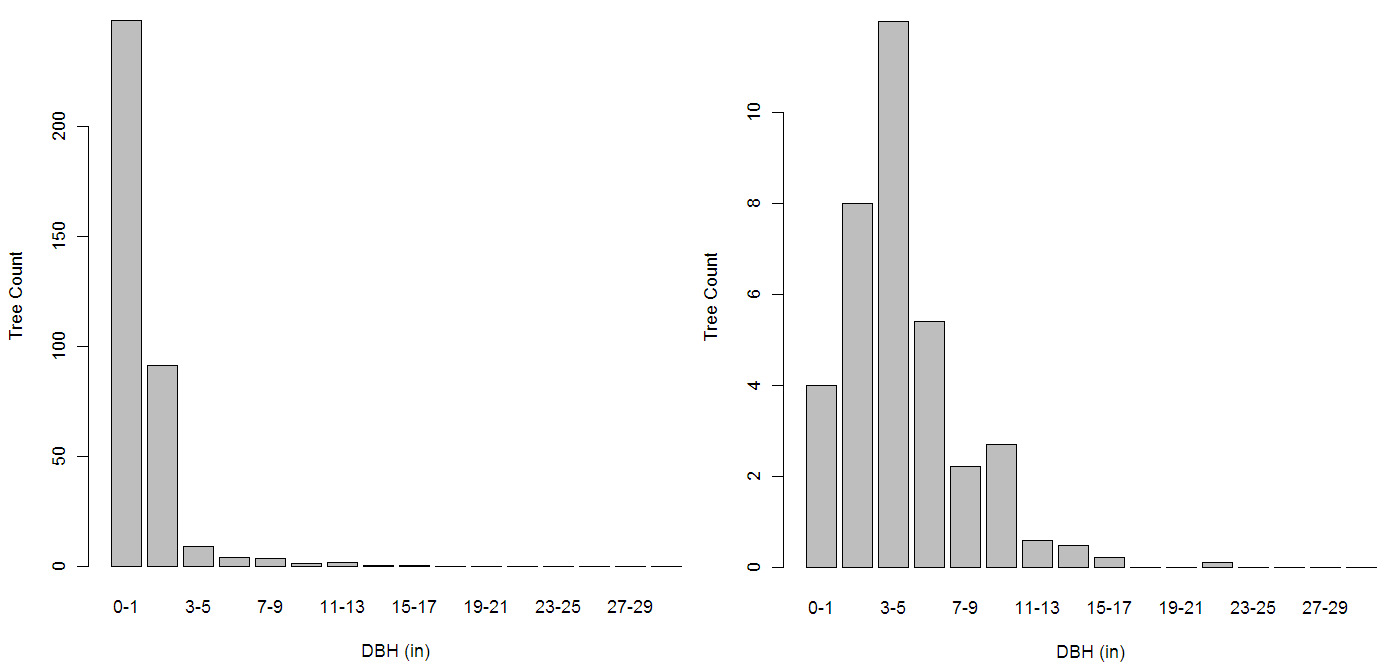
One of the key measures we can use to characterise forest stands is basal area (BA). We can assume that for each stand we generate a treelist for there is some ‘target BA’ that we are aiming to produce. As well as hitting a target BA, we also need to make sure that the tree diameter-at-breast-height (DBH) size-class distribution and species composition are representative of the stands in our empirical data. Therefore, our the first step is to look at the diameter size-class distribution of the stands we want to emulate. We can do this by plotting histograms of the frequency of trees of different diameter for each stand. In the empirical data we see two characteristic distributions (Fig 1).


Fig 1. Example stand tree count histograms

The distribution on the left has very many more trees in the smaller size classes as a result of stands self-thinning (as larger trees compete for finite resources). The second distribution, in which the smallest size classes are under-represented and larger size classes have relatively more trees, does not fit so well with the theoretical, self-thinning DBH size-class distribution. Stands with a distribution like this have probably been influenced by other factors (for example deer browse on the smaller trees). However, it turns out that both these DBH size-class distributions can be pretty well described by the gamma probability distribution (Fig 2).


Fig 2. Example stand gamma probability distributions for data in Fig 1

The gamma distribution has two parameters, a shape parameter we will call alpha and a scale parameter we will call beta. Interestingly, in the stands I examined (dominated by Sugar Maple and Ironwood) there are two different linear relationships between the parameters. The relationship between alpha and beta for 80% of stands represents the ‘self-thinning’ distribution, and the other 20% represent distributions in which small DBH classes are under-represented. We use these relationships – along with the fact that the range of values of alpha for all stands has a log-normal distribution – to generate characteristic DBH size-class distributions;

  1. sample a value of alpha from a normal distribution (subsequently reconvert using 10alpha),
  2. for the two different relationships use Bayesian linear regression to find mean and 95% credible intervals for the slope and intercept of a regression line between alpha and beta,
  3. use the value of alpha with the regression parameters to produce a value of beta.

So now for each stand we have a target basal area, and parameters for the DBH size class distribution. The next step is to add trees to the stand with diameters specified by the probability distribution. Each time we add a tree, basal area is added to the stand. The basal area for a tree is calculated by:

TreeBA = TreeDensity * (0.005454* diameter2)

[Tree density can be calculated for each tree because we know the sampling strategy used to collect empirical data on our timber cruise, whether on a fixed area plot, n-tree or with a prism].

Once we get within 1% of our target BA we stop adding trees to the stand [we’ll satisfy ourselves with a 1% accuracy because the size of tree that we allocate each time is sampled from a probability distribution and so we it is unlikely we will be able to hit our target exactly]. The trees in our (synthetic) stand should now (theoretically) have the appropriate DBH size-class distribution and basal area.

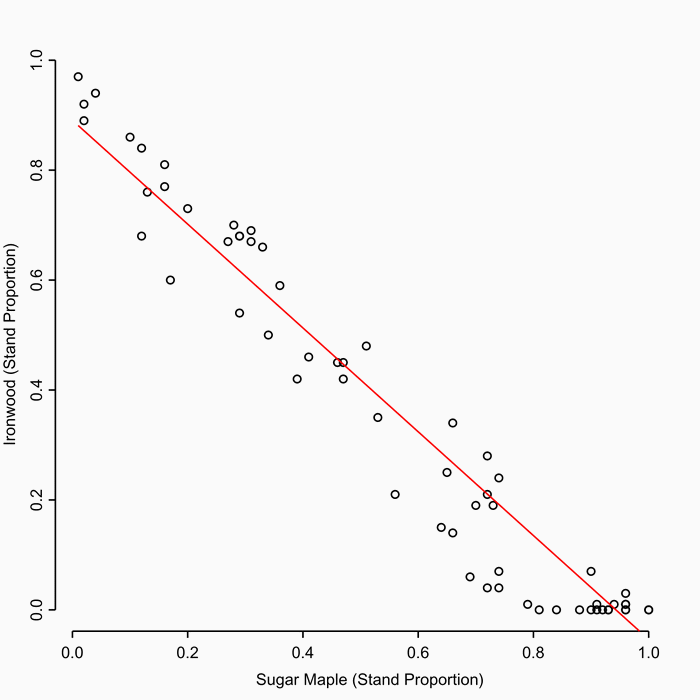
With a number of trees in now in our synthetic stand, each with a DBH value, the next step is to assign each tree to a species so that the stand has a representative species composition. For now, the two species we are primarily interested in are Sugar Maple and Ironwood. However, we will also allow trees in our stands to be Red Maple, White Ash, Black Cherry or ‘other’ (these are the next most common species in stands dominated by Sugar Maple and Ironwood). First we estimate the proportion of the trees in each species. In stands with Sugar Maple and Ironwood deer selectively browse Sugar Maple, allowing Ironwood a competitive advantage. Correspondingly, in the empirical data we observe a strong linear and inverse relationship between the abundance of Sugar Maple and Ironwood (Fig 3).


Fig 3. Relationship between stand Sugar Maple and Ironwood abundance

To assign species proportions we first estimate the proportion of Sugar Maple from the empirical data. Next, using the strong inverse relationship above we estimate the corresponding proportion of Ironwood (sampled using normal distribution with mean and standard deviation from from Bayesian linear regression). The remaining species proportions are assigned according to the frequency of their presence in the empirical data.

Now we use these proportions to assign a species to individual trees. Because physiology varies between species, the probability that a tree is of a given size also varies between species. For example, Ironwood very seldom reach DBH greater than 25 cm and the vast majority (almost 99% in our data) are smaller than 7.6 cm (3 inches) in diameter. Consequently, first we assign the appropriate number Ironwood to trees according to their empirical size-class distribution, before then assigning all other trees to the remaining species (using a uniform distribution).

The final step in generating our treelist is to assign each tree a height and a canopy ratio. We do this using empirical relationships between diameter and height for each species that are available in the literature (e.g. Pacala et al. 1994). And we’re done!

In the model I’m developing, these stands can be assigned a spatial location either using a pre-existing empirical map or using a synthetic land cover map with known characteristics (generated for example using the modified random clusters method, as the SIMMAP 2.0 software does). In either case we can now run the model multiple times to investigate the dynamics and consequences of different initial conditions. More on that in the future.

Securing the West Country’s Rural Future

A joint seminar between the Royal Bath and West of England Society and RGS with IBG, “with the aim of examining some of the problems and solutions relating to planning for future sustainable land use in rural areas. Using the West Country as a model, eminent speakers will cover such topics as climate change, population increase, pollution concerns, security of food, energy and economy, biodiversity and scientific developments.”

It takes all sorts

Neoclassical economics, both its assumptions and its ability to forecast future economic activity, has been taking a bit of a panning recently. Back near the start of this most recent economic downturn, Jean-Philippe Bouchard argued that neoclassical economists need to develop more pragmatic and realistic representations of what actually happens in ‘wild’ and messy free markets. And at the start of this year I highlighted how Niall Ferguson has stressed the importance of considering history in economic markets and decision-making. In both cases the criticism is that some economists have been blinded by the beauty of their elegant models and have failed to see where their assumptions and idealizations fail to match what’s happening in the real world. Most recently, Paul Krugman argued that ‘flaws-and-frictions economics’ (emphasizing imperfect decision-making and rejecting ideas of a perfectly free ‘friction-less’ market) must become more important. Krugman (‘friend’ of Niall Ferguson) suggests that mainstream economics needs to become more ‘behavioural’, and follow the lead of the behavioural economists that incorporate social, cognitive and emotional factors into their analyses of human decision-making.

The view from the Nature editors on all this is that in the future agent-based modelling will be an important tool to inform economic policy. In many ways agent-based modelling is very well suited to build more ‘behaviour’ into economics. For example, agent-based modelling provides the ability to represent several types of agent each with their own rules for decision-making, potentially based on their own life-histories and circumstances (this in contrast to the single perfectly rational ‘representative agent’ of neoclassical economics). Farmer and Foley, in their opinon piece of the same issue of Nature, are keen:

“Agent-based models potentially present a way to model the financial economy as a complex system, as Keynes attempted to do, while taking human adaptation and learning into account, as Lucas advocated. Such models allow for the creation of a kind of virtual universe, in which many players can act in complex — and realistic — ways. … To make agent-based modelling useful we must proceed systematically, avoiding arbitrary assumptions, carefully grounding and testing each piece of the model against reality and introducing additional complexity only when it is needed. Done right, the agent-based method can provide an unprecedented understanding of the emergent properties of interacting parts in complex circumstances where intuition fails.”

At the very least, our agent-based models need to improve upon the homogenizing assumptions of neoclassical economics. It takes all sorts to make a world — we need to do a better job of accounting for those different sorts in our models of it.

Interdisciplinarity, Sustainability and Critical Realism

I have a new paper to add to my collection of favourites. Hidden in the somewhat obscure Journal of Critical Realism it touches on several issues that I often find myself thinking about and studying: Interdisciplinarity, Ecology and Scientific Theory.

Karl Høyer and Petter Naess also have plenty to say about sustainability, planning and decision-making and, although they use the case of sustainable urban development, much of what they discuss is relevant to broader issues in the study of coupled human and natural systems. Their perspective resonates with my own.

For example, they outline some of the differences between studying open and closed systems (interestingly with reference to some Nordic writers I have not previously encountered);

… The principle of repetitiveness is crucial in these kinds of [reductionist] science [e.g. atomic physics, chemistry] and their related technologies. But such repetitiveness only takes place in closed systems manipulated by humans, as in laboratories. We will never find it in nature, as strongly emphasised by both Kvaløy and Hägerstrand within the Nordic school. In nature there are always open, complex systems, continuously changing with time. This understanding is in line with key tenets of critical realism. Many of our most serious ecological problems can be explained this way: technologies, their products and substances, developed and tested in closed systems under artificial conditions that generate the illusion of generalised repetitiveness, are released in the real nature of open systems and non-existing repetitiveness. We are always taken by surprise when we experience new, unexpected ecological effects. But this ought not to be surprising at all; under these conditions such effects will necessarily turn up all the time.

At the same time, developing strategies for a sustainable future relies heavily on the possibility of predicting the consequences of alternative solutions with at least some degree of precision. Arguably, a number of socio-technical systems, such as the spatial structures of cities and their relationships with social life and human activities, make up ‘pseudo-closed’ systems where the scope for prediction of outcomes of a proposed intervention is clearly lower than in the closed systems of the experiments of the natural sciences, but nevertheless higher than in entirely open systems. Anticipation of consequences, which is indispensable in planning, is therefore possible and recommendable, although fallible.

The main point of their paper, however, is the important role critical realism [see also] might play as a platform for interdisciplinary research. Although Høyer and Naess do highlight some of the more political reasons for scientific and academic disciplinarity, their main points are philosophical;

…the barriers to interdisciplinary integration may also result from metatheoretical positions explicitly excluding certain types of knowledge and methods necessary for a multidimensional analysis of sustainability policies, or even rejecting the existence of some types of impacts and/or the entities causing these impacts.

These philosophical (metatheoretical) barriers include staunchly positivist and strong social constructionist perspectives;

According to a positivist view, social science research should emulate research within the natural sciences as much as possible. Knowledge based on research where the observations do not lend themselves to mathematical measurement and analysis will then typically be considered less valid and perhaps be dismissed as merely subjective opinions. Needless to say, such a view hardly encourages natural scientists to integrate knowledge based on qualitative social research or from the humanities. Researchers adhering to an empiricist/naive realist metatheory will also tend to dismiss claims of causality in cases where the causal powers do not manifest themselves in strong and regular patterns of events – although such strong regularities are rare in social life.

On the other hand, a strong social constructionist position implies a collapsing of the existence of social objects to the participating agents’ conception or understanding of these objects. …strong social constructionism would typically limit the scope to the cultural processes through which certain phenomena come to be perceived as environmental problems, and neglecting the underlying structural mechanisms creating these phenomena as well as their impacts on the physical environment. At best, strong social constructionism is ambivalent as to whether we can know anything at all about reality beyond the discourses. Such ‘empty realism’, typical of dominant strands of postmodern thought, implies that truth is being completely relativised to discourses on the surface of reality, with the result that one must a priori give up saying anything about what exists outside these discourses. At worst, strong social constructionism may pave the way for the purely idealist view that there is no such reality.

At opposite ends of the positivist-relativist spectrum neither of these perspectives seem to be the most useful for interdisciplinary research. Something that sits between these two extremes – critical realism – might be more useful [I can’t do this next section justice in an abridged version – and this is the main point of the article – so here it is in its entirety];

The above-mentioned examples of shortcomings of reductionist metatheories do not imply that research based on these paradigms is necessarily without value. However, reductionist paradigms tend to function as straitjackets preventing researchers from taking into consideration phenomena and factors of influence not compatible with or ignored in their metatheory. In practice, researchers have often deviated from the limitations prescribed by their espoused metatheoretical positions. Usually, such deviations have tended to improve research rather than the opposite.

However, for interdisciplinary research, there is an obvious need for a more inclusive metatheoretical platform. According to Bhaskar and Danermark, critical realism provides such a platform, as it is ontologically characterised doubly by inclusiveness greater than competing metatheories: it is maximally inclusive in terms of allowing causal powers at different levels of reality to be empirically investigated; and it is maximally inclusive in terms of accommodating insights of other meta-theoretical positions while avoiding their drawbacks.

Arguably, many of the ecologists and ecophilosophers referred to earlier in this paper have implicitly based their work on the same basic assumptions as critical realism. Some critical realist thinkers have also addressed ecological and environmental problems explicitly. Notably, Ted Benton and Peter Dickens have demonstrated the need for an epistemology that recognises social mediation of knowledge but also the social and material dimensions of environmental problems, and how the absence of an interdisciplinary perspective hinders essential understanding of nature/society relationships.

According to critical realism, concrete things or events in open systems must normally be explained ‘in terms of a multiplicity of mechanisms, potentially of radically different kinds (and potentially demarcating the site of distinct disciplines) corresponding to different levels or aspects of reality’. As can be seen from the above, the objects involved in explanations of the (un)sustainability of urban development belong partially to the natural sciences, partially to the social sciences, and are partially of a normative or ethical character. They also belong to different geographical or organisational scales. Thus, similar to (and arguably to an even higher extent than) what Bhaskar and Danermark state about disability research, events and processes influencing the sustainability of urban development must be understood in terms of physical, biological, socioeconomic, cultural and normative kinds of mechanisms, types of contexts and characteristic effects.

According to Bhaskar, social life must be seen in the depiction of human nature as ‘four-planar social being’, which implies that every social event must be understood in terms of four dialectically interdependent planes: (a) material transactions with nature, (b) social interaction between agents, (c) social structure proper, and (d) the stratification of embodied personalities of agents. All these categories of impacts should be addressed in research on sustainable urban development. Impacts along the first dimension, category (a), typically include consequences of urban development for the physical environment. Consequences in terms of changing location of activities and changing travel- ling patterns are examples of impacts within category (b). But this category also includes the social interaction between agents leading to changes in, among others, the spatial and social structures of cities. Relevant mechanisms at the level of social structure proper (category [c]) might include, for exam- ple, impacts of housing market conditions on residential development projects and consequences of residential development projects for the overall urban structure. The stratified personalities of agents (category [d]) include both influences of agents on society and the physical environment and influences of society and the physical environment on the agents. The latter sub-category includes physical impacts of urban development, such as unwholesome noise and air pollution, but also impacts of the way urban planning and decision- making processes are organised, for example, in terms of effects on people’s self esteem, values, opportunities for personal growth and their motivation for participating in democratic processes. The influence of discourses on the population’s beliefs about the changes necessary to bring about sustainable development and the conditions for implementing such changes also belongs to this sub-category. The sub-category of influences of agents on society and the physical environment includes the exercise of power by individual and corporate agents, their participation in political debates, their contribution to knowledge, and their practices in terms of, for example, type and location of residence, mobility, lifestyles more generally, and so on.

Regarding issues of urban sustainability, the categories (a)–(d) are highly interrelated. If this is the case, we are facing what Bhaskar and Danermark characterise as a ‘laminated’ system, in which case explanations involving mechanisms at several or all of these levels could be termed ‘laminated expla- nations’. In such situations, monodisciplinary empirical studies taking into consideration only those factors of influence ‘belonging’ to the researcher’s own discipline run a serious risk of misinterpreting these influences. Examples of such misinterpretations are analyses where increasing car travel in cities is explained purely in terms of prevailing attitudes and lifestyles, addressing neither political-economic structures contributing to consumerism and car-oriented attitudes, nor spatial-structural patterns creating increased needs for individual motorised travel.

Moreover, the different strata of reality and their related mechanisms (that is, physical, biological, socio-economic, cultural and normative kinds of mechanisms) involved in urban development cannot be understood only in terms of categories (a)–(d) above. They are also situated in macroscopic (or overlying) and less macroscopic (or underlying) kinds of structures or mechanisms. For research into sustainable urban development issues, such scale-awareness is crucial. Much of the disagreement between proponents of the ‘green’ and the ‘compact’ models of environmentally sustainable urban development can probably be attributed to their focus on problems and challenges at different geographical scales: whereas the ‘compact city’ model has focused in particular on the impacts of urban development on the surrounding environment (ranging from the nearest countryside to the global level), proponents of the ‘green city’ model have mainly been concerned about the environment within the city itself. A truly environmentally sustainable urban development would require an integration of elements both from the former ‘city within the ecology’ and the latter ‘ecology within the city’ approaches. Similarly, analyses of social aspects of sustainable development need to include both local and global effects, and combine an understanding of practices within particular groups with an analysis of how different measures and traits of development affect the distribution of benefits and burdens across groups.

Acknowledging that reality consists of different strata, that multiple causes are usually influencing events and situations in open systems, and that a pluralism of research methods is recommended as long as they take the ontological status of the research object into due consideration, critical realism appears to be particularly well suited as a metatheoretical platform for interdisciplinary research. This applies not least to research into urban sustainability issues where, as has been illustrated above, other metatheoretical positions tend to limit the scope of analysis in such a way that sub-optimal policies within a particular aspect of sustainability are encouraged at the cost of policies addressing the challenges of sustainable urban development in a comprehensive way.

In conclusion; critical realism can play a very important role as an underlabourer of interdisciplinarity, with its maximal inclusiveness both in terms of allowing causal powers at different levels of reality to be empirically investigated and in terms of accommodating insights of other meta-theoretical positions while avoiding their drawbacks

I’m going to have to spend some time thinking about this but there seems to be plenty to get ones teeth into here with regards the study of coupled human and natural systems and the use of agent-based modelling approaches. For example, agent-based modelling seems to offer a means to represent Bhaskar‘s four planes but there are plenty of questions about how to do this appropriately. I also need to think more carefully about how these four planes are manifested in the systems I study. Generally however, it seems that critical realism offers a useful foundation from which to build interdisciplinary studies of the interaction of humans and their environment for the exploration of potential pathways to ensure sustainable landscapes.

Reference
Høyer, K.G and Naess, P. 2008 Interdisciplinarity, ecology and scientific theory: The case of sustainable urban development Journal of Critical Realism 7(2) 179-207 doi: 10.1558/jocr.v7i2.179

CHANS-Net at AAG 2010

Details of plans for CHANS-Net activities at the 2010 annual meeting of the Association of American Geographers (AAG) in Washington, D.C. have been posted.

Presentations and a workshop are expected to synthesise across CHANS research projects, potentially leading to publication. The CHANS-Net website also indicates there are opportunities for junior scholars to receive financial assistance.

Deadline for abstract submission to the AAG meeting is 28th October 2009 (submissions to the CHANS events are due by 20th October).