Seeing the Wood for the Trees: Pattern-Oriented Modelling

A while back I wrote about the potentially misplaced preoccupation with statistical power in species distribution models. Our attempts at drawing out some relationships between our deer distribution data and descriptors of land cover is proving taxing – the relationships evident at a more coarse spatial resolution (e.g. county level) than we are considering aren’t found in our stand-level data. As a result we moving toward taking a modelling approach that is driven less by our empirical data and more by inferences based on multiple information sources. Particularly I’m drawn toward emphasising an approach I first encountered in my undergraduate landscape ecology class taught by George Perry – ‘Pattern-Oriented Modelling‘.

A prime example of the POM approach is its use to model the spread of rabies through central Europe. The rabies virus has been observed to spread in a wave-like manner, carried by foxes. Grimm et al. (1996) describe how they developed a cellular automate-type model that considers cells (of fox territory) to be in either a healthy, infected or empty state. Through an iterative model development process, their model was gradually refined (i.e. its assumptions and parameters modified) by comparing model results with empirical patterns.

The idea underpinning this iterative POM approach is

“… if we decide to use a pattern for model construction because we believe this pattern contains information about essential structures and processes, we have to provide a model structure which in principle allows the pattern observed to emerge Whether it does emerge depends on the hypotheses we have built into the model.”

This approach has been found particularly useful for the development of ‘bottom-up’ agent-based models. Often understanding of the fine-scale processes driving broad-scale system dynamics and patterns is poor, making it difficult to both structure and parameterise mechanistic models. However, whilst the logical fallacy of affirming the consequent remains, if a model of low-level interactions is able to reproduce higher-level patterns, we can be confident that our model is a better representation of the system mechanics than one that doesn’t. Furthermore, the more patterns at different scales that the model reproduces, the mode confident we can be in it. Thus, in POM

“multiple patterns observed in real systems at different hierarchical levels and scales are used systematically to optimize model complexity and to reduce uncertainty.”Grimm et al. (2005)

Grimm and Berger outline the general protocol of a pattern-oriented modelling approach (whilst reminding us that there is no standard recipe for model development):

  1. Formulate the question or problem
  2. Assemble hypotheses about essential processes and structures
  3. Assemble (observed) patterns
  4. Choose state variables, parameters and structures
  5. Construct the model
  6. Analyse, test and revise the model
  7. Use patterns for parameterisation
  8. Search for independent predictions

Several iterations of this process will be required to refine the model. In initial iterations, steps 2 and 4 may need to be largely inferential if the state of knowledge about the system is poor. However, by moving iteratively back through these steps, and in particular exploiting steps 6 and 7 to inform us about model performance relative to system behaviour, we can improve our knowledge about the system whilst simultaneously ensuring our model recreates observed patterns. For example, during the development of the landscape fire-succession model in my PhD, I compared the landscape-level model results of different sets of (unknown) flammability probabilities (parameters) of each vegetation type required by the model with empirically observed wildfire regime behaviour. By modifying parameters for individual vegetation types I was able to reproduce the appropriate wildfire frequency-area distribution for Mediterranean-type environments that had previously been found (I’m currently writing this up for publications – more soon).

But what does this all have to do with our model of the relationship between deer browse and timber harvest in Michigan’s Upper Pensinsula? Well, right now I think we’re at steps 2,3 and 4 (all at the same time). As our deer and land cover relationships are weak at the stand-level (which is the level we are considering so that we can integrate the model with an economic module), I am currently developing hypotheses (i.e. assumptions) about the structure of the system from previous research on different specific aspects of similar systems. Furthermore, we’re continuing to look for spatial patterns in both vegetation and deer distribution so that we can compare the results of our hypothetical model.

For example, one thing I’m struggling with right now is is how to establish the probability of which individual trees (or saplings) will be removed from a stand due to a given level of deer browse (which in turn is dependent upon a deer density). This is not something that has been explicitly studied (and would be very difficult to study at the landscape level). Therefore we need to parameterise this process in order for the model to function. We should be able to do this by comparing several different parameterisations to empirically observed patterns such as spatial configuration of forest types classified by age class or age/species distributions at the stand-level. That’s the idea anyway – we’ll see how it goes over the next months…

In the meantime, next week I head back to the study area for the first stage of our seedling experiment. We’re planting seedlings now across a gradient of browse and site conditions with the intention of returning in the spring to see what has been browsed and count deer pellets. This should improve our understanding of the link between pellet counts and browse pressure and provide us with some more empirical patterns which we can use in our ongoing model development.

UP Deer Browse Experiment Recce

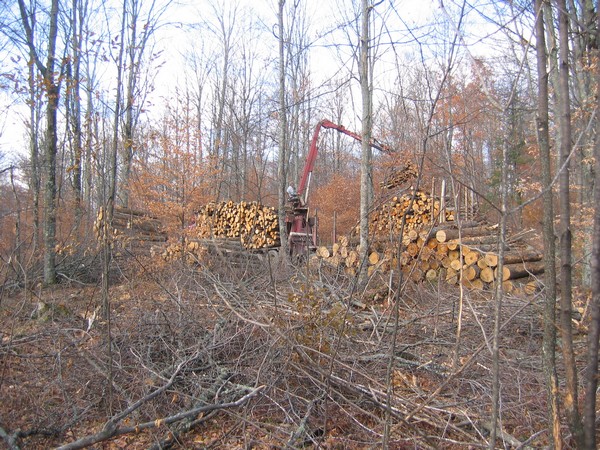
A few pictures from our trip to the UP study area this past week.

The fall was almost over. We were out on a recce to find sites for an experiment we’re setting up over the next couple of weeks to examine the impact of deer browse on seedlings of various conifer species.

We want to locate our seedling planting on both state and commercial lands – cutting had recently finished at this commercial site.

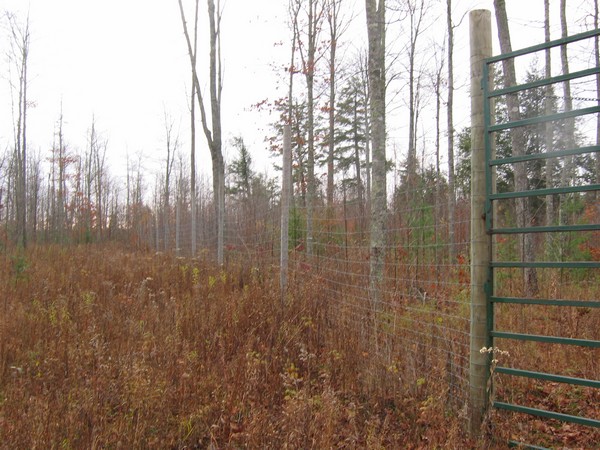
We also visited a deer exclosure set up to examine tree regeneration in the absence of deer browse (similar in many ways to our experiment). It’s not the best picture, but the effects of 12 years of protection can be seen – very little regeneration on the left of the fence but evidence of green juveniles on the right. These effects haven’t been quantified at this site but by sight alone there’s clearly difference outside s inside the exclosure.

Finally, not all the leaves had fallen. We were a couple of weeks late for the real colours, but some remained down on the Lake Michigan coastline.

An Integrated Fire Research Framework

Integrated, multi- and inter-disciplinary studies are becoming increasingly demanded and required to understand the consequences of human activity on the natural environment. In a recent paper, Sandra Lavorel and colleagues highlight the importance of considering the feedbacks and interactions between several systems when examining landscape vulnerabilities to fire. They present a framework for integrated fire research that considers the fire regime as the central subsystem (FR in the figure below) and two feedback loops, the first with consequences for atmospheric and biochemical systems (F1) and the second that represents ecosystems services and human activity (F2). It is this second feedback loop in their framework that my research focuses.


To adequately quantify the fire-related vulnerability of different regions of the world the authors suggest that a better understanding of the relative contributions of climate, vegetation and human activity to the fire regime is required. For example, they suggest that an examination of the statistical relationships between spatio-temporal patterns evident in wildfire regimes and data on ecosystem structure, land use and other socio-economic factors. We made a very similar point in our PNAS paper and hope to continue to use the exponent (Beta) of the power-law frequency-area relationship that is evident in many model and empirical wildfire regimes to examine these interactions. One statistical relationship that might be investigated is between Beta and the level of forest fragmentations, thought to be a factor confounding research on the effects of fire suppression of wildfire regimes.

But the effects of landscape fragmentation can also be examined in a more mechanistic fashion using dynamic simulation models. Lavorel et al. mention the impacts of agricultural abandonment on the connectivity of fuels in Mediterranean landscapes which are attributed, in conjunction with a drier than average climate, to the exceptionally large fires that burned there during the 1990s. My PhD research examined the impacts of agricultural land abandonment on wildfire regimes in central Spain. I’m currently working on writing this work up for publication, but I plan on continuing to develop the model to more explicitly represent the F2 feedbacks loop shown in the figure above.

The potential socio-economic consequences of changing fire regimes are an area with a lot of room to improve our understanding. For example, some regions of the world, such as the Canadian boreal forest, are transitioning from a net sink for carbon to a net source (due to emission during burning). If carbon sinks are considered in future emission trading systems, regions such as are losing a potential future economic commodity. Lavorel et al. also discuss the interesting subject of potential land conflict due to mismatches in the time scales between land planning and fire occurrence. In Indonesia for example, years which burn large areas force re-allocation of land development plans by local government. Often however the processes of developing these plans is not fast enough to forestall the exploitation by local residents of the new land available for occupation and use.

The need for increased research in this area is highlighted by the case studies for Alaskan and African savannah ecosystems presented by Lavorel et al. Whilst discussion of the wildfire regime and atmospheric/biochemical feedbacks can be discussed in detail, poor understanding of the ecosystem services/human activity feedbacks prevents such detailed discussion.

The framework Lavorel et al. present is a very useful way to conceptualise and plan for future research in this field. They suggest (p.47-48) that “Assessments of vulnerability of land systems to fire demand regional studies that use a systemic approach that focuses on the feedback loops described here” and “… will require engaging a collection of multiscale and interdisciplinary regional studies”. In many respects, I expect my future work to contribute to this framework, particularly with regards the human activity (F2) feedback loop.

CHANS and the Risks of Modelling

In their recent review of Coupled Human and Natural Systems (CHANS), Liu et al highlight several facets of the integrated study of these systems;

  • Reciprocal Effects and Feedback Loops
  • Nonlinearity and Thresholds
  • Surprises
  • Legacy Effects and Time Lags
  • Resilience

Whilst the emphasis of the paper is on the emergence of complex patterns and processes not evident when human and natural systems are studied independently by social or natural scientists, for me the issue that should be highlighted is the importance of surprises and legacy effects when studying these systems. This goes back to what I have written before about the open, middle-numbered nature of these systems. In these systems history matters and events that occur outside the bounds of the system being studied can have an influence on system dynamics.

With this in mind, when I was recently asked where the risks lie in ecological-economic modelling (modelling that specifically considers the interactions of ecological and economic systems) I suggested we might consider three areas of risk:

  1. The production of a integrated model that is not accepted or valued by those we hope it would (whether that be other scientists, decision-makers or members of the society we are modelling). For example, the nature of producing a model that lies somewhere between ecology and economics and/or between science and management has the potential to be accepted by neither party in these dichotomies (as it is not perceived by others to be ‘real ecology’ or ‘real science’ for example). However, this can be avoided by ensuring continued collaboration between economists and ecologists, and between scientists and managers, throughout the modelling process to ensure understanding or model structure.
  2. The production of a model that is not fully integrated but is rather an ecological model used to examine various economic scenarios. In this case, the study remains integrated (examining the interactions between economic and ecological systems) but the model is not (as feedbacks back from the ecological systems into the economic system, for example in terms of prices and costs, are not fully accounted for). Alternatively, if the modelling process is understood to be iterative, then this initial reduced version of the model may simply be a single step in the complete ecological-economic modeling process.
  3. Because of legacy effects, surprises etc, a misplaced confidence in what the model can accurately predict may arise. This is also related to the question of the limited capacity to validate models of complex ecological systems given limited empirical data. Again, this may be prevented by continued collaboration between scientist and manager to ensure the structure and limitations of a model are understood, and if a range of model results are predicted for different scenarios (in order to demonstrate the variability in potential outcomes).

The study of CHANS will become increasingly important in the future. But if political decisions are to be made based on the outcome of the knowledge gained, the risks present in the study (and specifically the modelling) of these systems must be minimized and accounted for.

CHANS Science Paper

In this week’s issue of Science Jack Liu, Director of CSIS (and my boss), and colleagues present a review of recent research on Coupled Human And Natural Systems (CHANS). Using six case studies from around the world the paper discusses these coupled systems with regards spatial, temporal and organisational units, nonlinear dynamics and feedback loops between systems, the importance of history within these sytems, and aspects of their resilience and heterogeneity. We’ll be discussing the paper within the center next week so maybe I’ll have some more insightful comments then. For now, here’s the abstract:

Integrated studies of coupled human and natural systems reveal new and complex patterns and processes not evident when studied by social or natural scientists separately. Synthesis of six case studies from around the world shows that couplings between human and natural systems vary across space, time, and organizational units. They also exhibit nonlinear dynamics with thresholds, reciprocal feedback loops, time lags, resilience, heterogeneity, and surprises. Furthermore, past couplings have legacy effects on present conditions and future possibilities.

Complexity of Coupled Human and Natural Systems
Jianguo Liu , Thomas Dietz, Stephen R. Carpenter, Marina Alberti, Carl Folke, Emilio Moran, Alice N. Pell, Peter Deadman, Timothy Kratz, Jane Lubchenco, Elinor Ostrom, Zhiyun Ouyang, William Provencher, Charles L. Redman, Stephen H. Schneider, William W. Taylor
Science 14 September 2007
Vol. 317. no. 5844, pp. 1513 – 1516
DOI: 10.1126/science.1144004
Also online here`

The Tyranny of Power?

The past week or two I’ve been wrestling with the data we have on white-tailed deer density and vegetation in Michigan’s Upper Peninsula in an attempt to find some solid statistical relationships that we might use in our ecological-economic simulation model. However, I seem to be encountering similar issues to previous researchers, notably (as Weisberg and Bugmann put it) “the weak signal-to noise ratio that is characteristic of ungulate-vegetation systems”, that “multiple factors need to be considered, if we are to develop a useful, predictive understanding of ungulate-vegetation relationships”, and that “ungulate-vegetation interactions need to be better understood over multiple scales”.

Hobbs suggests that one of the problems slowing species distribution research is a preoccupation with statistical power that he calls “the tyranny of power”. This tyranny arises, he suggests, because traditional statistical methods that are powerful at smaller scales become less useful at larger extents. There are at least three reasons for this including,

  1. small things are more amenable to study by traditional methods than large things
  2. variability increases with scale (extent)
  3. potential for bias increases with scale (extent)

“The implication of the tyranny of power is that many of the traditionally sanctioned techniques for ecological investigation are simply not appropriate at large-scales… This means that inferences at large-scales are likely to require research designs that bear little resemblance to the approaches many of us learned in graduate school.” Hobbs p.230

However, this tyranny may simply be because, as Fortin and Dale point out, “most study areas contain more than one ecological process that can act at different spatial and temporal scales”. That is, the processes are non-stationary in time and space. Leaving time aside for now, spatial non-stationarity has already been found to be present in our study area with regards the processes we’re considering. For example, Shi and colleagues found that Geographically Weighted Regression (GWR) models are better at predicting white-tailed deer densities than an ordinary least-squares regression model for the entirety of our study area.

Hobbs’ argument suggests that it’s often useful analyse ecological data from large regions by partitioning them into smaller, more spatially homogenous areas. The idea is that these smaller patches are more likely to be governed by the same ecological process. But how should these smaller regions be selected? A commonly used geographical division is the ecoregion. Ecoregions divide land into areas of similar characteristics such as climate, soils, vegetation and topography. For our study area we’ve found that relationships between deer densities and predictor variables do indeed vary by Albert’s ecoregions. But we think that there might be more useful ways to divide our study area that take into account variables that are commonly believed to strongly influence spatial deer distributions. In Michigan’s UP the prime example is the large snow fall is received each winter and which hinders deer movement and foraging.

We’re beginning to examine how GWR and spatial boundary analysis might be used to delineate these areas (at different scales) in the hope of refining our understanding about the interaction of deer and vegetation across our large (400,000 ha) landscape. In turn we should be able to better quantify some of these relationships for use in our model.

Oekologie #8

Welcome to the 8th issue of Oekologie, the travelling blog carnival of the best ecology and environmental science blog posts from the past month. Although the summer is often the time that ecologists and environmental scientists are out in the field doing what they love most (fieldwork) this didn’t stop some of us from posting stories that grabbed our attention.

Several of posts this month discussed the ecology of mammals, some more positive than others. Talking about Yellowstone’s Ecology of Fear, Jeremy at The Voltage Gate highlighted the benefits of the re-introduction of wolves to the National Park and that the restoration of historic ecosystems is possible. GrrlScientist notes that the egg-laying mammal Attenborough’s long-beaked echidna (named after Sir David Attenborough) is not extinct as was previously thought, and Tim at Walking the Berkshires emphasised the successes of the Khoadi Hôas Conservancy in Namibia for the conservation of elephant populations. Though problems remain, Tim suggests that it is possible for humans and elephants to exist side-by-side. In a great post over at Laelaps, Brian is less optimistic however about the management and survival prospects for the Saiga antelope (Saiga tatarica).

More concerned with the The Other 95%, Kevin discusses the benefits for crabs moulting their exoskeleton (other than simply allowing them to grow). Concerning the plant world, Jennifer at The Infinite Sphere presents the invasive Purple Loosestrife and the trade-offs associated with controlling the plants with herbicides, and at Seeds Aside Laurent suggests a game for the next time you’re strolling through a meadow.

Lorne at Geek Counterpoint presents a review of the Storm World by Chris Mooney, pointing out the social aspects of the scientific study of the climate and hurricanes;

“Mooney also takes a long, critical look at how scientists communicate (or don’t) to the public, and how the media handles what information they can get their hands on.”

Finally, considering some of the larger issues, Mike at 10,000 Birds examines the ecological basis for conservation. Part of a larger series called Protect the Commons, he highlights the need to remember the fragile connections between things and to understand that “all is of a part”

That’s it for this month – check Oekologie #9 at Fish Feet next month. Remember to submit your best posts here.

The Wilderness Ideal

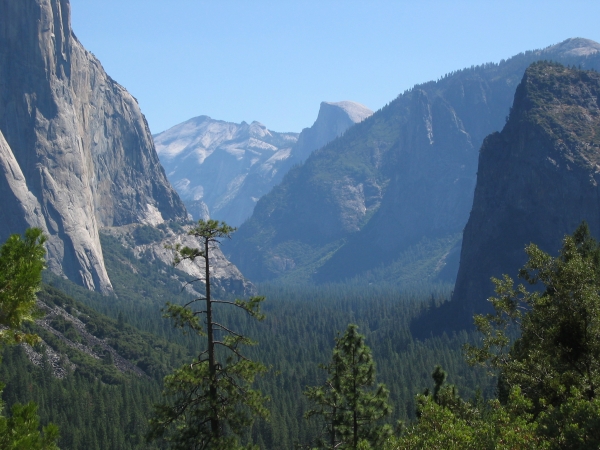
One evening whilst sitting on a deck overlooking a tranquil lake in the wilds of the UP’s northern hardwood forests, I began reading William Cronon’s contributions to the volume he edited himself; Uncommon Ground. The book has been around for a decade and more but it is only recently that I came across a copy in a secondhand book store. It seems apt that I considered what it had to say about the ‘social construction’ of nature in a setting of the type that has long intrigued me. Maybe the view of a landscape which confronted me is another of the reasons I am doing what I am right now. I have had pictures of these large wilderness landscapes on the walls of my mind, and elsewhere, for a while.

Cronon examines “the trouble with wilderness” with reference to the Edenic ideal that underlay it from the beginning. Wordsworth and Thoreau were in bewildered or lost awe of the sublime landscapes they travelled, but by the time John Muir came to the Sierra Nevada the landscape was an ecstasy. Whilst Adam and Eve may have been driven from the garden out into the wilderness, the myth was now ‘the mountain as cathedral’ and sacred wilderness was a place to worship God’s natural world. Furthermore, as the American frontier diminished with time and technology,

“wilderness came to embody the national frontier myth, standing for the wild freedom of America’s past and and seeming to represent a highly attractive natural alternative to the ugly artificiality of modern civilization. … Ever since the nineteenth century, celebrating wilderness has been an activity mainly for well-to-do city folks. Country people generally know far too much about working the land to regard unworked land as their ideal.” (p.78)

Cronon suggests that there is a paradox at the heart of the Wilderness ideal, this conception that true nature must also be wild and that humans must set aside areas of the world for it to remain pristine. As Cronon puts it, this paradox is that “The place where we are is the place where nature is not”. Taking this logic to its extreme results in the need for humans to kill themselves in order to preserve the natural world;

“The absurdity of this proposition flows from the underlying dualism it expresses. … The tautology gives us no way out: if wild nature is the only thing worth saving, and if our mere presence destroys it, then the sole solution to our own unnaturalness, the only way to protect sacred wilderness from profane humanity, would seem to be suicide. It is not a proposition that seems likely to produce very positive or practical results.” (p.83)

I’ll say. But Cronon is not saying that protected wilderness areas are themselves undesirable things, of course not. His point is about the idea of Wilderness. As a response he suggests that rather than thinking of nature as ‘out there’, we need to learn how to bring the wonder we feel when in the wilderness closer to home. We need to abandon the idea of the tree in the garden as artificial and the tree in the wilderness as natural. If we see both trees as natural, as wild, then we will be able to see nature and wildness everywhere; in the fields of the countryside, between the cracks in the city pavement, and even in our own cells.

“If wildness can stop being (just) out there and start being (also) in here, if it can start being as humane as it is natural, then perhaps we can get on with the unending task of struggling to live rightly in the world – not just in the garden, not just in the wilderness, but in the home that encompasses both” (p.90)

Sitting on that deck looking out over the lake it was clear that landscapes such as the one I was in aren’t the idealised, pristine, wilderness that they may be portrayed as in books, photographs and travel brochures. Just as in studying its nature I have come to understand a little better the uncertainties of the scientific method that is supposed to bring facts and truth, so I think have come to better understand the place of human needs within these ‘wild’ landscapes. As naive as it is to think that science might offer the absolute truth (it can’t, but it is still the best game in town to understand the world around us), thinking humans are inseparable from nature seems equally foolish.

In the introduction to a book on natural resource economics (which has mysteriously vanished from my bookshelf), an author describes a similar situation. As a young man he wanted to study the environment in order that he might save it from destructive hands of humans. But in time he came to realise this was unrealistic and that better would be to study the means by which humans use the ‘natural world’ to harvest and produce the resources we need to live. Economics is concerned with the means by which we allocate, and create value from, resources. Just as it is important to understand how ‘nature’ works, it is also important to understand how a world in which humans are a natural component works, and how it can continue to function indefinitely.

Landscape Ecology and Ecological Economics have grown out of this understanding. Whilst theories and models about the natural world independent of humans remain necessary, increasingly important are theories and models that consider the interaction between the social, economic and biophysical components of the natural world. These tools might help us get on with the task of living sustainably in the place which humans should naturally call home.

Buy on Amazon