Characterizing wildfire regimes in the United States

This post is my second contribution to JustScience week, and follows on from the first post yesterday.

During my Master’s Thesis I worked with Dr. Bruce Malamud to examine wildfire frequency-area statistics and their ecological and anthropogenic drivers. Work resulting from this thesis led to the publication of Malamud et al. 2005

We examined wildfires statistics for the conterminous United States (U.S.) in a spatially and temporally explicit manner. Using a high-resolution data set of 88,916 U.S. Department of Agriculture Forest Service wildfires over the time period 1970-2000 to consider wildfire occurrence as a function of biophysical landscape characteristics. We used Bailey’s ecoregions as shown by Figure 1A below.

Figure 1.

In Bailey’s classification, the conterminous U.S. is divided into ecoregion divisions according to common characteristics of climate, vegetation, and soils. Mountainous areas within specific divisions are also classified. In the paper, we used ecoregion divisions to geographically subdivide the wildfire database for statistical analyses as a function of ecoregion division. Figure 1B above shows the location of USFS lands in the conterminous U.S.

We found that wildfires exhibit robust frequency-area power-law behaviour in the 18 different ecoregions and used power-law exponents (normalized by ecoregion area and the temporal extent of the wildfire database) to compare the scaling of wildfire-burned areas between ecoregions. Normalizing the relationships allowed us to map the frequency-area relationships, as shown in Figure 2A below.
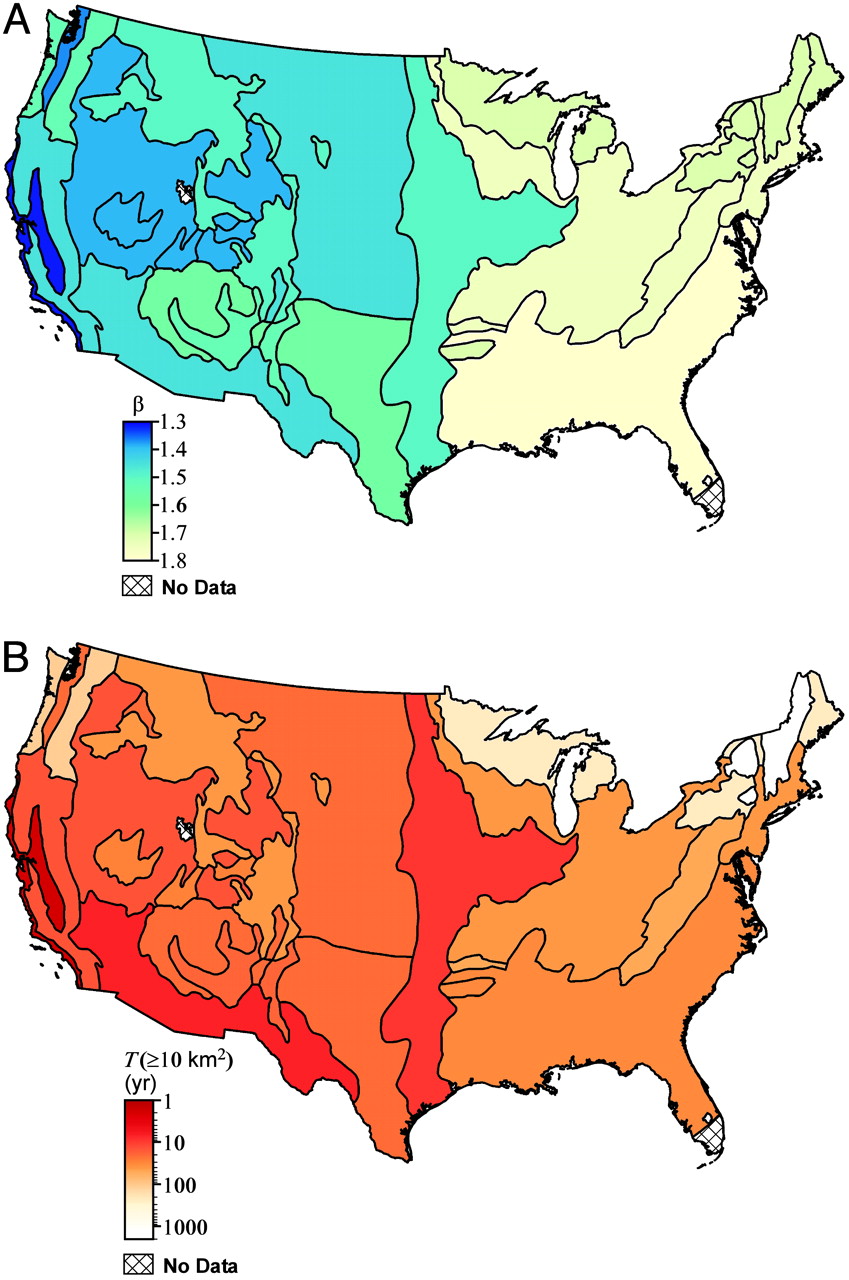
Figure 2.

This mapping exercise shows a systematic change east-to-west gradient in power-law exponent beta values. This gradient suggests that the ratio of the number of large to small wildfires decreases from east to west across the conterminous U.S. Controls on the wildfire regime (for example, climate and fuels) vary temporally, spatially, and at different scales, so it is difficult to attribute specific causes to this east-to-west gradient. We suggested that the reduced contribution of large wildfires to total burned area in eastern ecoregion divisions might be due to greater human population densities that have increased forest fragmentation compared with western ecoregions. Alternatively, the gradient may have natural drivers, with climate and vegetation producing conditions more conducive to large wildfires in some ecoregions compared with others.

Finally, this method allowed us to calculate recurrence intervals for wildfires of a given burned area or larger for each ecoregion (Figure 2B above). In turn this allowed for the classification of wildfire regimes for probabilistic hazard estimation in the same vein as is now used for earthquakes.

Read the full paper here.

Technorati Tags: , , , ,

Wildfire Frequency-Area Scaling Relationships

This post is the first of my contribution to JustScience week.

Wildfire is considered an integral component of ecosystem functioning, but often comes into conflict with human interests. Thus, understanding and managing relationship between wildfire, ecology and human activity is of particular interest to both ecologists and wildfire managers. Quantifying the wildfire regime is useful in this regard. The wildfire regime is the name given to the combination of the timing, frequency and magnitude of all fires in a region. The relationship between the frequency and magnitude of fires, the frequency-area distribution, is one particular aspect of the wildfire regime that has become of interest recently.

Malamud et al. 1998 examined ‘Forest Fire Cellular Automata‘ finding a power-law relationship between the frequency and size of events. The power-law relationship takes the form:

power-law function

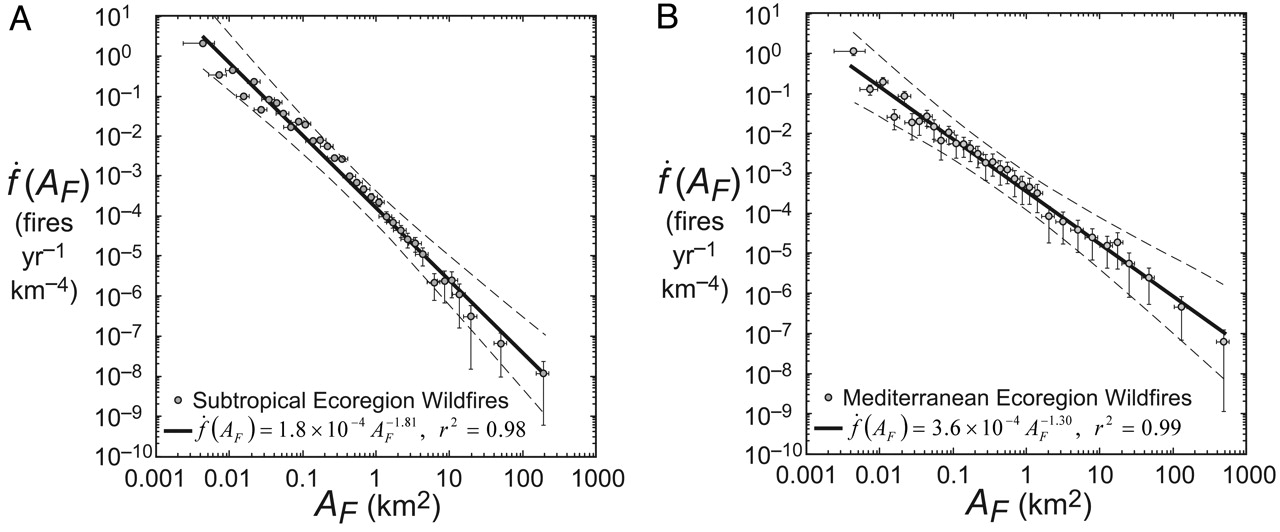
where frequency is the frequency of fires with size area, and beta is a constant. beta is a measure of the ratio of small to medium to large size fires and how frequently they occur. The smaller the value of beta, the greater the contribution of large fires (compared to smaller fires) to the total burned area of a region. The greater the value, the smaller the contribution. Such a power-law relation is represented on a log-log plot as straight line, as the example from Malamud et al. 2005 shows:

power-law distribution

Shown circles are number of wildfires per “unit bin” of 1 km^2 (in this case normalized by database length in years and area in km^2) plotted as a function of wildfire area. Also shown is a solid line (best least-squares fit) with coefficient of determination r^2. Dashed lines represent lower/upper 95% confidence intervals, calculated from the standard error. Horizontal error bars on burned area are due to measurement and size binning of individual wildfires. Vertical error bars represent two standard deviations of the normalized frequency densities and are approximately the same as the lower and upper 95% confidence interval.

As a result of their work on the forest fire cellular automata Malamud et al. 1998 wondered whether the same relation would hold for empirical wildfire data. They found the power-law relationship did indeed hold for observed wildfire data for parts of the US and Australia. As Millington et al. 2006 discuss, since this seminal publication several other studies have suggested a power-law relationship is the best descriptor of the frequency-size distribution of wildfires around the world.

During my Master’s Thesis I worked with Dr. Bruce Malamud to examine wildfire frequency-area statistics and their ecological and anthropogenic drivers. Work resulting from this thesis led to the publication of Malamud et al. 2005 which I’ll discuss in more detail tomorrow.

Technorati Tags: , , ,

Pale Blue Dot

I saw this YouTube video containing an excerpt from Carl Sagan’s writings over on Perceiving Wholes recently. It’s a little cheesy, but it contains a strong and important message – that we humans are our own custodians on this planet. Whilst the way Sagan goes about making this point is understandable from is background as an astronomer and astrobiologist and the context of the image he discusses, I think there’s a more salient way to think about our position within the universe.


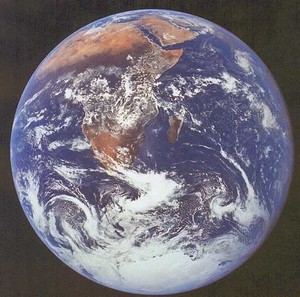
Sagan talks about out insignificance [text of video here], about the miniscule size of this plant and our short time upon it. I think that misses the pale blue point. More importantly, we need to recognise that this world is finite. In both size and resources. Just as Silent Spring kick-started the environmental movement, another image taken from space a decade later and almost two before Sagan’s Pale Blue Dot, ‘The Blue Marble‘ highlighted that the blue planet in our solar system is not the infinite horizon it may seem from the surface.


Sagan is probably right, we are alone for now in this part of the universe to solve our own problems. But we can’t prove that (which is quite a cool thought eh?). What we do know for sure, by looking at images from space for example, is that this planet is finite and that many of the resources we require to survive here are not infinite but are most definitely exhaustable.

Sometimes, as an individual sat atop a mountain ridge surrounded by miles of forest it may feel as though we are so small that we would have an insignificant effect upon the landscape. But we are now over six and a half billion individuals and that is no small number. Upon the Geologic scale and relative to the size and age of the known universe our number and time here may well be insignificant. Upon the scale of our finite pale blue dot however, the global population is now of such a size that in all likelihood our actions are having a significant effect on our capacity to survive.

Just as we might remember our insignificance in the Grand Scheme of Things, we might also remember our significance in the smaller scheme of things too.

Addendum 31st Jan 2007: An editorial in this week’s Nature takes a similar view with regards looking at Earth from space (rather than turning our attention to the moon).

Technorati Tags: , , , , ,

Generational Landscape Change: Montana and Madrid

It’a been out for a while (so there are several reviews available ) but I only just got and started reading Jared Diamond’s Collapse (How societies choose to fail or survive). I’ve only read the first part (Modern Montana) so far, but already I’ve come across several parallels between the socio-economic changes, and their potential ecological impacts, occuring in the landscapes under Montana’s Big Sky and Madrid’s Sun-Blessed Skies.

The broad similarity between the change Diamond describes in Montana and that occurring in my PhD study area (SPA 56, an EU protection area for endangered bird species to the west of Madrid, Spain) is the shift from an economy and landscape driven by agricultural activity to one driven by recreational activities. Such a shift reflects both the differing visions of multiple stakeholders within these landscapes, but also generational changes in attitude between older inhabitants and their children and grandchildren. In Montana’s Bitteroot Valley larger macroeconomic changes nationally and internationally have made previously profitable extractive industries (forestry, mining and agriculture) largely unsustainable economically. This has come about as land is now valued not according to resource and agricultural production but according to real-estate potential for incoming retirees, second-homers and tourists. Incoming (usually older) ‘out-of-staters’ arrive to enjoy the outdoor recreation (fishing, hiking, etc.), beauty and lifestyle opportunities, replacing the younger generation of Montanans going the other way to seek modern urban lifestyle opportunities and lifestyles;


“It’s a wonderful lifestyle to get up before dawn and see the sunrise, to watch fly hawks overhead, and to see deer jump through your hay field to avoid your haying equipment. … Occasionally I get up at 3 AM and work until 10 AM. This isn’t a 9 to 5 job. But none of our children will sign up for being a farmer if it is 3 AM to 10 PM every day.”

Dairy Farmer, Montana

Locals in SPA 56 have expressed similar feelings and ideas when I have visited over the last few years. Younger generations that would have previously continued the family farm that has passed through generation upon generation of farmers, are now seeking out employment in construction and service sectors to secure what is understood as a more ‘modern’ lifestyle. A lifestyle that affords leisure time at specified times of the week and at regular intervals (i.e. the weekends and paid holidays);


“Most farmers are part-time, maintaining the tradition agriculture. The children or grandchildren of those [farmers] do not have interest [in agriculture] because is it not profitable and requires a lot of dedication. The youths go or they seek other work.”

Local Development Official, Madrid (2006)

In Montana, Diamond describes the conflicts that have arisen between existing inhabitants and the new-comers, each with differing world-views, priorities and values. For example, contrast the attitudes of the third generation dairy farmer fighting to ensure the survival of his farm in the global economy vs. the lady who complained to him when she got manure on her white running shoes. Of course, these multiple perspectives within the landscape are inevitable in a changing world and tools and strategies must be found and employed to ensure appropriate decisions and compromises are made. In my simulation model of agricultural decision-making I have attempted to represent the influence of two differing world-views on landscape change (as have other modellers). I have termed the representative agents ‘commercial’ and ‘traditional’; the former behaving as a perfectly rational actor (in economic terms), the latter designed to reflect the importance of traditional cultural values in land-use decision-making;


“Whoever has a vineyard nowadays is like a gardener… they like to keep it, even if they lose money. They maintain vineyards because they have done it all their life and they like it, even having to pay for it. If owners were looking for profitability there would be not a singe vineyard… People here grow wine because of a matter of feeling, love for the land…”

Vinter, Madrid (2005)

As the primary thesis of his book Diamond highlights, for both contemporary and historical societies, the impacts of social, economic and technological change on the physical environment, and the sustainability of those changes. Of the several issues of concern in Montana, those related to forestry and water availability are likely to be of most concern in SPA 56. One particular interest of my PhD thesis is the importance of changes in the landscape for wildfire regimes, which Diamond discusses with reference to previous management strategies of the Unites States Forest Service (USFS). Commercial forestry has not been a widespread activity in SPA 56, the nature and human history of Mediterranean ecosystems restricting contemporary timber productivity. However, the problems of increased fuel loads due to the fire suppression policies of the USFS during the 20th century may be beginning to present themselves in SPA 56. If the agricultural sector continues to decline due to the social and economic trends just outlined, farmland will (continue to) be abanoned or converted to recreational uses (for example, hunting reservations). In turn this will leading to increased biomass and fuel loads in the landscape. As yet the consequences of such change on the frequency and magnitude of fires in the region is unclear due to spatial relationships and feedbacks between vegetation growth and burning. In the very near future the results of my simulation model will be able shed some light on this aspect of the region’s changing landscape and ecology.

Buy on Amazon


Diamond Reviews
GristMill
Ecological Economics
Futures

Oekologie Blog Carnival

Jeremy at The Voltage Gate and Jen at The Infinite Sphere have just started the blogosphere’s first ecology and environmental science Blog CarnivalOekologie.

Oekologie will be published on the 15th of every month, starting this month (Jan 2007), and aims to review the best ecology and environmental science posts of the month from across the blogosphere.

Submissions should be credible, science-centered posts discussing new research and ideas, reviews of the tenets of either field, or evidence-based personal opinions regarding ecology and environmental science. Specifically, they’re looking for posts describing biological interactions – human or nonhuman – with the environment. I’ll be submitting some of my musings from time-to-time I’m sure.

Direction not Destination will be hosting Oekologie in May 2007 but they’re still on the look-out for more hosts in the forthcoming months.

Ecosystems Paper

In an effort not to become one of the estimated 200 million blogs that have now been abandoned, I thought it about time I let the blogosphere know that the paper I submitted to Ecosystems with Dr. George Perry and Dr. Raul Romero-Calcerrada has been accepted for publication. The paper arose out of the initial statistical modelling of the SPA I did for my PhD thesis (also used in Millington 2005) and examines the use of statistical techniques for explaining causes of land use and cover changes versus techniques for projecting change.

Here’s the abstract:

In many areas of the northern Mediterranean Basin the abundance of forest and scrubland vegetation is increasing, commensurate with decreases in agricultural land use(s). Much of the land use/cover change (LUCC) in this region is associated with the marginalisation of traditional agricultural practices due to ongoing socioeconomic shifts and subsequent ecological change. Regression-based models of LUCC have two purposes: (i) to aid explanation of the processes driving change and/or (ii) spatial projection of the changes themselves. The independent variables contained in the single ‘best’ regression model (i.e. that which minimises variation in the dependent variable) cannot be inferred as providing the strongest causal relationship with the dependent variable. Here, we examine the utility of hierarchical partitioning and multinomial regression models for, respectively, explanation and prediction of LUCC in EU Special Protection Area 56, ‘Encinares del río Alberche y Cofio’ (SPA 56) near Madrid, Spain. Hierarchical partitioning estimates the contribution of regression model variables, both independently and in conjunction with other variables in a model, to the total variance explained by that model and is a tool to isolate important causal variables. By using hierarchical partitioning we find that the combined effects of factors driving land cover transitions varies with land cover classification, with a coarser classification reducing explained variance in LUCC. We use multinomial logistic regression models solely for projecting change, finding that accuracies of maps produced vary by land cover classification and are influenced by differing spatial resolutions of socioeconomic and biophysical data. When examining LUCC in human-dominated landscapes such as those of the Mediterranean Basin, the availability and analysis of spatial data at scales that match causal processes is vital to the performance of the statistical modelling techniques used here.

Look out for it during 2007:

MILLINGTON, J.D.A., Perry, G.L.W. and Romero-Calcerrada, R. (In Press) Regression techniques for explanation versus prediction: A case study of Mediterranean land use/cover change Ecosystems

Categories: , , , , , ,

Critical Realim in Environmental and Social Sciences

Richards (1990) initiated debate on the possibility of the adoption of a realist perspective toward research in the environmental sciences (specifically geomorphology) by criticising the then emphasis on rationalist (hypothetico-deductive) methods.

The ontology of Critical Realism (CR) theorises that reality exits independently of our knowledge of it or scientific research or theories about it, and that it is structured into three levels:

  1. ‘Real’ natural generating mechanisms
  2. actual events caused by the real mechanisms
  3. empirical observations of the actual events

The separation these three levels impose between real processes and human observation means that whilst reality exists objectively and independently, we cannot observe it. Therefore perception and cognition are important components of our knowledge about the real world. In this way, critical realism sits as an alternative between positivism and relativisms, between the nomothetic and the idiographic, and between determinist and stochastic perspectives (Sayer 2000).

Whilst mechanisms are time and space invariant, actual events are not because they are realisations of the generating mechanisms acting in particular conditions and contingent circumstances. The history and geography of events matters. Identical generating mechanisms will not produce identical events at different locations in space and time.

CR does not claim absolute truth; rather it understands science is a method to progress towards understanding true reality. A critical realist approach does not require falsification or predictive success – theories are proven through consistency of theory and explanation at multiple time and space scales. Thus, it emphasises looking at systems within their context and undertaking multidisciplinary scientific activity.

CR has been suggested as a useful perspective for examining environmental (and social) systems for several reaons;

  1. It addresses systems and their elements in context. This is very important given the complex (multiple interacting elements), ‘open’ (energy and mass able to flow across system boundaries) nature of many environmental systems (von Bertalanffy 1950).
  2. It does not attempt prediction of time and space dependent environmental events and phenomena, the accuracy of which is logically impossible to verify (Oreskes et al. 1994, Oreskes 2000).
  3. It provides a more holistic and multi-disciplinary approach to studying environmental systems. Such a perspective is consistent with other other theoretical frameworks (e.g. General Systems Theory, Gestalt Systems, Hierarchy Theory) and as advocated elsewhere in the environmental sciences (e.g. Naveh 2000).

As Sayer (2000) notes; “Realists expect concrete open systems and discourses to be much more messy an ambiguous than our theories”. That is, realists don’t expect their model results to match empirical observations. Rather, the key is to develop an understanding of the relevant causal structures and mechanisms. Characteristically realist questions are:

  • What does the existence of this object presuppose?
  • Could object/process A exist without object/process B?
  • What is it about the structure of this object which enables it to do certain things?

Many landscapes are characteristic of the open, complex systems Richards and Sayer are referring to. Multiple interacting actors and elements are combined with flows of energy and mass and, when humans are in the landscape, meaning and value into and out of them. At the human scale, observed and located in the real world, landscapes exist in a unique time and place – the non-ergodic nature of the universe makes individual events within them virtually unreproducible (Kauffman 2000). In these systems history and geography are important. Adopting a realist perspective toward modelling of these systems, whilst not offering predictions of their future states, offers an approach to better understand them and inform debate about their future.

References
von Bertalanffy, L. (1950) The Theory of Open Systems in Physics and Biology Science 111 p.23 – 29

Kauffman, S. (2000) Investigations. Oxford: Oxford University Press

Naveh, Z. (2000) What is Holistic Landscape Ecology? A Conceptual Introduction. Landscape and Urban Planning 50 p.7 – 26.

Oreskes, N., Shrader-Frechette, K. and Belitz, K. (1994) Verification, Validation, and Confirmation of Numerical Models in the Earth Sciences, Nature 263 p.641 – 646.

Oreskes, N. (2000) Why Predict? Historical Perspectives on Prediction in Earth Science In Sarewitz, D., Pielke Jr., R.A., and Byerly, Jr., R. (Eds) Prediction: Science, Decision Making and the Future of Nature. Washington D.C.: Island Press.

Richards, K. (1990) ‘Real Geomorphology’. Earth Surface Processes and Landforms 15 p.195 – 197.

Richards, K., Brooks, S., Clifford, N., Harris, T. and Lane, S. (1997) Theory, Measurement and Testing in ‘Real’ Geomorphology and Physical Geography In Stoddart, D. (Ed.) Process and Form in Geomorphology. London: Routledge.

Sayer, A. (2000) Realism and Social Science. London: Sage

Categories: , , , , , , ,

Lester Brown: Plan B 2.0

We went straight from the pub to Lester Brown’s lecture at MSU this evening so I didn’t have a pen or pad of paper with me. I need to jot something down before I forget so why don’t I blog it…

President of the Earth Policy Institute, Lester Brown’s talk was based largely around his recently updated book Plan B 2.0. Essentially this was an ecological economics discussion, and many of his examples echoed what I heard at the THEMES summer school earlier this year (did I blog that yet? I should). For example, one clear message was that biofuels (ethanol) is NOT a viable alternative to gasoline for running cars; the resources and area demanded to grow the products to produce the biofuel are to great to ensure it’s economic or ecological viability. A more sustainable alternative presented was wind power; the US could satisfy its annual electricity needs by installing wind turbines in just the three windiest states (I forget which they are). If the number of hybrid electricity/gasoline cars increased this wind power could be efficiently harnessed, stored and used for travel.

Orders for wind turbines globally are so high that waiting lists for production currently stretch to 2008. Why not use the infrastructure already in place in the form of automobile factories to constuct these wind turbines? Unfeasible? Not possible? The example of the shift from automobilie manufacture to arms manufacture in the US during the second World War shows that “where there’s a will there’s a way”.

But do we want have the will? Are we in denial? Why is it so easy to persuade ourselves that there isn’t a problem? Lester Brown suggests that one reason is that we’re not doing our economics properly; we’re hiding many of the costs of the products we produce just as Enron did before their collapse. It may only ‘cost’ $3 to produce a packet of cigarettes (at least that’s the cost they could sell at before tax), but when you factor in ecological and human health into the equation we find that it actually costs $7 in terms of ecosystem and health services.

Echoing Al Gore in his recent movie (still need to blog about that), unless the environmental question is on the lips of the constituent when they meet their political representative, these issues can get swept under the carpet. We need to have the will to make the necessary changes, and we need to let our politicians know we want that change.

And I need to get some sleep so that my presentation tomorrow doesn’t collapse into farce…

Categories: , , , , , , , ,