Agent-Based Modelling for Interdisciplinary Geographical Enquiry

Bruce Rhoads argued that;

“The time has come for geography to fulfil its potential by adopting a position of intellectual leadership in the realm of interconnections between human and biophysical systems.”

Many areas of scientific endeavour are currently attempting to do the same and interdisciplinarity has become a big buzzword. Modelling has become a common tool for this interdisciplinary study (for example ecological-economic models), with several different approaches available. Increases in computing power and the arrival of object-oriented programming have led to the rise of agent-based modelling (also termed individual-based and discrete element).

In their latest paper in Geoforum, Bithell et al. propose this form of modelling, with its “rich diversity of approaches”, as an opportune way to explore the interactions of social and environmental processes in Geography. The authors illustrate the potential of this form of modelling by providing outlines of individual-based models from hydrology, geomorphology, ecology and land-use change (the latter of which I have tried to turn my hand to). The advantages of agent-based modelling, the authors suggest, include the ability to represent

  1. agents as embedded within their environment,
  2. agents as able to perceive both their internal state and the state of their environment
  3. agents that may interact with one another in a non-homogeneous manner
  4. agents that can take action to change both their relationships with other agents and their environment
  5. agents that can retain a ‘memory’ of a history of past events.

However the development of these representation can be a challenging task as I found during my PhD modelling exploits, and requires a ‘diversity of resources’. When representing human agents these resources include past population censuses, surveys and interviews of contemporary populations, and theoretical understanding of social, cultural and economic behaviour from the literature. In my modelling of a contemporary population I used interviews and theoretical understanding from the literature and found that, whilst more resource intensive, actually going to speak with those being represented in the model was by far more useful (and actually revealed the deficiencies of accepted theories).

In their discussion, Bithell et al. consider the problems of representing social structures within and an individual-based model suggesting that;

“simulation of social structure may be a case of equipping model agents with the right set of tools to allow perception of, and interaction with, dynamic structures both social and environmental at scales much larger than individual agents”.

Thus, the suggestion is that individually-based models of this type may need some form of hierarchical representation.

Importantly I think, the authors also briefly highlight the reflexive nature of agent-based models of human populations. This reflexivity occurs of the model is embedded within the society which it represents, thus potentially modifying the structure of system it represents. This situation has parallels with Hacking’s ‘looping effect’ that I’ll write about more another time. Bithell et al. suggest that this reflexive nature may, in the end, limit the questions that such models can hope meaningfully address. However, this does not prevent them from concluding;

“The complex intertwined networks of physical, ecological and social systems that govern human attachment to, and exploitation of, particular places (including, perhaps, the Earth itself) may seem an intractable problem to study, but these methods have the potential to throw some light on the obscurity; and, indeed, to permit geographers to renew their exploration of space–time geographies.”
Ecological and economic models for biodiversity conservation

As a follow-up to yesterday’s post, the latest volume of Ecological Economics has a paper by Drechsler et al. entitled, ‘Differences and similarities between ecological and economic models for biodiversity conservation’. They compare 60 ecological and economic models and suggest:

“Since models are a common tool of research in economics and ecology, it is often implicitly assumed that they can easily be combined. By making the differences between economic and ecological models explicit we hope to have helped to avoid miscommunication that may arise if economists and ecologists talk about “models” and believe they mean the same but in fact think of something different. The question that arises from the analysis of this paper is, of course: What are the reasons for the differences between economic and ecological models?”

The authors suggest five possible routes into the examination of this question:

  1. Different disciplinary traditions
  2. Differences in the systems analysed
  3. Differences in the perception of the system analysed
  4. Varying personal preferences of researchers
  5. Models serve different purposes

Drechsler et al. conclude:

“The general lesson from this is that economists who start thinking about developing ecological–economic models have to be prepared that they might be involved in complex modelling not typical and possibly less respected in economics. On the other hand, ecologists starting collaborations with modellers from economics have to be aware that in economics analytical tractability is much higher valued and simple models are more dominant than in ecology.”

Integrating Ecology and Economics

With my viva voce just over two weeks ago I really should be concentrating all my efforts on ensuring that I’m adequately prepared for the oral defence of my PhD thesis. I’m doing OK, but I’m a little distracted by my impending move to the Center for Systems Integration and Sustainability at Michigan State University. There I’ll be working on a project that will take a systems approach to develop an integrated ecological-economic model for the management of a forest landscape in Michigan’s Upper Peninsula.

I touched on some of the difficulties of integrated ecological-economic modelling in my thesis:

The difficulties of integrating ecological and economic theory into a model or framework for study have been outlined by Svedin and Bockstael et al.. These authors highlight some common points regarding time and space scales. First, the spatial boundaries on systems’ analysis may not coincide, as economists place their boundaries according to the extent of the market, whilst ecologists typically use physical features. Second, the temporal extents of study may differ vastly as economists do not believe they can predict too far into the future, but ecologists are often more ambitious. Potentially the biggest stumbling block for integrating economic and ecological approaches however, is the difference in the disciplines’ fundamental approach and philosophy. First, economists disregard things that they cannot value financially but ecologists believe that a theoretical framework must take account of the most important aspects of a problem (regardless of financial value – Bockstael et al.). As ecosystem processes are very difficult (if not impossible) to value in financial terms, these two standpoints are hard to reconcile. These differences in approach, and the difference in the systems of study, result in different “units of measurement, populations of interest, handling of risk and uncertainty and paradigms of analysis” when modelling (Bockstael et al. p.146). Svedin discusses the potential of using energy or information as fundamental units that might be used in common by the two disciplines. However, Bockstael et al. point out that reducing systems to the lowest possible common denominator has often simply resulted in larger black box models, compromising individual model modules’ integrity. Svedin possibly realised this when he concluded that integration should be context-dependent for the study at hand, and that the underlying philosophies of different disciplines must be remembered when attempting integration.

One method that has been developed to address these issues is economic valuation of ecosystem services. A recent example of this sort of exercise was undertaken for the trees of New York City. Designed for use in urban areas, the USFS Stratum model uses a tree growth model coupled with data on the regional climate, building construction and energy use patterns, fuel mix for energy production, and air pollutant concentrations to estimate environmental benefits and costs as well as effects on property values. Alongside the economic value of the trees (the annual monetary value of the benefits provided and costs accrued), Stratum estimates the resource’s structure (species composition, extent and diversity), function (the environmental & aesthetic benefits trees afford the community), and resource management needs (evaluations of diversity, canopy cover, and pruning needs). According to Stratum the nearly 600,000 trees lining the streets of New York City are worth $122 million – and this doesn’t include the 4.5 million trees in parks and on private land.

As the outputs of Stratum suggest, there are both monetary and non-monetary forms of ecosystem valuation, both with pros and cons. One notable form of monetary ecosystem valuation is non-market valuation. Non-market valuation attempts to estimate the value of goods and services that do not have observable market values. In the forthcoming project at CSIS we hope to use non-market valuation as a complementary approach to more traditional market valuation analysis to better examine economic trade-offs between various ecosystem services and ensure the development of sustainable management plans. In developing the model in this way we will be exploring ways to overcome the fundamental differences between economic and ecological theory.

Reference
Svedin, U. (1985) Economic and ecological theory: differences and similarities In: Hall, D. O., Myers, N. and Margaris, N. S. Economics of ecosystems management:31-39 Dordrecht: Dr W. Junk Publishers

‘What I Want’ versus ‘What Is Best’

When ‘what is best’ doesn’t align with ‘what I want’, making the right decision is hard. We need to find ways of working out how make these options align as closely as possible.

Jared Diamond’s point in Collapse is that the fate of contemporary society is in our own hands. I read and wrote about the introductory chapter to a while ago. Eventually I did read the whole book, though as Michael Kavanagh points out;

“You could read the introduction and the last few chapters and get the point. But then you’d miss out on what Jared Diamond does best: tell stories.”

Kavanagh is right; as I’ve talked about before here storytelling is an important way of understanding the world. William Cronon has suggested narratives of global change that offer hope are needed for us to tackle the (potential) problems that contemporary society faces. Most of Diamond’s stories about the fate of previous societies don’t offer much hope however – most collapsed and the only modern example of positive action on the environment is Iceland. Diamond’s identifies five contributing factors to societal collapse:

“… climate change, hostile neighbours, trade partners (that is, alternative sources of essential goods), environmental problems, and, finally, a society’s response to its environmental problems. The first four may or may not prove significant in each society’s demise, Diamond claims, but the fifth always does. The salient point, of course, is that a society’s response to environmental problems is completely within its control, which is not always true of the other factors. In other words, as his subtitle puts it, a society can “choose to fail.”

Diamond emphasises the need for individual action – for a bottom-up approach to make sure that we choose not to fail. Kavanagh suggests the implications is that

“in a world where public companies are legally required to maximize their profits, the burden is on citizens to make it unprofitable to ruin the environment — for an individual, a company, or a society as a whole.”

Others suggest more dramatic action is needed however. Richard Smith suggests that this ‘market meliorist strategy’ won’t be enough. Smith contrasts the bottom-up decision-making of the New Guinea villages that Diamond uses as a potential model for contemporary decision-making with that of contemporary capitalist society. Whereas the New Guinea villages’ decision-making process takes into account everyone’s input:

“…we do not live in such a ‘bottom-up’ democratic society. We live in a capitalist society in which ownership and control of the economy is largely in the hands of private corporations who do not answer to society. In this system, democracy is limited to the political sphere. …under capitalism, economic power is effectively monopolized by corporate boards whose day-to-day requirements for reproduction compel their officers to systematically make ‘wrong’ decisions, to favour the particular interests of shareholders against the general interests of society.”

Smith’s solution? As the global issues contemporary society faces are so interconnected and international, international governance by a “global citizenry” is required. Critics to this approach are likely to be many, but whether it will be enough for individual consumers to “make it unprofitable to ruin the environment”, or whether the we develop a “global citizenry”, the ultimate question here seems to be ‘Are we prepared to change our lifestyles to ensure the survival of our contemporary (global) society’?

With the “End of Tradition” in western societies (i.e. life is no longer lived as fate in these societies) maybe the future of society really is in our hands as Diamond suggests. On the other hand, as Beck points out, as contemporary problems are due to dispersed causes (e.g. individuals driving their car to work everyday) responsibility is rather easily evaded and some form of global decision-making would be useful. To me the latter seems unlikely – those with power are unlikely to give it up easily. The ‘global’ institutions we currently have are frequently undermined by the actions of individual states and leaders. The power to change society and lifestyles (in the west at least) now lies with individuals. But with power comes a responsibly which, on the whole, currently we individuals are shirking.

The changes my and the next generation will need to make will have to go further than simply throwing our glass, paper and plastic in different boxes. There are small ways in which we can save ourselves money whilst helping the environment and they all add up. But sea changes in lifestyle are likely to be required. Governments will not make people do that, and have no right in a democracy. They can cajole via taxation (if they do it right) but they can’t force people to change their lifestyles. People must make those changes themselves because they want to make it profitable to sustain contemporary society. The problem is it’s very difficult to do what’s best when it doesn’t align with what you want. It can hurt. Findings ways of making the two align will become increasingly important. Often the two will not align and it will be necessary to take individual responsibility by accepting there will be a degree of pain. But once this responsibility has been accepted, the next step can be taken – working to minimise the pain whilst ensuring people get as close to what they want as possible.

Inevitably, I think modelling may have something to offer here. Just as Diamond uses evidence of historical environmental, technological and social change to discuss and tell stories about past problems we might use models to discuss and tell stories about potential problems we might face in the future. Simulation models, if appropriately constructed, offer us a tool to reconstruct and examine uncertain landscape change due to environmental, technological and social change in the future. Further, simulation models offer the opportunity to examine alternative futures, to investigate traps that might lie in wait. Just as we should learn from past histories of landscape change (as Diamond suggests), we should be able to use simulation models to construct future histories of change in our contemporary landscapes.

These alternative ‘model futures’ are unlikely to be realised exactly as the model says (that’s the nature of modelling complex open systems), and may not contain the details some people might like, but if they are useful to get people around a table discussing the most sustainable ways of managing their consumption of natural resources then they can’t be a bad thing. Modelling offers insight into states of potential future environmental systems given different scenarios of human activity. At the very least, models will provide a common focus for debate on, and offer a muse to inspire reflection about, how to align ‘what I want’ with ,‘what is best’.

EGU 2007 Poster

I’m not attending the European Geophysics Union General Assembly this year as I have done the past couple. However, I do have a poster there (today, thanks to Bruce Malamud for posting it) on some work I have been doing with Raul Romero Calcerrada at Universidad Rey Juan Carlos in Madrid, Spain. We have been using various spatial statistical modelling techniques to examine the spatial patterns and causes (including both socioeconomic and biophysical) of wildfire ignition probabilities in central Spain. The poster abstract is presented below and we’re working on writing a couple of papers related to this right now.

Spatial analysis of patterns and causes of fire ignition probabilities using Logistic Regression and Weights-of-Evidence based GIS modelling
R. Romero-Calcerrada, J.D.A. Millington
In countries where more than 95% of wildfires are caused by direct or indirect human activity, such as those in the Iberian Peninsula, ignition risk estimation must consider anthropic influences. However, the importance of human factors has been given scant regard when compared to biophysical factors (topography, vegetation and meteorology) in quantitative analyses of risk. This disregard for the primary cause of wildfires in the Iberian Peninsula is owed to the difficulties in evaluating, modelling and representing spatially the human component of both fire ignition and spread. We use logistic regression and weights-of-evidence based GIS modelling to examine the relative influence of biophysical and socio-economic variables on the spatial distribution of wildfire ignition risk for a six year time series of 508 fires in the south west of the Autonomous Community of Madrid, Spain. We find that socioeconomic variables are more important than biophysical to understand spatial wildfire ignition risk, and that models using socioeconomic data have a greater accuracy than those using biophysical data alone. Our findings suggest the importance of socioeconomic variables for the explanation and prediction of the spatial distribution of wildfire ignition risk in the study area. Socioeconomic variables need to be included in models of wildfire ignition risk in the Mediterranean and will likely be very important in wildfire prevention and planning in this region.

Logistic Regression for LUCC Modelling

This post is my third contribution to JustScience week.

In Land Use/Cover Change (LUCC) studies, empirical (statistical) models use the observed relationship between independent variables (for example mean annual temperature, human population density) and a dependent variable (for example land-cover type) to predict the future state of that dependent variable. The primary limitation of this approach is the inability to represent systems that are non-stationary.

Non-stationary systems are those in which the relationships between variables are changing through time. The assumption of stationarity rarely holds in landscape studies – both biophysical (e.g. climate change) and socio-economic driving forces (e.g. agricultural subsidies) are open to change. Two primary empirical models are available for studying lands cover and use change; transition matrix (Markov) models and regression models. My research has particularly focused on the latter, particularly the logistic regression model.


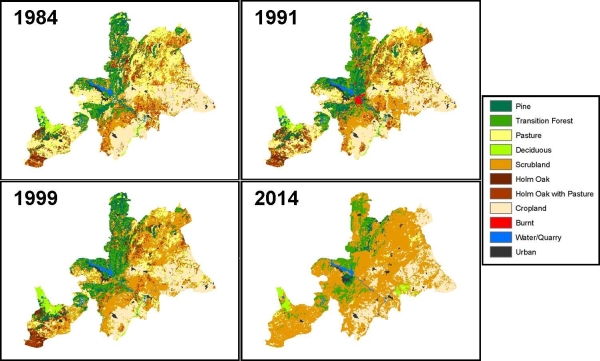
Figure 1.

Figure 1 above shows observed land cover for 3 years (1984 – 1999) for SPA 56, with a fourth map (2014) predicted from this data. Models run for observed periods of change for SPA 56 were found to have a pixel-by-pixel accuracy of up to 57%. That is, only just over half of the map was correctly predicted. Not so good really…

Pontius and colleagues have bemoaned such poor performance of models of this type, highlighting that models are often unable to perform even as well as the ‘null model of no change’. That is, assuming the landscape does not change from one point in time to another is often a better predictor of the landscape (at the second point in time) than a regression model! Clearly, maps of future land cover from these models should be understood as a projection of future land cover given observed trends continue unchanged into the future (i.e. the stationarity condition is maintained).

Acknowledgement of the stationarity assumption is perhaps more important, and more likely to be invalid, from a socio-economic perspective than biophysical. Whilst biophysical processes might be assumed to be relatively constant over decadal timescales (climatic change aside), this will likely not be the case for many socio-economic processes. With regard to SPA 56 for example, the recent expansion of the European Union to 25 countries, and the consequent likely restructuring of the Common Agricultural Policy (CAP), will lead to shifts in the political and economic forces driving LUCC in the region. The implication is that where socio-economic factors are important contributors to landscape change regression models are unlikely to be very useful for predicting future landscapes and making subsequent ecological interpretation or management decisions.

Because of the shortcomings of this type of model, alternative methods to better understanding processes of change, and likely future landscape states, will be useful. For example, hierarchical partitioning is a method for using statistical modelling in an explanatory capacity rather than for predictive purposes. Work I did on this with colleagues was recently accepted for publication by Ecosystems and I’ll discuss it in more detail tomorrow. The main thrust of my PhD however, is the development of an integrated socio-ecological simulation model that considers agricultural decision-making, vegetation dynamics and wildfire regimes.

Technorati Tag: , , ,

Generational Landscape Change: Montana and Madrid

It’a been out for a while (so there are several reviews available ) but I only just got and started reading Jared Diamond’s Collapse (How societies choose to fail or survive). I’ve only read the first part (Modern Montana) so far, but already I’ve come across several parallels between the socio-economic changes, and their potential ecological impacts, occuring in the landscapes under Montana’s Big Sky and Madrid’s Sun-Blessed Skies.

The broad similarity between the change Diamond describes in Montana and that occurring in my PhD study area (SPA 56, an EU protection area for endangered bird species to the west of Madrid, Spain) is the shift from an economy and landscape driven by agricultural activity to one driven by recreational activities. Such a shift reflects both the differing visions of multiple stakeholders within these landscapes, but also generational changes in attitude between older inhabitants and their children and grandchildren. In Montana’s Bitteroot Valley larger macroeconomic changes nationally and internationally have made previously profitable extractive industries (forestry, mining and agriculture) largely unsustainable economically. This has come about as land is now valued not according to resource and agricultural production but according to real-estate potential for incoming retirees, second-homers and tourists. Incoming (usually older) ‘out-of-staters’ arrive to enjoy the outdoor recreation (fishing, hiking, etc.), beauty and lifestyle opportunities, replacing the younger generation of Montanans going the other way to seek modern urban lifestyle opportunities and lifestyles;


“It’s a wonderful lifestyle to get up before dawn and see the sunrise, to watch fly hawks overhead, and to see deer jump through your hay field to avoid your haying equipment. … Occasionally I get up at 3 AM and work until 10 AM. This isn’t a 9 to 5 job. But none of our children will sign up for being a farmer if it is 3 AM to 10 PM every day.”

Dairy Farmer, Montana

Locals in SPA 56 have expressed similar feelings and ideas when I have visited over the last few years. Younger generations that would have previously continued the family farm that has passed through generation upon generation of farmers, are now seeking out employment in construction and service sectors to secure what is understood as a more ‘modern’ lifestyle. A lifestyle that affords leisure time at specified times of the week and at regular intervals (i.e. the weekends and paid holidays);


“Most farmers are part-time, maintaining the tradition agriculture. The children or grandchildren of those [farmers] do not have interest [in agriculture] because is it not profitable and requires a lot of dedication. The youths go or they seek other work.”

Local Development Official, Madrid (2006)

In Montana, Diamond describes the conflicts that have arisen between existing inhabitants and the new-comers, each with differing world-views, priorities and values. For example, contrast the attitudes of the third generation dairy farmer fighting to ensure the survival of his farm in the global economy vs. the lady who complained to him when she got manure on her white running shoes. Of course, these multiple perspectives within the landscape are inevitable in a changing world and tools and strategies must be found and employed to ensure appropriate decisions and compromises are made. In my simulation model of agricultural decision-making I have attempted to represent the influence of two differing world-views on landscape change (as have other modellers). I have termed the representative agents ‘commercial’ and ‘traditional’; the former behaving as a perfectly rational actor (in economic terms), the latter designed to reflect the importance of traditional cultural values in land-use decision-making;


“Whoever has a vineyard nowadays is like a gardener… they like to keep it, even if they lose money. They maintain vineyards because they have done it all their life and they like it, even having to pay for it. If owners were looking for profitability there would be not a singe vineyard… People here grow wine because of a matter of feeling, love for the land…”

Vinter, Madrid (2005)

As the primary thesis of his book Diamond highlights, for both contemporary and historical societies, the impacts of social, economic and technological change on the physical environment, and the sustainability of those changes. Of the several issues of concern in Montana, those related to forestry and water availability are likely to be of most concern in SPA 56. One particular interest of my PhD thesis is the importance of changes in the landscape for wildfire regimes, which Diamond discusses with reference to previous management strategies of the Unites States Forest Service (USFS). Commercial forestry has not been a widespread activity in SPA 56, the nature and human history of Mediterranean ecosystems restricting contemporary timber productivity. However, the problems of increased fuel loads due to the fire suppression policies of the USFS during the 20th century may be beginning to present themselves in SPA 56. If the agricultural sector continues to decline due to the social and economic trends just outlined, farmland will (continue to) be abanoned or converted to recreational uses (for example, hunting reservations). In turn this will leading to increased biomass and fuel loads in the landscape. As yet the consequences of such change on the frequency and magnitude of fires in the region is unclear due to spatial relationships and feedbacks between vegetation growth and burning. In the very near future the results of my simulation model will be able shed some light on this aspect of the region’s changing landscape and ecology.

Buy on Amazon


Diamond Reviews
GristMill
Ecological Economics
Futures

Ironies of the Flat World

Something very ironic just happened in my email inbox, a symptom of the Flat World if you like.

___________________________
Date: 05 Jan 07
Time: 17.29
Sender: Snowmail – Channel 4 News
Subject: Air rage
Message:
Jon Snow here with the newsroom latest

Air rage
==========

The irresponsible face of capitalism? This damning indictment of the airline industry came from the normally exceptionally mild mannered Ian Pearson, an environment minister.

Something undoubtedly got into his tea because he didn’t give up at that, his target specifically was the short-haul cheap flight carrier Ryanair, though he wasn’t very complimentary about British Airways either.

It’s a rare glimpse of antagonism between government and big business, and suggests that despite the appearance of a cozy consensus over climate change, real tensions are starting to emerge over who should pay the price of carbon emissions.

Yes it’s true that carbon emissions from the airline industry are set to triple in the next 20 years, and for every two per cent of efficiency and saving they make through updating planes and engines, the sheer growth of the business is double that, so their carbon footprint is getting worse by the day.

On the other hand, the government is rushing ahead with plans to increase airport capacity so that all these flights can land and take off. If they didn’t build the airports, the flights wouldn’t be able to happen, and carbon emissions – well, Britain’s anyway — wouldn’t increase by as much.

Cathy Newman is on the case but the minister is strangely shy again tonight and his government very far from excited from saying anything at all. Ryanair’s boss Michael O’Leary is voluble, describing the minister as a dead sheep.

Next email
___________________________
Date: 05 Jan 07
Time: 17.31
Sender: easyJet Newsletter
Subject: New Year Sale on flights, hotels and car rental!
Message:
Over 500,000 seats at under £21.99

Thanks to easyJet’s New Year Sale, you can now do more for less in 2007! Why not treat yourself to some winter sun, some ski slope fun or visit a new city with all the family?

We’ve got over 500,000 seats for sale at under £21.99 – but you need to be quick! This fantastic offer must end at midnight on Wednesday 10 January 2007.

These amazing discounts are on flights for travel between 24 January and 24 March 2007.

So don’t delay, book now at…

I shouldn’t laugh but it’s a case in point. Globalization in action in a Flat World. Something that Thomas Friedman would laud – but he doesn’t spare much time in his book to discuss the impacts of globalization on the environment. He does briefly discuss how certain organisations such as Conservation International are beginning to work ‘in partner’ with companies such as McDonalds to reduce environmental impacts (in ways that don’t negatively impact profits), but otherwise there’s nothing. I like the book; its a good, motivating read. I like and agree with the message – get innovating in the developed world or lose out to those who will in the developing world. But it seems to assume that whatever environmental problems we encounter, our innate creativity will be able to solve.

Fair enough, Friedman does suggests at one point that “While many of the old corporate and government safety nets will vanish under global competition in the flat world, some fat still needs to be maintained, and even added. As everyone who worries about his or her health knows, there is “good fat” and “bad fat” – but everybody needs some fat. And that is true of every country in the flat world. Social security is good fat. We need to keep it. A welfare system that discourages people from working is bad fat.” What about the good fat of our valuable and vital environmental resources upon which we base our economies? Our Natural Environment Security? Does that get a look in? It should do but it at the moment when the points are raised we just end up with laughable ironies like that illustrated from my inbox above. Nowhere in his book does he explicitly address this issue.

In his summary, Friedman quotes a business consultant speaking of companies’ demise; “When memories exceed dreams, the end is near”. True maybe, but when all we have are memories of a life-supporting natural environment our end will be upon us. We need to dream and innovate in the flat world, but we also need to remember where we came from and the environment in which we live and require to survive.

________________________
Friedman, T.L. (2006) The World is Flat (2nd Ed.) London: Penguin ISBN: 0-141-02272-8

Categories: , , ,

Stoic Bravery and the Bull Economy

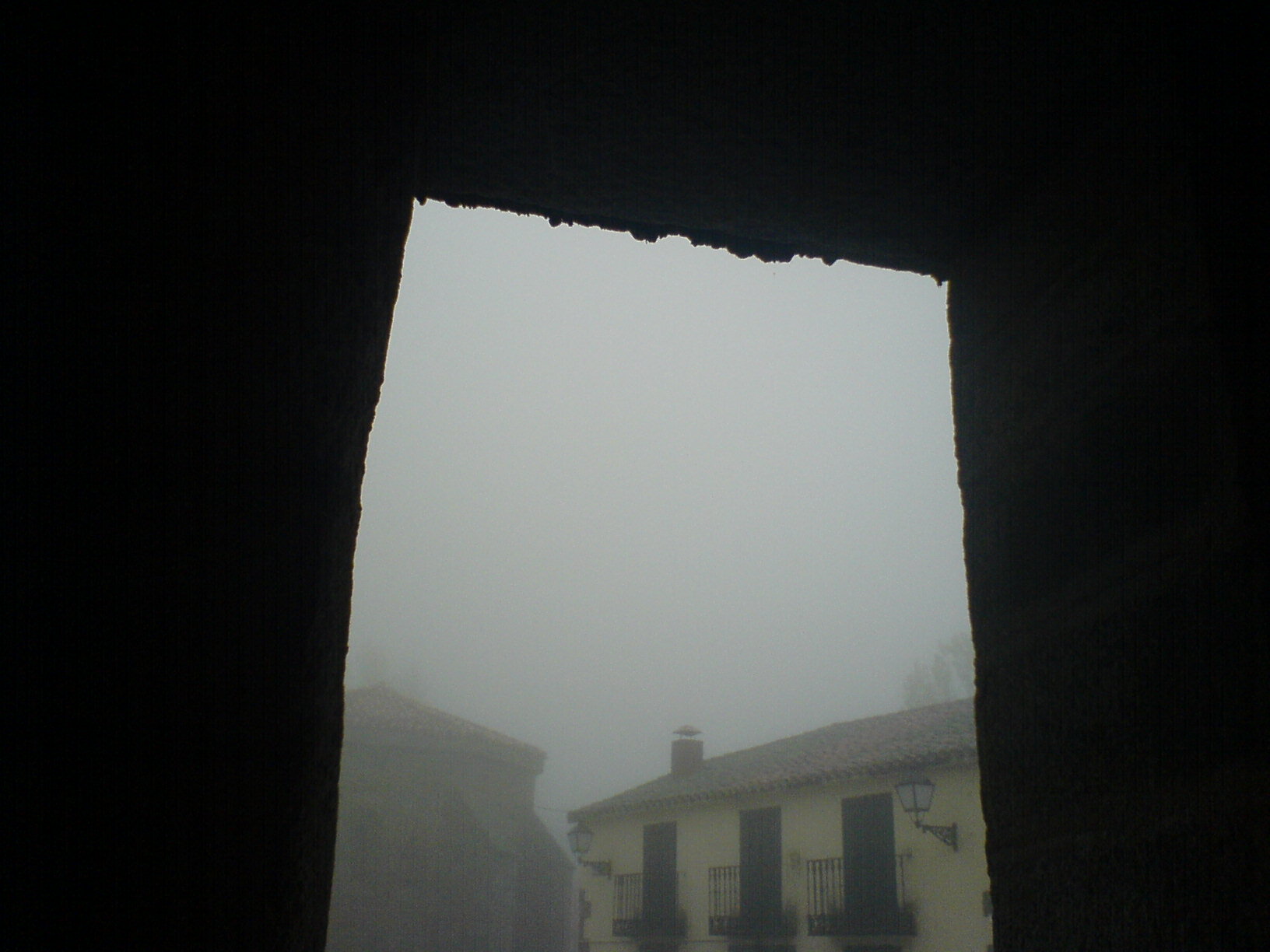
The rain in Spain stays mainly on the plain? Not when I’m there it doesn’t, then it follows me about. In this case all the way up to Santa Maria de la Alameda in the Sierra de Guadarrama.

Santa Maria de la Alameda
Quite a gloomy picture. We were up there interviewing the president of a local cattle farming organisation for some work related to my PhD. Earlier in the week we had been talking about bullfighting, and Raul had pointed out the large stones found in each corner of town squares, one on either side of the road, with large holes cut through them. The purpose of these holes is to hold wooden poles across the road, closing the square for the corrida de toros. As we waited for el presidente to arrive we sheltered from the rain in the porch of the ayuntamiento. Looking at the bullring’s cornerstones and the balconies that would allow spectators to overlook the confrontation, the town square reminded me of a story retold in Hemingway’s For Whom the Bell Tolls. On that occasion it wasn’t a bullfight, it was a civil war a massacre.

Hemingway’s leading characters display stoic bravery becoming, in Lawrence Broer’s view, “manifestations of the Spanish matador”;

The bull was on him as he jumped back and as he tripped on a cushion he felt the horn go into him, into his side. He grabbed the horn with his two hands and rode backward, holding tight onto the place. The bull tossed him and he was clear. He lay still. It was all right. The bull was gone.

He got up coughing and feeling broken and gone. The dirty bastards!

“Give me the sword”, he shouted. “Give me the stuff.”

Fuentes came up with the muleta and the sword.

Hernandez put his arm around him.

“Go on to the infirmary, man”, he said. “Don’t be a damn fool.”

“Get away from me”, Manuel said. “Get to hell away from me.”

He twisted free. Hernandez shrugged his shoulders. Manuel ran toward the bull.

There was the bull standing, heavy, firmly planted.

All right, you bastard! Manuel drew his sword out of the muleta, sighted with the same movement, and flung himself onto the bull. He felt the sword go in all the way. Right up to the guard. Four fingers and his thumb into the bull. The blood was hot on his knuckles, and he was on top of the bull.

The bull lurched with him as he lay on, and seemed to sink; then he was standing clear. He looked at the bull going down slowly over on his side, then suddenly four feet in the air.

Then he gestured at the crowd, his hand warm from the bull blood.

[from Ernest Hemingway, The Undefeated]

Down on the plains of Madrid below Santa Maria, the rain has stopped and the attitude seems more ‘spirited optimism’ than ‘stoic bravery’. The Spanish economy is booming, with GDP steadily rising year on year.

The environs of Madrid feel positive, the attitude is ‘go-ahead’. Cranes are everywhere, more than in London probably. Apartments being thrown up rapidly. New roads and motorways being constructed apace. It’s been like that the last few years I’ve been visiting.

Further out, within range of the commuters (going into Madrid) and the day-trippers (coming out), economic change is modifying the landscape. The agricultural sector is in decline and as the younger generation seeks out employment in manufacturing, construction and service sectors. Talking to people in my study area it seems such employment is desired as it brings more stable working hours, more benefits, greater leisure time and a more ‘modern’ lifestyle. The environmental consequences of these shifts are still playing themselves out however. For example, such a lifestyle is likely to require more water, a precious resource in the Mediterranean. Environmentalists still campaign against large dam projects and the environmental impacts of tourism along the Costa del Sol and the Balearic Isles are well known. Maybe James ‘The Bringer of Rain’ Millington should spend more time in those places…

My particular interest is the impact of agricultural change on wildfire regimes; will the spirited optimism have to be tempered by some stoic bravery in the face of increasing wildfire risk? I’m nearing the end of my PhD research now so I hope to be able to comment on that with more authority in the near future.

Categories: , , , , , , , , , , ,

Lester Brown: Plan B 2.0

We went straight from the pub to Lester Brown’s lecture at MSU this evening so I didn’t have a pen or pad of paper with me. I need to jot something down before I forget so why don’t I blog it…

President of the Earth Policy Institute, Lester Brown’s talk was based largely around his recently updated book Plan B 2.0. Essentially this was an ecological economics discussion, and many of his examples echoed what I heard at the THEMES summer school earlier this year (did I blog that yet? I should). For example, one clear message was that biofuels (ethanol) is NOT a viable alternative to gasoline for running cars; the resources and area demanded to grow the products to produce the biofuel are to great to ensure it’s economic or ecological viability. A more sustainable alternative presented was wind power; the US could satisfy its annual electricity needs by installing wind turbines in just the three windiest states (I forget which they are). If the number of hybrid electricity/gasoline cars increased this wind power could be efficiently harnessed, stored and used for travel.

Orders for wind turbines globally are so high that waiting lists for production currently stretch to 2008. Why not use the infrastructure already in place in the form of automobile factories to constuct these wind turbines? Unfeasible? Not possible? The example of the shift from automobilie manufacture to arms manufacture in the US during the second World War shows that “where there’s a will there’s a way”.

But do we want have the will? Are we in denial? Why is it so easy to persuade ourselves that there isn’t a problem? Lester Brown suggests that one reason is that we’re not doing our economics properly; we’re hiding many of the costs of the products we produce just as Enron did before their collapse. It may only ‘cost’ $3 to produce a packet of cigarettes (at least that’s the cost they could sell at before tax), but when you factor in ecological and human health into the equation we find that it actually costs $7 in terms of ecosystem and health services.

Echoing Al Gore in his recent movie (still need to blog about that), unless the environmental question is on the lips of the constituent when they meet their political representative, these issues can get swept under the carpet. We need to have the will to make the necessary changes, and we need to let our politicians know we want that change.

And I need to get some sleep so that my presentation tomorrow doesn’t collapse into farce…

Categories: , , , , , , , ,