Ironies of the Flat World

Something very ironic just happened in my email inbox, a symptom of the Flat World if you like.

___________________________
Date: 05 Jan 07
Time: 17.29
Sender: Snowmail – Channel 4 News
Subject: Air rage
Message:
Jon Snow here with the newsroom latest

Air rage
==========

The irresponsible face of capitalism? This damning indictment of the airline industry came from the normally exceptionally mild mannered Ian Pearson, an environment minister.

Something undoubtedly got into his tea because he didn’t give up at that, his target specifically was the short-haul cheap flight carrier Ryanair, though he wasn’t very complimentary about British Airways either.

It’s a rare glimpse of antagonism between government and big business, and suggests that despite the appearance of a cozy consensus over climate change, real tensions are starting to emerge over who should pay the price of carbon emissions.

Yes it’s true that carbon emissions from the airline industry are set to triple in the next 20 years, and for every two per cent of efficiency and saving they make through updating planes and engines, the sheer growth of the business is double that, so their carbon footprint is getting worse by the day.

On the other hand, the government is rushing ahead with plans to increase airport capacity so that all these flights can land and take off. If they didn’t build the airports, the flights wouldn’t be able to happen, and carbon emissions – well, Britain’s anyway — wouldn’t increase by as much.

Cathy Newman is on the case but the minister is strangely shy again tonight and his government very far from excited from saying anything at all. Ryanair’s boss Michael O’Leary is voluble, describing the minister as a dead sheep.

Next email
___________________________
Date: 05 Jan 07
Time: 17.31
Sender: easyJet Newsletter
Subject: New Year Sale on flights, hotels and car rental!
Message:
Over 500,000 seats at under £21.99

Thanks to easyJet’s New Year Sale, you can now do more for less in 2007! Why not treat yourself to some winter sun, some ski slope fun or visit a new city with all the family?

We’ve got over 500,000 seats for sale at under £21.99 – but you need to be quick! This fantastic offer must end at midnight on Wednesday 10 January 2007.

These amazing discounts are on flights for travel between 24 January and 24 March 2007.

So don’t delay, book now at…

I shouldn’t laugh but it’s a case in point. Globalization in action in a Flat World. Something that Thomas Friedman would laud – but he doesn’t spare much time in his book to discuss the impacts of globalization on the environment. He does briefly discuss how certain organisations such as Conservation International are beginning to work ‘in partner’ with companies such as McDonalds to reduce environmental impacts (in ways that don’t negatively impact profits), but otherwise there’s nothing. I like the book; its a good, motivating read. I like and agree with the message – get innovating in the developed world or lose out to those who will in the developing world. But it seems to assume that whatever environmental problems we encounter, our innate creativity will be able to solve.

Fair enough, Friedman does suggests at one point that “While many of the old corporate and government safety nets will vanish under global competition in the flat world, some fat still needs to be maintained, and even added. As everyone who worries about his or her health knows, there is “good fat” and “bad fat” – but everybody needs some fat. And that is true of every country in the flat world. Social security is good fat. We need to keep it. A welfare system that discourages people from working is bad fat.” What about the good fat of our valuable and vital environmental resources upon which we base our economies? Our Natural Environment Security? Does that get a look in? It should do but it at the moment when the points are raised we just end up with laughable ironies like that illustrated from my inbox above. Nowhere in his book does he explicitly address this issue.

In his summary, Friedman quotes a business consultant speaking of companies’ demise; “When memories exceed dreams, the end is near”. True maybe, but when all we have are memories of a life-supporting natural environment our end will be upon us. We need to dream and innovate in the flat world, but we also need to remember where we came from and the environment in which we live and require to survive.

________________________
Friedman, T.L. (2006) The World is Flat (2nd Ed.) London: Penguin ISBN: 0-141-02272-8

Categories: , , ,

Stoic Bravery and the Bull Economy

The rain in Spain stays mainly on the plain? Not when I’m there it doesn’t, then it follows me about. In this case all the way up to Santa Maria de la Alameda in the Sierra de Guadarrama.

Santa Maria de la Alameda
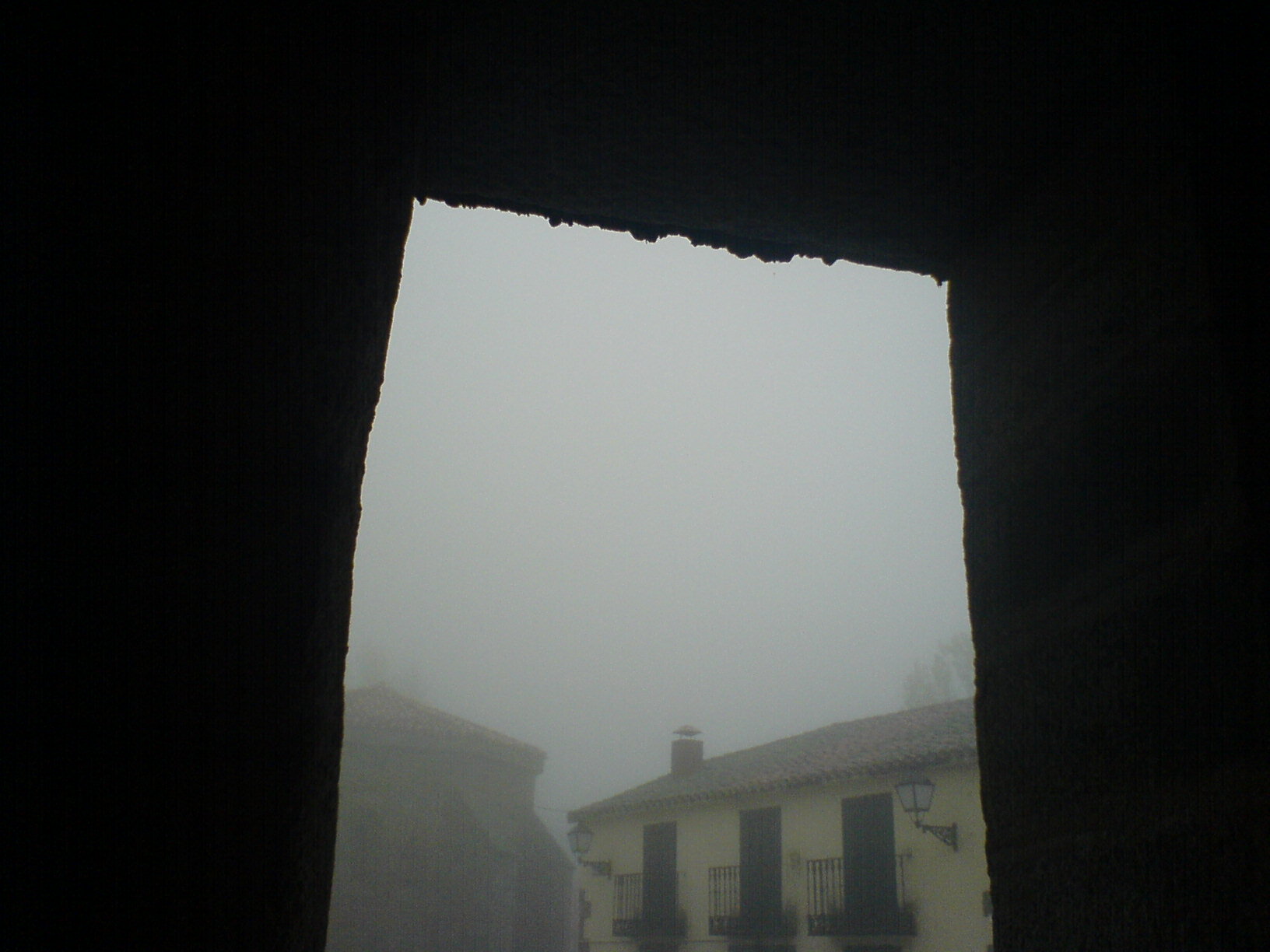
Quite a gloomy picture. We were up there interviewing the president of a local cattle farming organisation for some work related to my PhD. Earlier in the week we had been talking about bullfighting, and Raul had pointed out the large stones found in each corner of town squares, one on either side of the road, with large holes cut through them. The purpose of these holes is to hold wooden poles across the road, closing the square for the corrida de toros. As we waited for el presidente to arrive we sheltered from the rain in the porch of the ayuntamiento. Looking at the bullring’s cornerstones and the balconies that would allow spectators to overlook the confrontation, the town square reminded me of a story retold in Hemingway’s For Whom the Bell Tolls. On that occasion it wasn’t a bullfight, it was a civil war a massacre.

Hemingway’s leading characters display stoic bravery becoming, in Lawrence Broer’s view, “manifestations of the Spanish matador”;

The bull was on him as he jumped back and as he tripped on a cushion he felt the horn go into him, into his side. He grabbed the horn with his two hands and rode backward, holding tight onto the place. The bull tossed him and he was clear. He lay still. It was all right. The bull was gone.

He got up coughing and feeling broken and gone. The dirty bastards!

“Give me the sword”, he shouted. “Give me the stuff.”

Fuentes came up with the muleta and the sword.

Hernandez put his arm around him.

“Go on to the infirmary, man”, he said. “Don’t be a damn fool.”

“Get away from me”, Manuel said. “Get to hell away from me.”

He twisted free. Hernandez shrugged his shoulders. Manuel ran toward the bull.

There was the bull standing, heavy, firmly planted.

All right, you bastard! Manuel drew his sword out of the muleta, sighted with the same movement, and flung himself onto the bull. He felt the sword go in all the way. Right up to the guard. Four fingers and his thumb into the bull. The blood was hot on his knuckles, and he was on top of the bull.

The bull lurched with him as he lay on, and seemed to sink; then he was standing clear. He looked at the bull going down slowly over on his side, then suddenly four feet in the air.

Then he gestured at the crowd, his hand warm from the bull blood.

[from Ernest Hemingway, The Undefeated]

Down on the plains of Madrid below Santa Maria, the rain has stopped and the attitude seems more ‘spirited optimism’ than ‘stoic bravery’. The Spanish economy is booming, with GDP steadily rising year on year.

The environs of Madrid feel positive, the attitude is ‘go-ahead’. Cranes are everywhere, more than in London probably. Apartments being thrown up rapidly. New roads and motorways being constructed apace. It’s been like that the last few years I’ve been visiting.

Further out, within range of the commuters (going into Madrid) and the day-trippers (coming out), economic change is modifying the landscape. The agricultural sector is in decline and as the younger generation seeks out employment in manufacturing, construction and service sectors. Talking to people in my study area it seems such employment is desired as it brings more stable working hours, more benefits, greater leisure time and a more ‘modern’ lifestyle. The environmental consequences of these shifts are still playing themselves out however. For example, such a lifestyle is likely to require more water, a precious resource in the Mediterranean. Environmentalists still campaign against large dam projects and the environmental impacts of tourism along the Costa del Sol and the Balearic Isles are well known. Maybe James ‘The Bringer of Rain’ Millington should spend more time in those places…

My particular interest is the impact of agricultural change on wildfire regimes; will the spirited optimism have to be tempered by some stoic bravery in the face of increasing wildfire risk? I’m nearing the end of my PhD research now so I hope to be able to comment on that with more authority in the near future.

Categories: , , , , , , , , , , ,

skytower (not rugby)

England’s loss to the All Blacks on Saturday reminded me of an email I sent over a year ago from New Zealand, detailing my adventures on the day after the Lions first crushing defeat of their tour. I’ve posted it here for posterity…

Sunday 26th June 2005

Hi Guys! Only me. I know what you’re thinking; “Oh No, it’s that boring bloke on the other side of the world with another email the length of my arm rambling and ranting about rubbish…”. Don’t worry this one’s shorter (maybe) but definitely has more pictures.

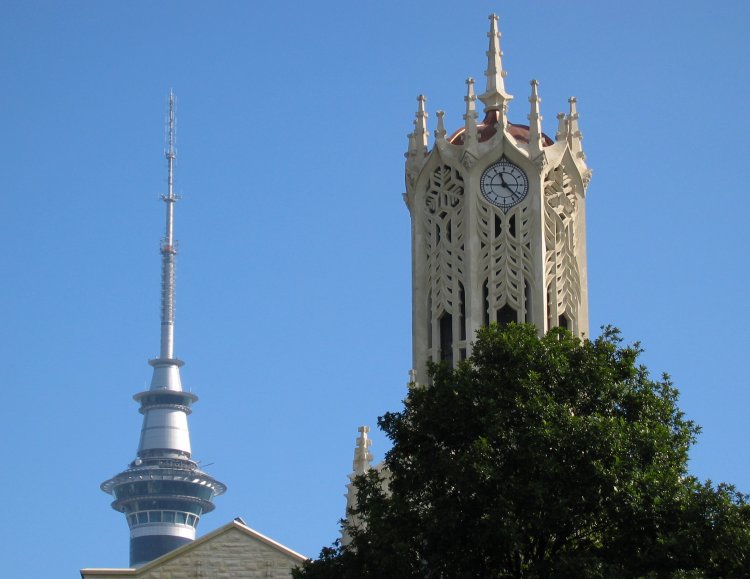
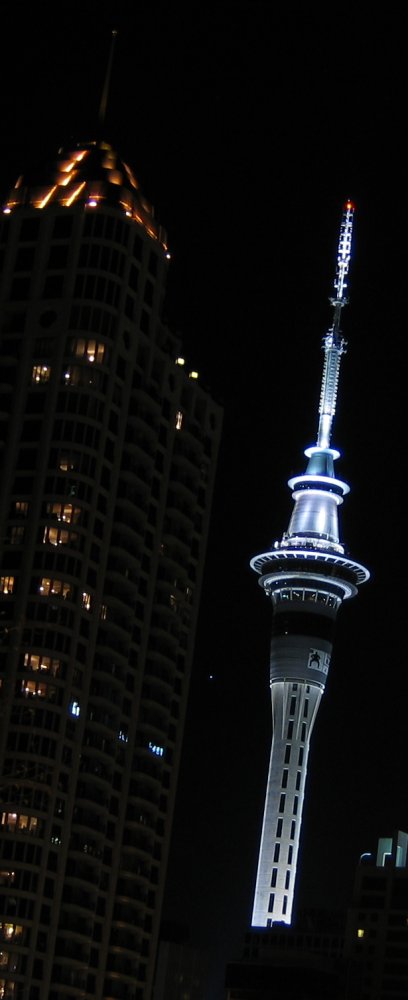
The Skytower: Auckland’s newest landmark and the tallest human-made structure in the Southern Hemisphere (does that make it the shortest in the Northern Hemisphere?). The Skytower is your point of reference for navigating this city, you can see it from pretty much everywhere and it always seems to be lurking in the background somewhere. Look at the first pic of the University of Auckland Clock Tower.


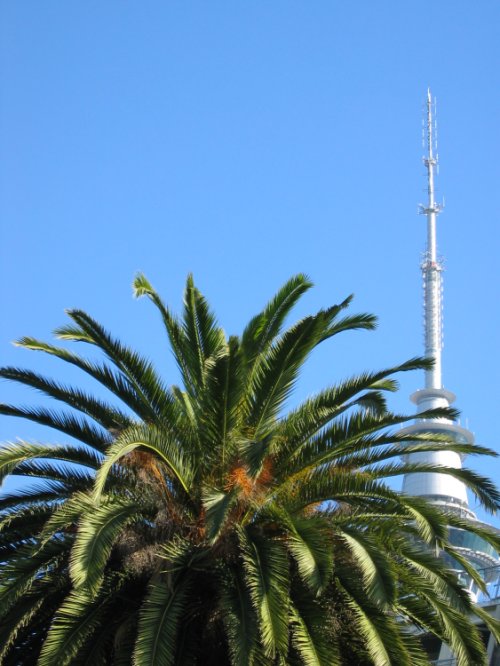
Quite nice eh? But there’s the Skytower loitering in the background trying to steal some of the limelight. And then here’s me, an honest Geographer trying to improve my botanical knowledge of the local flora and there’s the lanky thing looming in the wings again.


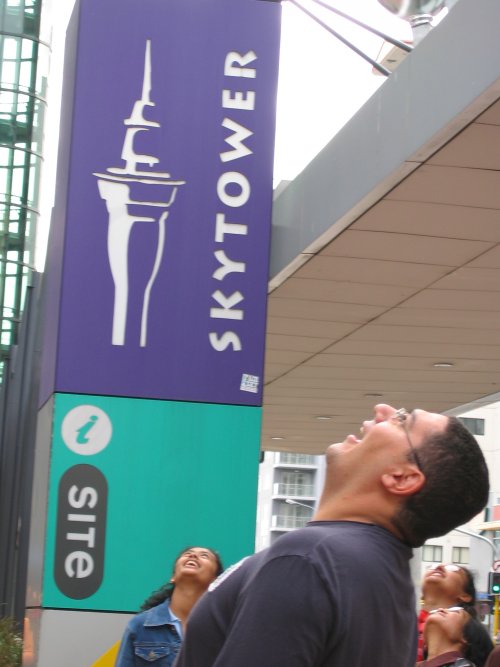
So nursing my Sunday hangover (I had a lot of sorrows to drown on Saturday evening – but let’s not talk about the Rugby, I’ve heard enough already) and seeing from under the covers that it was a nice day I thought I’d go and see what the view was like. As with all really-tall-landmarks-in-big-cities-that-you-have-to-go-up-to-see-what-the-view-is-like, and because you’re always noting it from afar, when you get to the bottom you HAVE to look UP. Case in point;


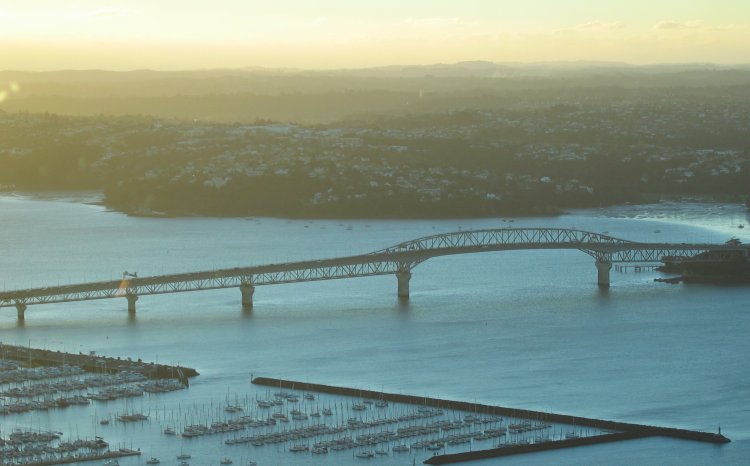
As you’ve paid your money and climbed all the way to the top (well actually you took the lift didn’t you?) you may as well check out the view. A prime here, as Auckland’s Harbour bridge basks in the evening sun and a flotilla of sailing boats bob in the foreground (Auckland is the “city of sails” doncha know?). Very pretty.


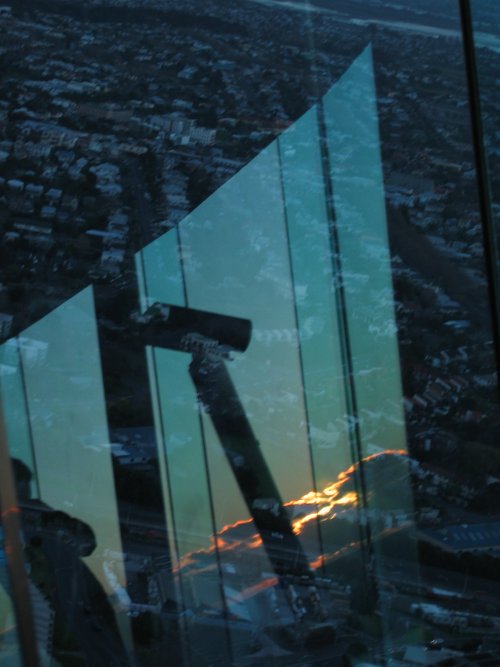
Then you think, “Doesn’t Auckland sprawl an awful lot” (sorry to go on about it). The harbour’s nice, you can see for miles ‘cos its a nice day and you can see a couple of old volcanoes hanging out in the background. Then you start daydreaming ‘cos you really can’t think straight after last night and you try to take some fancy reflexive-type photos to reflect how really spaced out everything feels. But there’s something missing…


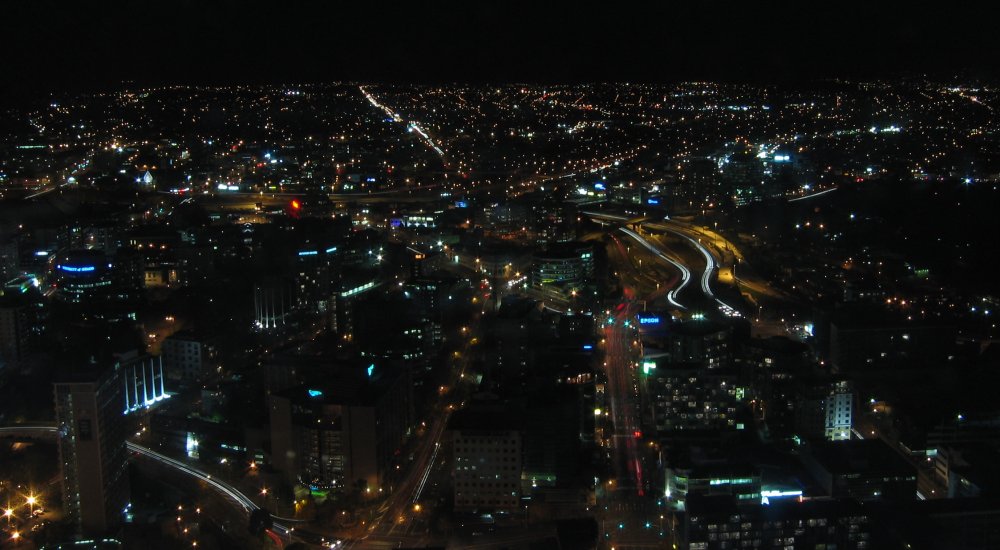
No matter, lets mess aroung taking some night shots. You’re no Hannes Opelz; but who’d want to be? you chuckle to yourself.


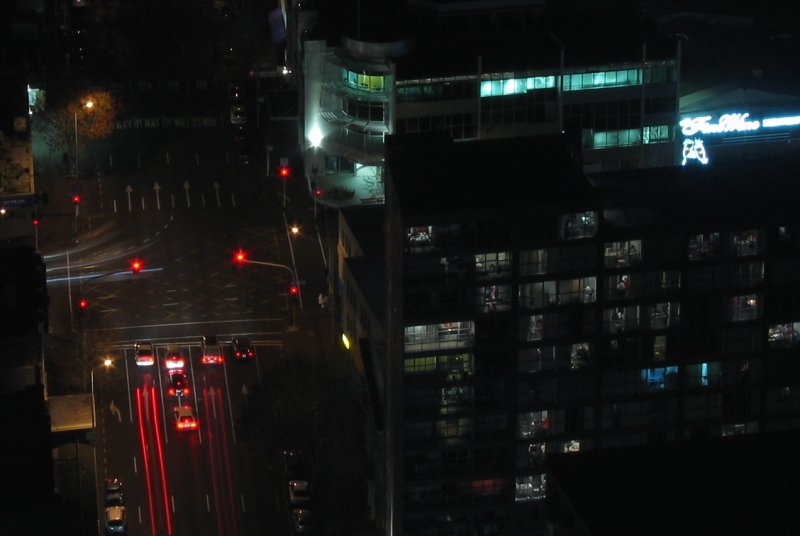
Jeez this is a bad hangover. Not as bad as we played last night though. What are those people doing in that window?


So in the lift on way back down I got chatting to the girl who clearly saw my photographic prowes when she asked me to take her photo with Auckland as backdrop (“OK, where’s the loser wandering aimlessly around in a daze and won’t mind taking my photo” she was more likely to be thinking to herself; she knew she’d struck gold when she saw me). She asked me what I thought of the view; the sound of cogs grinding echoed around the lift as I struggled to string a sentence together (we really did play badly didn’t we? But those sorrows didn’t have an chance even in the “city of sails” and its many life-bouys). And then it dawned. It’s a good view from the top. Auckland looks nice in the sunset on a nice day. And the city-scape at night is cool.

But the thing that is missing is the thing you’re stood in. The Skytower is nowhere to be seen and you’re free of that feeling that there’s someone looking over your shoulder. At least that’s what I thought. I’m not sure what the noises coming out of my mouth sounded like…

Categories: , , , , ,

Bill Cronon: Secular Apocaplyse


I saw this photo a couple of days ago. It’s a comparison of the state of a Chilean glacier in 1928 with 2004. The glacier is retreating by 14 metres per year, attributed by scientists to a warming of the global climate. At that rate of retreat the it could be gone in 25 years. Look at that panorama though – would’t it be great to go and see that before it’s gone? Imagine if you were stood there confronted by this awesome sight, what would you be thinking? Greenpeace have been pretty sneaky though (as they have a right to be). Using those beautiful photos that would stick in my mind; when I arrived at that vista I might just think, “I contributed to this”.

I made a point of going to see Bill Cronon at the Thursday morning plenary “Narrative of climate change” at the RGS conference. He suggested that narratives of climate change have been used as both prediction AND (secular) prophecy. This idea of a secular prophecy comes from recent intonations of Nature as a secular proxy for God. Prophecies are often told as stories of retribution that will be incurred if God’s laws were broken. If Nature is a proxy for God then Climate Change is portrayed as a retribution for humans breaking the laws of Nature.

Cronon suggests that Global Narratives are abstract, virtual, systemic, remote, vast, have a diffuse sense of agency, posses no individual characters (i.e. no heros/villains), and are repetitive (so boring). These characteristics make it difficult to emphasise and justify calls for human action to mitigate against the anthropic influence on the climate. Cronon suggests these types of prophetic narrative are ‘unsustainable’ because they do not offer the possibility of individual or group action to reverse or address global climate problems, and therefore are no use politically or socially.

Coronon went on to discuss the micro-cosms (micro narratives) Elizabeth Kolbert uses in her book “Field Notes from a Catastrophe” to illustrate the impacts of global change in a localised manner. She uses individual stories that are picked because they are not expected, they are non-abstract and the antithesis of the unsustainable global narratives. He concluded that we need narratives that offer hope, and not those tied to social and political models based on anarchic thought that do not address the systemic issues driving the change itself. This is the political challenge he suggests – to create narratives that not only make us think “I contributed to this” when we see evidence of glacier retreat, but that offer us hope of finding ways to reduce our future impact upon the environment.

RGS 2006: Day One

I went to the participatory techniques showcase session on the first day of the RGS annual conference. Nick Lunch (from Insight) made an interesting presentation on Participatory Video – something they call a “community empowerment tool”, but also a way it seems to me of eliciting local knowledge and understandings. I’d suggest that when modelling the interaction between local communities and their environment, this would be a good way to enable the modeller to improve their understanding of the what the problem is and what the key variables and parameters that need to be considered in a model are.

Nick also said that insight have found that one of the techniques best uses was as a catalyst to ‘do things’ and initiate local action within their communities. I can see why this might the case – I’ve found this blog enables me to ‘get things done’ too. It’s given me confidence just to start writing and prompted me to record my thought processes better (both on and off blog) – something I haven’t been strict enough about with myself during the PhD modelling project. This is defintiely a lesson learned from my PhD work and something I want to make sure I do better in the next project I tackle.

It also helps to “crystalise one’s thoughts” as one colleague put it. I often have several ideas swirling around in my head at once, and ususally have a general ‘impression’ of how they relate. But it’s not until I write it down that I really understand – writing something in prose really demands the idea is properly understood. The process of writing clearly aids the process of understanding. And whilst writing in prose helps to shore up these loosely tied ideas, coding demands an even more explicit understanding. This is where I see the worth of the process of generating a simulation model in itself.

Depending upon how much a modeller wishes to publish online, a blog might be an interesting way to demonstrate the modelling process and a way to document and highlight the dead ends that a modelling project often finds itself following. Mike Bithell suggested in a presentation later on the first day at the RGS conference that that the limitations of modelling often cannot be explored without going through the process of producing a model itself. From some of the issues I’ve encountered in my modelling exploits, I can understand what he means.

Landscape Influences Human Social Interaction

Scientific American: Landscape Influences Human Social Interaction

Thay know all about this in Spain. One of the presentations at the THEMES Summer School I was at in June was all about the current problems in the Barcelona suburbs as people decide they want nice green lawns like they see on Desperate Housewives.

Domene E., Sauri D., Parés M. 2005, ‘Urbanization and Sustainable
Resource Use: The Case of Garden Watering in the Metropolitan Region of Barcelona’,
Urban Geography, Vol.26, Number 6, pp.520-535.

So maybe it’s “natural” for us to want to live in “unnatural” surroundings…

RGS Programme

The programme for this year’s RGS-IBG Annual Conference was published today. I’m presenting two papers:

  1. ‘A simulation model of vegetation dynamics and
    wildfire for a Mediterranean landscape’ in PGF & QMRG Session ‘Postgraduate research in quantitative geography‘, 9am Friday 1st September
  2. ‘Modelling Feedbacks between land-use decision-making and ecological processes in a Mediterranean landscape‘ in QMRG Session ‘Social simulation & modelling complexity’, 2pm Friday 1st September