EGU 2007 Poster

I’m not attending the European Geophysics Union General Assembly this year as I have done the past couple. However, I do have a poster there (today, thanks to Bruce Malamud for posting it) on some work I have been doing with Raul Romero Calcerrada at Universidad Rey Juan Carlos in Madrid, Spain. We have been using various spatial statistical modelling techniques to examine the spatial patterns and causes (including both socioeconomic and biophysical) of wildfire ignition probabilities in central Spain. The poster abstract is presented below and we’re working on writing a couple of papers related to this right now.

Spatial analysis of patterns and causes of fire ignition probabilities using Logistic Regression and Weights-of-Evidence based GIS modelling
R. Romero-Calcerrada, J.D.A. Millington
In countries where more than 95% of wildfires are caused by direct or indirect human activity, such as those in the Iberian Peninsula, ignition risk estimation must consider anthropic influences. However, the importance of human factors has been given scant regard when compared to biophysical factors (topography, vegetation and meteorology) in quantitative analyses of risk. This disregard for the primary cause of wildfires in the Iberian Peninsula is owed to the difficulties in evaluating, modelling and representing spatially the human component of both fire ignition and spread. We use logistic regression and weights-of-evidence based GIS modelling to examine the relative influence of biophysical and socio-economic variables on the spatial distribution of wildfire ignition risk for a six year time series of 508 fires in the south west of the Autonomous Community of Madrid, Spain. We find that socioeconomic variables are more important than biophysical to understand spatial wildfire ignition risk, and that models using socioeconomic data have a greater accuracy than those using biophysical data alone. Our findings suggest the importance of socioeconomic variables for the explanation and prediction of the spatial distribution of wildfire ignition risk in the study area. Socioeconomic variables need to be included in models of wildfire ignition risk in the Mediterranean and will likely be very important in wildfire prevention and planning in this region.

Logistic Regression for LUCC Modelling

This post is my third contribution to JustScience week.

In Land Use/Cover Change (LUCC) studies, empirical (statistical) models use the observed relationship between independent variables (for example mean annual temperature, human population density) and a dependent variable (for example land-cover type) to predict the future state of that dependent variable. The primary limitation of this approach is the inability to represent systems that are non-stationary.

Non-stationary systems are those in which the relationships between variables are changing through time. The assumption of stationarity rarely holds in landscape studies – both biophysical (e.g. climate change) and socio-economic driving forces (e.g. agricultural subsidies) are open to change. Two primary empirical models are available for studying lands cover and use change; transition matrix (Markov) models and regression models. My research has particularly focused on the latter, particularly the logistic regression model.


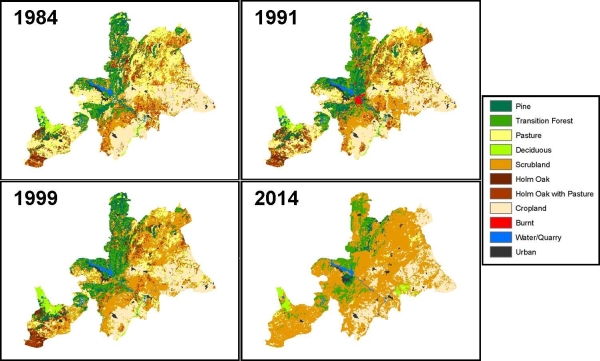
Figure 1.

Figure 1 above shows observed land cover for 3 years (1984 – 1999) for SPA 56, with a fourth map (2014) predicted from this data. Models run for observed periods of change for SPA 56 were found to have a pixel-by-pixel accuracy of up to 57%. That is, only just over half of the map was correctly predicted. Not so good really…

Pontius and colleagues have bemoaned such poor performance of models of this type, highlighting that models are often unable to perform even as well as the ‘null model of no change’. That is, assuming the landscape does not change from one point in time to another is often a better predictor of the landscape (at the second point in time) than a regression model! Clearly, maps of future land cover from these models should be understood as a projection of future land cover given observed trends continue unchanged into the future (i.e. the stationarity condition is maintained).

Acknowledgement of the stationarity assumption is perhaps more important, and more likely to be invalid, from a socio-economic perspective than biophysical. Whilst biophysical processes might be assumed to be relatively constant over decadal timescales (climatic change aside), this will likely not be the case for many socio-economic processes. With regard to SPA 56 for example, the recent expansion of the European Union to 25 countries, and the consequent likely restructuring of the Common Agricultural Policy (CAP), will lead to shifts in the political and economic forces driving LUCC in the region. The implication is that where socio-economic factors are important contributors to landscape change regression models are unlikely to be very useful for predicting future landscapes and making subsequent ecological interpretation or management decisions.

Because of the shortcomings of this type of model, alternative methods to better understanding processes of change, and likely future landscape states, will be useful. For example, hierarchical partitioning is a method for using statistical modelling in an explanatory capacity rather than for predictive purposes. Work I did on this with colleagues was recently accepted for publication by Ecosystems and I’ll discuss it in more detail tomorrow. The main thrust of my PhD however, is the development of an integrated socio-ecological simulation model that considers agricultural decision-making, vegetation dynamics and wildfire regimes.

Technorati Tag: , , ,

Adaption not Mitigation

There’s a lot written about climate change on web 2.0 – and there’s about to be a lot more written about it over the coming weeks. The impending release of the Intergovernmental Panel on Climate Change (IPCC) 4th Assessment Report is going to have plenty for the commentators and bloggers to chew on. If you were so inclined it would take you quite a while to get through it all. But if there is one thing I think you should read about climate change in the light of the latest IPCC report it’s Maragret Wente’s piece (re)posted on Seeker.

The important point raised is that although much gets written about climate change mitigation, it is at the expense of discussion about climate change adaptation.

This is not a new point – Rayner and Malone wrote about it in Nature a decade ago, and I even got the message in my third year undergrad climate modelling course. Although reducing carbon emissions is important it may not halt what has already started, and we would do well to get thinking about the best adaptation strategies to the consequences of a changing climate. Of course, we should continue working to reduce our carbon emissions. But we need to accept that, regardless of whether the change is human induced or not, in all probability the climate is changing and we need to be prepared for the consequences.

I’ve posted what I think is the more relevant section below, but the whole thing is very interesting: read the whole article;


The climate debate focuses almost entirely on mitigation (how we can slow down global warming). But climate scientists and policy experts say that in the short term — our lifetimes — our most important insurance policy is adaptation. Nothing we do to cut emissions will reduce the risk from hurricanes or rising seas in the short term. But there are other ways to reduce the risk. We can build storm-surge defences, stop building in coastal areas and make sure we protect our fresh-water supplies from salination. We also can develop crops that will do well in hotter climates.

‘Adaptation’ is not a word that figures much in climate-change debates. Activists (and much of the general public) think it sounds lazy and defeatist. But the experts talk about adaptation all the time.

Technorati Tags: , , , , ,

Generative Landscape Science

A paper from the recent special issue of Professional Geographer (and discussed briefly here) of particular interest to me, as it examines and emphasises an approach and perspective similar to my own, was that by Brown et al. (2006). They suggest that a generative landscape science, one which considers the implications microscale processes for macroscale phenomena, offers a complementary approach to explanation via other methods. Such an approach would combine ‘bottom-up’ models of candidate processes, believed to give rise to observed patterns, with empirical observations, predominantly through individual-based modelling approaches such as agent-based models. There are strong parallels between modelling in a generative landscape science approach and the pattern-oriented modelling of agent-based systems in ecology discussed by Grimm et al. (1995). As a result of the theory-ladeness of data (Oreskes et al. 1994) and issues of equifinality (Beven 2002) landscape modellers often find themselves encountering an ‘interesting’ issue (as Brown et al. put it):


“we may understand well the processes that operate on a landscape, but still be unable to make accurate predictions about the outcomes of those processes.”

Thus, whilst pattern-matching of (model and observed) system-level properties from models of microscale interactions may be useful for examining and explaining system structure, it does not imply prediction is necessarily possible. There is a distinction between pattern-matching for validation (sensu Oreskes and Beven) and pattern-matching for understanding (via strong inference), but it is a fine line. If we say, “Model 1 uses structure A and Model 2 uses structure B, Model 1 reproduces observed patterns at multiple scales more accurately than Model 2, so Model 1 is more like reality, and therefore we understand reality better”, we’re still left with the problems of equifinality.

And so (rightly IMHO) in turn, Brown et al. suggest that whilst the use of pattern-matching exercises to evaluate and interpret models will be useful, we should wary of an over-emphasis on these techniques at the expense of intuition and deduction. This perspective partly contributed to my investigation of the use of ‘stakeholder assessment’ to evaluate the landscape change model I’ve been developing as part of my PhD.

In conclusion Brown et al. suggest a generative component (i.e. exploiting individual- and process-based modelling approaches) in landscape science will help;

  • develop and encode explanations that combine multiple scales
  • evaluate the implicaitons of theory
  • identify and structure needs for empirical investigation
  • deal with uncertainty
  • highlight when prediction may not be a reasonable goal

This modelling approach adopts perspective that is characteristic of recent attitudes toward the uses and interpretation of models arising recently in other areas of simulation modelling (e.g. Beven in hydrology and Moss and Edmonds in social science) and is also resonant with perspectives arising from critical realism (without explicitly discussing ontology). As such their discussion is illustrative of recent trends environmental and social simulation with some good modelling examples from Elk-Wolf population dynamics in Yellowstone National Park, and places the discussion in a context and forum in which individuals with backgrounds in Geography, GIScience and Landscape Ecology can all associate.

Reference
Daniel G. Brown, Richard Aspinall, David A. Bennett (2006)
Landscape Models and Explanation in Landscape Ecology—A Space for Generative Landscape Science?
The Professional Geographer 58 (4), 369–382.
doi:10.1111/j.1467-9272.2006.00575.x

Technorati Tags: , , , , , , ,

Generational Landscape Change: Montana and Madrid

It’a been out for a while (so there are several reviews available ) but I only just got and started reading Jared Diamond’s Collapse (How societies choose to fail or survive). I’ve only read the first part (Modern Montana) so far, but already I’ve come across several parallels between the socio-economic changes, and their potential ecological impacts, occuring in the landscapes under Montana’s Big Sky and Madrid’s Sun-Blessed Skies.

The broad similarity between the change Diamond describes in Montana and that occurring in my PhD study area (SPA 56, an EU protection area for endangered bird species to the west of Madrid, Spain) is the shift from an economy and landscape driven by agricultural activity to one driven by recreational activities. Such a shift reflects both the differing visions of multiple stakeholders within these landscapes, but also generational changes in attitude between older inhabitants and their children and grandchildren. In Montana’s Bitteroot Valley larger macroeconomic changes nationally and internationally have made previously profitable extractive industries (forestry, mining and agriculture) largely unsustainable economically. This has come about as land is now valued not according to resource and agricultural production but according to real-estate potential for incoming retirees, second-homers and tourists. Incoming (usually older) ‘out-of-staters’ arrive to enjoy the outdoor recreation (fishing, hiking, etc.), beauty and lifestyle opportunities, replacing the younger generation of Montanans going the other way to seek modern urban lifestyle opportunities and lifestyles;


“It’s a wonderful lifestyle to get up before dawn and see the sunrise, to watch fly hawks overhead, and to see deer jump through your hay field to avoid your haying equipment. … Occasionally I get up at 3 AM and work until 10 AM. This isn’t a 9 to 5 job. But none of our children will sign up for being a farmer if it is 3 AM to 10 PM every day.”

Dairy Farmer, Montana

Locals in SPA 56 have expressed similar feelings and ideas when I have visited over the last few years. Younger generations that would have previously continued the family farm that has passed through generation upon generation of farmers, are now seeking out employment in construction and service sectors to secure what is understood as a more ‘modern’ lifestyle. A lifestyle that affords leisure time at specified times of the week and at regular intervals (i.e. the weekends and paid holidays);


“Most farmers are part-time, maintaining the tradition agriculture. The children or grandchildren of those [farmers] do not have interest [in agriculture] because is it not profitable and requires a lot of dedication. The youths go or they seek other work.”

Local Development Official, Madrid (2006)

In Montana, Diamond describes the conflicts that have arisen between existing inhabitants and the new-comers, each with differing world-views, priorities and values. For example, contrast the attitudes of the third generation dairy farmer fighting to ensure the survival of his farm in the global economy vs. the lady who complained to him when she got manure on her white running shoes. Of course, these multiple perspectives within the landscape are inevitable in a changing world and tools and strategies must be found and employed to ensure appropriate decisions and compromises are made. In my simulation model of agricultural decision-making I have attempted to represent the influence of two differing world-views on landscape change (as have other modellers). I have termed the representative agents ‘commercial’ and ‘traditional’; the former behaving as a perfectly rational actor (in economic terms), the latter designed to reflect the importance of traditional cultural values in land-use decision-making;


“Whoever has a vineyard nowadays is like a gardener… they like to keep it, even if they lose money. They maintain vineyards because they have done it all their life and they like it, even having to pay for it. If owners were looking for profitability there would be not a singe vineyard… People here grow wine because of a matter of feeling, love for the land…”

Vinter, Madrid (2005)

As the primary thesis of his book Diamond highlights, for both contemporary and historical societies, the impacts of social, economic and technological change on the physical environment, and the sustainability of those changes. Of the several issues of concern in Montana, those related to forestry and water availability are likely to be of most concern in SPA 56. One particular interest of my PhD thesis is the importance of changes in the landscape for wildfire regimes, which Diamond discusses with reference to previous management strategies of the Unites States Forest Service (USFS). Commercial forestry has not been a widespread activity in SPA 56, the nature and human history of Mediterranean ecosystems restricting contemporary timber productivity. However, the problems of increased fuel loads due to the fire suppression policies of the USFS during the 20th century may be beginning to present themselves in SPA 56. If the agricultural sector continues to decline due to the social and economic trends just outlined, farmland will (continue to) be abanoned or converted to recreational uses (for example, hunting reservations). In turn this will leading to increased biomass and fuel loads in the landscape. As yet the consequences of such change on the frequency and magnitude of fires in the region is unclear due to spatial relationships and feedbacks between vegetation growth and burning. In the very near future the results of my simulation model will be able shed some light on this aspect of the region’s changing landscape and ecology.

Buy on Amazon


Diamond Reviews
GristMill
Ecological Economics
Futures

country of citizenship?

What nationality do you say you are when you’re in a foreign country and people ask you where you’re from? Not such a straightforward question for people from the UK – for example, 48% of people living in England describe themselves as British versus 27% in Scotland and 35% in Wales. In the UK 50% of people regard themselves as as either English, Scottish, Welsh or Irish only, just less than a third as British only, and the remainder giving different combinations of British and other nationalities. (And this all disregards the tricky questions of ethnicity and religion)

Personally I’d say I would fall in this last category, I’m British-English. When in Britain I’m English. As I move further away I become less English and more British. I probably become more European the further I move away from Europe too. That’s understandable isn’t it? – as the spatial distance increases the spatial resolution of your answer increases. If pressed you can become more precise.

But why the two, British AND English? Well, I feel British, my culture and history are British, and I can move freely around these isles and feel at home. But I still recognise there are differences between the countries, culturally and socially. But also, I think (for me at least) sport is important. Sport is important to me in its own right but I think it also reflects quite well one of the reasons I would distinguish my Englishness from my Britishness. There are great rivalries between the Football and Rugby teams of England, Scotland, Wales and N. Ireland. Sport generates pride in your team, and when your team represents your ‘nation’ you have pride in that place. The Six Nations is a fantastic tournament and a prime example of this. When England are in the World Cup, England goes crazy. Whilst I’ve never been there during a World Cup I’m sure the fervour is less ardent in Scotland when England are competing but Scotland aren’t… At the Olympics we compete as Great Britain (that’s OK none of us would get very far individually!?) but we don’t enter a GB Soccer team. The individual Football Associations are worried that their status as footballing nations would be weakened if a GB team were ever fielded. It looks like there’s going to be a GB team for the 2012 Olympics in London, but I’d doubt many ‘real’ football fans will be too interested.

But what about where I’m from legally? I was filling out a form this week in which there were four boxes regarding the legal status of where I come from (this is what got me thinking about all this). Four boxes:

1. City of Birth:
2. Country of Birth:
3. Country of Citizenship:
4: Country of legal permanent residence:

The first was straightforward (Bristol), as was the second really (England). But the final two were a little more tricky. The immigration cards you get on an aeroplane usually ask for your nationality. But my country of citizenship? Is Britain a country? Isn’t the “United Kingdom of Great Britain and Northern Ireland” the official name of this country? Can I be UK-ish? And my country of legal permanent residence? England? Britain? UK? I found some help here and filled out the boxes.

So what is my “country of citizenship”? I don’t think I have one. It’s a question that doesn’t work if you’re a British citizen.

Categories: , , , ,

Ironies of the Flat World

Something very ironic just happened in my email inbox, a symptom of the Flat World if you like.

___________________________
Date: 05 Jan 07
Time: 17.29
Sender: Snowmail – Channel 4 News
Subject: Air rage
Message:
Jon Snow here with the newsroom latest

Air rage
==========

The irresponsible face of capitalism? This damning indictment of the airline industry came from the normally exceptionally mild mannered Ian Pearson, an environment minister.

Something undoubtedly got into his tea because he didn’t give up at that, his target specifically was the short-haul cheap flight carrier Ryanair, though he wasn’t very complimentary about British Airways either.

It’s a rare glimpse of antagonism between government and big business, and suggests that despite the appearance of a cozy consensus over climate change, real tensions are starting to emerge over who should pay the price of carbon emissions.

Yes it’s true that carbon emissions from the airline industry are set to triple in the next 20 years, and for every two per cent of efficiency and saving they make through updating planes and engines, the sheer growth of the business is double that, so their carbon footprint is getting worse by the day.

On the other hand, the government is rushing ahead with plans to increase airport capacity so that all these flights can land and take off. If they didn’t build the airports, the flights wouldn’t be able to happen, and carbon emissions – well, Britain’s anyway — wouldn’t increase by as much.

Cathy Newman is on the case but the minister is strangely shy again tonight and his government very far from excited from saying anything at all. Ryanair’s boss Michael O’Leary is voluble, describing the minister as a dead sheep.

Next email
___________________________
Date: 05 Jan 07
Time: 17.31
Sender: easyJet Newsletter
Subject: New Year Sale on flights, hotels and car rental!
Message:
Over 500,000 seats at under £21.99

Thanks to easyJet’s New Year Sale, you can now do more for less in 2007! Why not treat yourself to some winter sun, some ski slope fun or visit a new city with all the family?

We’ve got over 500,000 seats for sale at under £21.99 – but you need to be quick! This fantastic offer must end at midnight on Wednesday 10 January 2007.

These amazing discounts are on flights for travel between 24 January and 24 March 2007.

So don’t delay, book now at…

I shouldn’t laugh but it’s a case in point. Globalization in action in a Flat World. Something that Thomas Friedman would laud – but he doesn’t spare much time in his book to discuss the impacts of globalization on the environment. He does briefly discuss how certain organisations such as Conservation International are beginning to work ‘in partner’ with companies such as McDonalds to reduce environmental impacts (in ways that don’t negatively impact profits), but otherwise there’s nothing. I like the book; its a good, motivating read. I like and agree with the message – get innovating in the developed world or lose out to those who will in the developing world. But it seems to assume that whatever environmental problems we encounter, our innate creativity will be able to solve.

Fair enough, Friedman does suggests at one point that “While many of the old corporate and government safety nets will vanish under global competition in the flat world, some fat still needs to be maintained, and even added. As everyone who worries about his or her health knows, there is “good fat” and “bad fat” – but everybody needs some fat. And that is true of every country in the flat world. Social security is good fat. We need to keep it. A welfare system that discourages people from working is bad fat.” What about the good fat of our valuable and vital environmental resources upon which we base our economies? Our Natural Environment Security? Does that get a look in? It should do but it at the moment when the points are raised we just end up with laughable ironies like that illustrated from my inbox above. Nowhere in his book does he explicitly address this issue.

In his summary, Friedman quotes a business consultant speaking of companies’ demise; “When memories exceed dreams, the end is near”. True maybe, but when all we have are memories of a life-supporting natural environment our end will be upon us. We need to dream and innovate in the flat world, but we also need to remember where we came from and the environment in which we live and require to survive.

________________________
Friedman, T.L. (2006) The World is Flat (2nd Ed.) London: Penguin ISBN: 0-141-02272-8

Categories: , , ,

Critical Realim in Environmental and Social Sciences

Richards (1990) initiated debate on the possibility of the adoption of a realist perspective toward research in the environmental sciences (specifically geomorphology) by criticising the then emphasis on rationalist (hypothetico-deductive) methods.

The ontology of Critical Realism (CR) theorises that reality exits independently of our knowledge of it or scientific research or theories about it, and that it is structured into three levels:

  1. ‘Real’ natural generating mechanisms
  2. actual events caused by the real mechanisms
  3. empirical observations of the actual events

The separation these three levels impose between real processes and human observation means that whilst reality exists objectively and independently, we cannot observe it. Therefore perception and cognition are important components of our knowledge about the real world. In this way, critical realism sits as an alternative between positivism and relativisms, between the nomothetic and the idiographic, and between determinist and stochastic perspectives (Sayer 2000).

Whilst mechanisms are time and space invariant, actual events are not because they are realisations of the generating mechanisms acting in particular conditions and contingent circumstances. The history and geography of events matters. Identical generating mechanisms will not produce identical events at different locations in space and time.

CR does not claim absolute truth; rather it understands science is a method to progress towards understanding true reality. A critical realist approach does not require falsification or predictive success – theories are proven through consistency of theory and explanation at multiple time and space scales. Thus, it emphasises looking at systems within their context and undertaking multidisciplinary scientific activity.

CR has been suggested as a useful perspective for examining environmental (and social) systems for several reaons;

  1. It addresses systems and their elements in context. This is very important given the complex (multiple interacting elements), ‘open’ (energy and mass able to flow across system boundaries) nature of many environmental systems (von Bertalanffy 1950).
  2. It does not attempt prediction of time and space dependent environmental events and phenomena, the accuracy of which is logically impossible to verify (Oreskes et al. 1994, Oreskes 2000).
  3. It provides a more holistic and multi-disciplinary approach to studying environmental systems. Such a perspective is consistent with other other theoretical frameworks (e.g. General Systems Theory, Gestalt Systems, Hierarchy Theory) and as advocated elsewhere in the environmental sciences (e.g. Naveh 2000).

As Sayer (2000) notes; “Realists expect concrete open systems and discourses to be much more messy an ambiguous than our theories”. That is, realists don’t expect their model results to match empirical observations. Rather, the key is to develop an understanding of the relevant causal structures and mechanisms. Characteristically realist questions are:

  • What does the existence of this object presuppose?
  • Could object/process A exist without object/process B?
  • What is it about the structure of this object which enables it to do certain things?

Many landscapes are characteristic of the open, complex systems Richards and Sayer are referring to. Multiple interacting actors and elements are combined with flows of energy and mass and, when humans are in the landscape, meaning and value into and out of them. At the human scale, observed and located in the real world, landscapes exist in a unique time and place – the non-ergodic nature of the universe makes individual events within them virtually unreproducible (Kauffman 2000). In these systems history and geography are important. Adopting a realist perspective toward modelling of these systems, whilst not offering predictions of their future states, offers an approach to better understand them and inform debate about their future.

References
von Bertalanffy, L. (1950) The Theory of Open Systems in Physics and Biology Science 111 p.23 – 29

Kauffman, S. (2000) Investigations. Oxford: Oxford University Press

Naveh, Z. (2000) What is Holistic Landscape Ecology? A Conceptual Introduction. Landscape and Urban Planning 50 p.7 – 26.

Oreskes, N., Shrader-Frechette, K. and Belitz, K. (1994) Verification, Validation, and Confirmation of Numerical Models in the Earth Sciences, Nature 263 p.641 – 646.

Oreskes, N. (2000) Why Predict? Historical Perspectives on Prediction in Earth Science In Sarewitz, D., Pielke Jr., R.A., and Byerly, Jr., R. (Eds) Prediction: Science, Decision Making and the Future of Nature. Washington D.C.: Island Press.

Richards, K. (1990) ‘Real Geomorphology’. Earth Surface Processes and Landforms 15 p.195 – 197.

Richards, K., Brooks, S., Clifford, N., Harris, T. and Lane, S. (1997) Theory, Measurement and Testing in ‘Real’ Geomorphology and Physical Geography In Stoddart, D. (Ed.) Process and Form in Geomorphology. London: Routledge.

Sayer, A. (2000) Realism and Social Science. London: Sage

Categories: , , , , , , ,

Stoic Bravery and the Bull Economy

The rain in Spain stays mainly on the plain? Not when I’m there it doesn’t, then it follows me about. In this case all the way up to Santa Maria de la Alameda in the Sierra de Guadarrama.

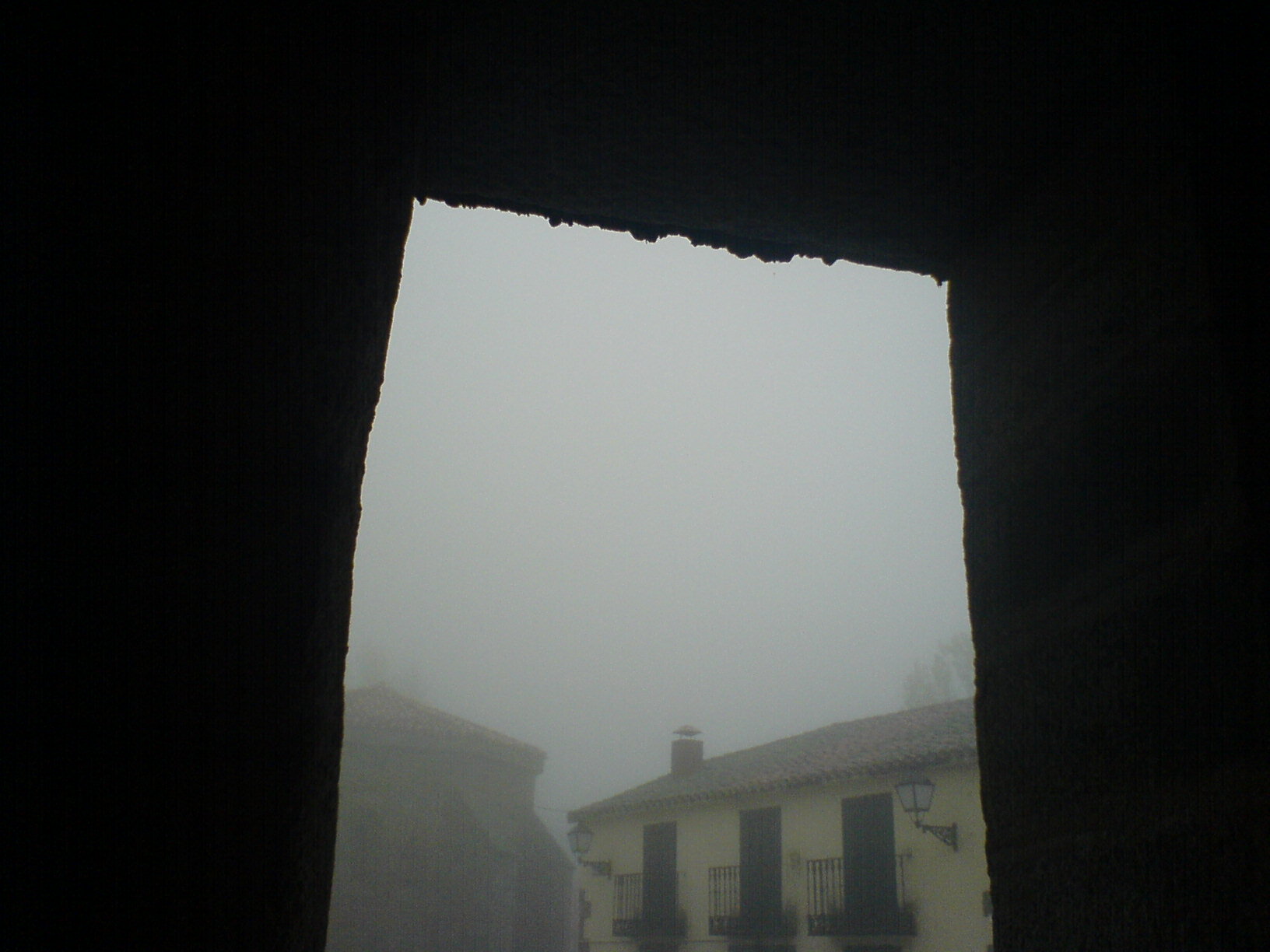
Santa Maria de la Alameda
Quite a gloomy picture. We were up there interviewing the president of a local cattle farming organisation for some work related to my PhD. Earlier in the week we had been talking about bullfighting, and Raul had pointed out the large stones found in each corner of town squares, one on either side of the road, with large holes cut through them. The purpose of these holes is to hold wooden poles across the road, closing the square for the corrida de toros. As we waited for el presidente to arrive we sheltered from the rain in the porch of the ayuntamiento. Looking at the bullring’s cornerstones and the balconies that would allow spectators to overlook the confrontation, the town square reminded me of a story retold in Hemingway’s For Whom the Bell Tolls. On that occasion it wasn’t a bullfight, it was a civil war a massacre.

Hemingway’s leading characters display stoic bravery becoming, in Lawrence Broer’s view, “manifestations of the Spanish matador”;

The bull was on him as he jumped back and as he tripped on a cushion he felt the horn go into him, into his side. He grabbed the horn with his two hands and rode backward, holding tight onto the place. The bull tossed him and he was clear. He lay still. It was all right. The bull was gone.

He got up coughing and feeling broken and gone. The dirty bastards!

“Give me the sword”, he shouted. “Give me the stuff.”

Fuentes came up with the muleta and the sword.

Hernandez put his arm around him.

“Go on to the infirmary, man”, he said. “Don’t be a damn fool.”

“Get away from me”, Manuel said. “Get to hell away from me.”

He twisted free. Hernandez shrugged his shoulders. Manuel ran toward the bull.

There was the bull standing, heavy, firmly planted.

All right, you bastard! Manuel drew his sword out of the muleta, sighted with the same movement, and flung himself onto the bull. He felt the sword go in all the way. Right up to the guard. Four fingers and his thumb into the bull. The blood was hot on his knuckles, and he was on top of the bull.

The bull lurched with him as he lay on, and seemed to sink; then he was standing clear. He looked at the bull going down slowly over on his side, then suddenly four feet in the air.

Then he gestured at the crowd, his hand warm from the bull blood.

[from Ernest Hemingway, The Undefeated]

Down on the plains of Madrid below Santa Maria, the rain has stopped and the attitude seems more ‘spirited optimism’ than ‘stoic bravery’. The Spanish economy is booming, with GDP steadily rising year on year.

The environs of Madrid feel positive, the attitude is ‘go-ahead’. Cranes are everywhere, more than in London probably. Apartments being thrown up rapidly. New roads and motorways being constructed apace. It’s been like that the last few years I’ve been visiting.

Further out, within range of the commuters (going into Madrid) and the day-trippers (coming out), economic change is modifying the landscape. The agricultural sector is in decline and as the younger generation seeks out employment in manufacturing, construction and service sectors. Talking to people in my study area it seems such employment is desired as it brings more stable working hours, more benefits, greater leisure time and a more ‘modern’ lifestyle. The environmental consequences of these shifts are still playing themselves out however. For example, such a lifestyle is likely to require more water, a precious resource in the Mediterranean. Environmentalists still campaign against large dam projects and the environmental impacts of tourism along the Costa del Sol and the Balearic Isles are well known. Maybe James ‘The Bringer of Rain’ Millington should spend more time in those places…

My particular interest is the impact of agricultural change on wildfire regimes; will the spirited optimism have to be tempered by some stoic bravery in the face of increasing wildfire risk? I’m nearing the end of my PhD research now so I hope to be able to comment on that with more authority in the near future.

Categories: , , , , , , , , , , ,

Gidden’s Risk and Responsibility

A good story is one that grips you; it’s hard to guess what is coming next but once it has been told, the outcome seemed inevitable. The same could be said for theories about how the world is — sometimes you read something that just makes sense. You knew that’s how the world was before you read about it, but couldn’t put it into words quite so eloquently. That’s how I felt when I was reading Giddens’ ‘Risk and Responsibility’.

The story goes that we have reached the End of Nature and the End of Tradition, and we are no longer in a time of External Risk but now live in a time of Manufactured Risk. Essentially Giddens‘ piece is a discussion of the about how the threats to contemporary society are a product of science and technology, and in this sense is based within the notion of the Risk Society.

To be more specific, the advances of science and technology and the ‘domination’ over nature it allows us, means that our environmental worries are no longer about what nature might do to us, but what we are doing to nature. This may be true in the majority of developed societies, but there are still plenty of developing areas in the world for which this does not apply (and natural hazards still pose a major threat to some areas of the developed world). But let’s leave that point aside and remember the problems of anthropogenically caused climate change, pollution of the worlds water-ways, deforestation of tropical rainforest, the problem of radioactive waste, and all the other protection-of-the-global-commons-type issues. In many ways, we humans have more of an influence over our environment than it has over us. This is the End of Nature.

The End of Tradition, in Gidden’s own words, “is essentially to be in a world where life is no longer lived as fate.” Previously in industrial society, the man went out to work and the woman stayed at home with the kids. But all this has changed; we are more socially mobile and we live in a world where information (via the internet), freedom (via democracy) and opportunities (via strong economies) abound. We can do what we want to do and take control of our own lives. Again, there is a limit to this and it applies mainly to developed areas of the world, but it sounds about right doesn’t it?

Risk as a concept only originated as humans began to think they might be able to take control of their environment. Whilst nature and tradition had not yet ended their demise was on the horizon. Prior to this dangers were ‘taken as given’, as ‘acts of god’ that humans could not control. Humans had little control over external risk, but they could take steps to reduce their losses in the face of frequent hazards. External Risk originated in early industrial societies with the advent of public and private insurance — we couldn’t do much about the risk (because it was external) but we could at least mitigate against our losses.

And now, finally, we have Manufactured Risk, a symptom of the risk society. Manufactured risk is the very risk caused by our own human progress and development, primarily because of the fantastic recent advances of scientific knowledge and technological innovation. Although manufactured risk is caused by human activity, because it is new and we have little experience of it we cannot calculate any probabilities associated with it. Although created by science and technology, science and technology cannot solve the problems they’ve caused — they produce uncertainty as fast as they destruct it. And besides, problem-solving is not the goal of science, science is for generating knowledge (via puzzle-solving).

Thus, whilst science and technology have reduced the problems of external risk, they have also brought the end of nature and manufactured risk with it. The threats and risks produced in our risk society are dispersed in nature and origin. Beck suggests that from this situation emerges ‘organised irresponsibility’; whilst anthropic in nature, no individual actor(s) can be held responsible. This also seems to resonate with the idea of The Tyranny of Small Decisions that I was describing just a few days ago. Scientific knowledge and technological innovation developed in an accumulative fashion, and are used by everyone that has access to it. Who can you blame?

So this is all very gloomy isn’t it? The End of Tradition. The End of Nature. The End of the Story? What can we do about this?

Seemingly the tools we used to get us to this point won’t work to help us move on and deal with the pressing environmental problems facing contemporary society; global warming, pollution, radiation, deforestation, carcinogens… To continue the story and solve these problems it’s been suggested we need a new kind of science. Not a ‘normal’, universal, value-free, distant science, but a situated, value-laden, engaged science. It’s time science stopped sticking it’s head in the sand saying “we just produce the knowledge, it’s up to society to decide what to do with it”. This ‘new’ science been named post-normal science and will be the subject (maybe hero?) as the the story continues another time. Gripping eh?

Categories: , , , , , , , , ,