Seeds and Quadtrees

The main reason I haven’t blogged much recently is because all my spare time has been taken up working on revisions to a paper submitted to Environmental Modelling and Software. Provisionally entitled ‘Modelling Mediterranean Landscape Succession-Disturbance Dynamics: A Landscape Fire-Succession Model’, the paper describes the biophysical component of the coupled human-natural systems model I started developing during my PhD studies. This biophysical component is a vegetation state-and-transition model combined with a cellular-automata to represent wildfire ignition and spread.

The reviewers of the paper wanted to see some changes to the seed dispersal mechanism in the model. Greene et al. compared three commonly used empirical seed dispersal functions and concluded that the log-normal distribution is generally the most suitable approximation to observed seed dispersal curves. However, dispersal functions using an exponential function have also been used. A good example is the LANDIS forest landscape simulation model that calculates the probability of seed fall (P) in a region between the effective (ED) and maximum (MD) seed distance from the seed source. For distances from the seed source (x) < ED, P = 0.95. For x > MD, P = 0.001. For all other distances P is calculated using the negative exponential distribution function is used as follows:
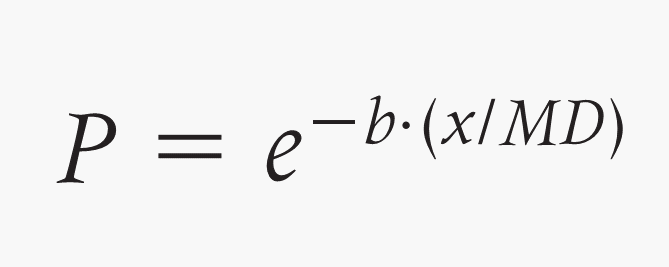
where b is a shape parameter.

Recently Syphard et al. modified LANDIS for use in the Mediterranean Type Environment of California. The two predominant pine species in our study area in the Mediterran Basin have different seed types: one (Pinus pinaster) has has wings and can fly large distances (~1km), but the other (Pinus pinea) does not. In this case a negative exponential distribution is most appropriate. However, research on the dispersal of acorns (from Quercus ilex) found that the distance distribution of acorns was best modeled by a log-normal distribution. I am currently experimenting with these two alternative seed dispersal distributions and comparing them with spatially random seed dispersal (dependent upon quantity but not locations of seed sources).

The main thing that has kept me occupied the last couple of weeks has been the implementation of these approaches in a manner that is computationally feasible. I need to run and test my model over several hundred (annual) timesteps for a landscape grid of data ~1,000,000 pixels. Keeping computation time down so that model execution does not take hundreds of hours is clearly important if sufficient model executions are to be run to ensure some form of statistical testing is possible. A brute-force iteration method was clearly not the best approach.

One of my co-authors suggested I look into the use of Quadtrees. Quadtrees are a tree data structure that are often used to partition a two dimensional space by recursively subdividing regions into quadrants (nodes). A region Quadtree partitions a region of interest into four equal quadrants. Each of these quadrants is subdivided into four subquadrants, each of which is subdivided and so on to the finest level of spatial resolution required. The University of Maryland have a nice Java applet example that helps illustrate the concept.

For our seed dispersal purposes, a region quadtree with n levels of may be used to represent an landscape of 2n × 2n pixels, where each pixel is assigned a value of 0 or 1 depending upon whether it contains a seed source of the given type or not. The distance of all landscape pixels to a seed source can then be quickly calculated using this data structure – staring at the top level we work our way down the tree querying whether each quadrant contains a pixel(s) that is a seed source. In this way, large areas of the grid can be discounted as not containing a seed source, thereby speeding the distance calculation.

Now that I have my QuadTree structure in place model execution time is much reduced and a reasonable number of model executions should be possible over the next month or so of model testing, calibration and use. My next steps are concerned with pinning down the appropriate values for ED and MD in the seed dispersal functions. This process of parameterization will take into account values previously used by similar models in similar situations (e.g. Syphard et al.) and empirical research and data on species found within our study area (e.g. Pons and Pausas). The key thing to keep in mind with these latter studies is their focus on the distribution of individual seeds from individual trees – the spatial resolution of my model is 30m (i.e. each pixel is 30m square). Some translation of values for individuals versus aggregated representation of individuals (in pixels) will likely be required. Hopefully, you’ll see the results in print early next year.

ABM of Mediterranean LUCC Paper Published in JASSS

Apparently blogging is just soooo 2004 and we should just leave it to the pros. The blog you’re reading may not be dead, but has been anaemic of late. Although this may not be the place to catch breaking news and cutting edge analysis in the 24-hour current affairs news cycle, it is a place where I can highlight some of my recent thoughts and activities. Maybe others will benefit from these notes, maybe they won’t. But in writing things down for public view it forces me to refine my thoughts so that I can express them concisely. Hopefully this blog has some life it yet and I will try to write soon about what has been taking up all my spare time recently – QuadTrees, seed dispersal and fire.

For now I will just let you know that the paper describing the agent-based model of Mediterranean agricultural Land-Use/Cover Change that I began developing as part of my PhD studies has now officially been published in the latest issue of JASSS.

Millington, J.D.A., Romero-Calcerrada, R., Wainwright, J. and Perry, G.L.W. (2008) An Agent-Based Model of Mediterranean Agricultural Land-Use/Cover Change for Examining Wildfire Risk. Journal of Artificial Societies and Social Simulation 11(4)4 http://jasss.soc.surrey.ac.uk/11/4/4.html

A Potted Guide to Washington DC

Last weekend I took a trip to Washington DC to meet up with an old friend as he passed through the East Coast (and, I might add, a newer friend who now lives there). Being Brits, two of us did all the quintessential tourist stuff that one does – wandered past the official residence of the leader of the free world, took an elevator to the top of the world’s tallest stone structure, reminded ourselves that freedom isn’t free and paid our respects to fallen soldiers, got spaced out (awesome flight simulators) at the World’s largest museum complex, debated the Wall Street Bail Out on the hill, saw some pretty pictures, and drank several of world’s best beers*.

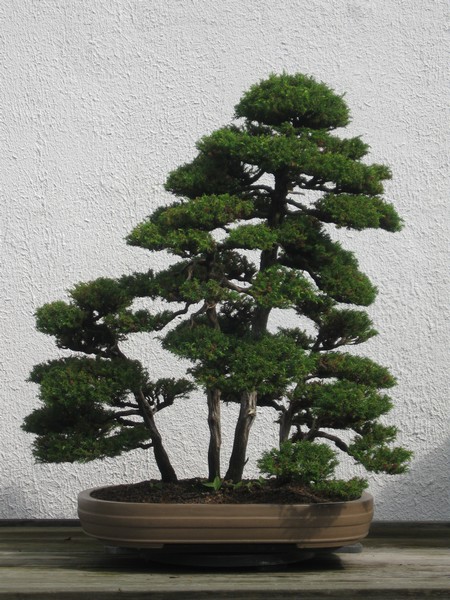
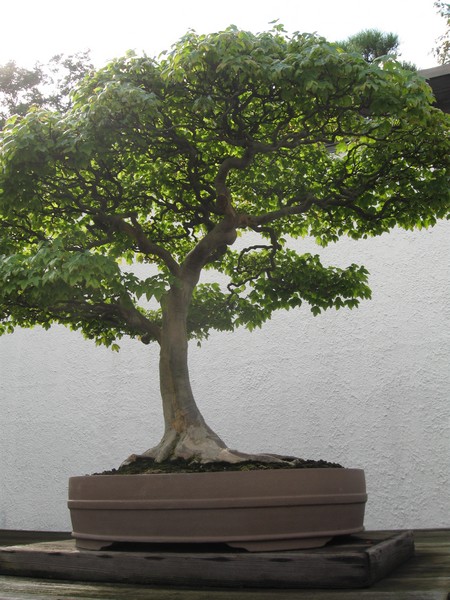
However, despite all that (and all that was very good fun) one of the things that really took my attention was the National Bonsai and Penjing Museum at the National Arboretum. Whilst vaguely aware of Bonsai I don’t think I had ever actually seen a Bonsai tree (or ‘forest’ for that matter) outside of a book. I think I assumed they were just small trees in pots, like potted plants. I certainly have never really appreciated them until now.


Bonsai is the art of cultivating miniature trees through shaping, watering, and repotting. The goal is to produce a tree that is aesthetically pleasing and realises the the principle of ‘heaven and earth in one container’. To some, all the wiring that is required and the stunting of growth may seem un-natural (or even cruel), but the results (when done right, of course) are miniature forms of arboreal beauty, expressing how the past, the present, humanity, the elements, and change itself, are all fundamentally intertwined. Bonsai are not deformed caricatures – if they were we would be unable to associate them with the nature they reflect and as a consequence they would be infinitely less beautiful or intriguing.


If I have have encountered Bonsai infrequently before, I’m sure I have never been aware of the Chinese precursor, <a href="
http://www.manlungpenjing.org/&#8221; class=”regular” target=”_blank”>Penjing. Penjing is not limited to the miniaturisation of trees but extends to the culture of idealised landscapes and scenery. Whereas Bonsai is an expression of Zen Buddhism, Penjing is philosophically influenced by Taoism and the concept of a universe containing inherently opposite but complementary forces (Yin and Yang). Penjing may juxtapose organic with mineral (for example using the root-over-rock style of tree culture) or include characters and figures to highlight contrasts in scale.


Initially, I saw Bonsai as idealisations of the untamed, full-size trees they share their genes with. And Penjing seemed to be an attempt to recreate reality on a reduced scale. But I was thinking about them as if they were models – abstract, intentionally objective, representations of reality like the ones we scientists often like to use to better understand the material world. But the more one considers them, observing the trees and the forms produced, and the more one reads and thinks about the philosophies underlying them, the more apparent it is that they are artistic creations that reflect their philosophies. They take the laws of biology and manipulate them to meet our human aesthetic intuitions. There is no claim of objectivity – this is art.

So, there are certainly plenty of venerable museums, monuments, institutions, and buildings in Washington DC. As expected I got to see and appreciate many of them. But I didn’t expect to come away with a greater appreciation and interest in an ancient art form (other than brewing, of course).

*According to the labels on the bottles.

Science Fictions

What’s happened to this blog recently? I used to write things like this and this. All I seem to have posted recently are rather vacuous posts about website updates and TV shows I haven’t watched (yet).

Well, one thing that has prevented me from posting recently has been that I’ve spent some of my spare time (i.e., when I’m not at work teaching or having fun with data manipulation and analysis for the UP modelling project) working on a long-overdue manuscript.

Whilst I was visiting at the University of Auckland back in 2005, David O’Sullivan, George Perry and I started talking about the benefits of simulation modelling over less-dynamic forms of modelling (such as statistical modelling). Later that summer I presented a paper at the Royal Geographical Society Annual Conference that arose from these discussions. We saw this as our first step toward writing a manuscript for publication in a peer review journal. Unfortunately, this paper wasn’t at the top of our priorities, and whilst on occasions since I have tried to sit down to write something coherent, it has only been this month [three years later!] that I have managed to finish a first draft.

Our discussions about the ‘added value’ of simulation modelling have focused on the narrative properties of of this scientific tool. The need for narratives in scientific fields that deal with ‘historical systems’ has been recognised by several authors previously (e.g. Frodeman in Geology), and in his 2004 paper on Complexity Science and Human Geography, David suggested that there was room, if not a need, for greater reference to the narrative properties of simulation modelling.

What inspired me to actually sit down and write recently was some thinking and reading I had been doing related to the course I’m teaching on Systems Modelling and Simulation. In particular, I was re-acquainting myself with Epstein’s idea of ‘Generative Social Science‘ to explain the emergence of macroscopic societal regularities (such as norms or price equilibria) arising from the local interaction of heterogeneous, autonomous agents. The key tool for the generative social scientist is agent-based simulation that considers the local interactions of heterogeneous, autonomous agents acting in a spatially-explicit environment and possessing bounded (i.e. imperfect) information and computing power. The aim of the generative social scientist is to ‘grow’ (i.e. generate) the observed macroscopic regularity from the ‘bottom up’. In fact, for Epstein this is the key to explanation – the demonstration of a micro-specification (properties or rules of agent interactions and change) able generate the macroscopic regularity of interest is a necessary condition for explanation. Describing the final aggregate characteristics and effects of these processes without accounting for how they arose due to the interactions of the agents is insufficient in the generativist approach.

As I was reading I was reminded of the recent suggestion of the potential of a Generative Landscape Science. Furthermore, the generative approach really seemed to ring true to the critical realist perspective of investigating the world – understanding that regularity does not imply causation and explanation is achieved by identifying causal mechanisms, how they work, and under what conditions they are activated.

Thus, in the paper (or the first draft I’ve written at least – no doubt it will take on several different forms before we submit for publication!) after discussing the characteristics of the ‘open, middle-numbered’ systems that we study in the ‘historical sciences’, reviewing Epstein’s generative social science and presenting examples of the application of generative simulation modelling (i.e., discrete element or agent-based) to land use/cover change, I go on to dicuss how a narrative approach might complement quantitative analysis of these models. Specifically, I look at how narratives could (and do) aid model explanation and interpretation, and the communication of these findings to others, and how the development of narratives will help to ‘open up’ the process of model construction for increased scrutiny.

In one part of this discussion I touch upon the keynote speech given by William Cronon at the RGS annual meeting in 2006 about the need for ‘sustainable narratives‘ of the current environmental issues we are facing as a global society. I also briefly look at how narrative might act as mediators between models and society (related to calls for ‘extended peer communities‘ and the like), and highlight where some of the potential problems for this narrative approach lie.

Now, as I’ve only just [!] finished this very rough initial draft, I’m going to leave the story of this manuscript here. David and George are going to chew over what I’ve written for a while and then it will be back to me to try to draw it all together again. As we progress on this iterative writing process, and the story becomes clearer, I’ll add another chapter here on the blog.

Website Update

Over the last week or so I’ve made a few changes to my website. The CV page has gone and a link to this blog (the one you’re reading right now) has been place in a more prominent position, right up there between Home and Research. I’ve also added a Headline Animator down in the lower left corner of each page that displays the latest blog posts I’ve made (and links to the blog). If you do want to see my CV I’ve provided links on the Home and Publications pages to download a .pdf version.

More substantially, I’ve change the Landscape Modelling section (which in turn is within the Research section) so that is is now organized by the locations I’ve studied: Spain and Michigan. There’s not so much on the Michigan pages as yet, but content will increase as progress is made on the project. If you want to read more, you can read my blog posts about the subject.

Forest Fire Cellular Automata


One of the examples I used in class this week when talking about ‘Complex Systems’ and associated modelling approaches was the Forest Fire Cellular Automata model. I’ve produced an implementation of the model in NetLogo, complete with plots to illustrate the frequency-area scaling relationship of the resulting wildfire regime. I’ve updated the wildfire behaviour page on my website to include an applet of the NetLogo model (if that page gets changed in the future, you can view and experiment with the model here).

Systems Modeling and Simulation

No sooner am I back from a fun weekend in Toronto (photos on the photos page soon) than the fall semester starts at MSU (is summer over already?!).

Today was the first day of the graduate-level class I am teaching, FW852 Systems Modeling and Simulation. During the course we will:

  1. Review systems theory and the systems modeling and simulation process
  2. Introduce modeling and simulation methods and tools, specifically the STELLA and NetLogo modeling environments
  3. Apply modeling theory, methods and tools to natural resource management and other areas of research

Term projects are a critical component of the course and students will have opportunities to develop their own models, usually related to their dissertation and thesis research. Students will peer-review others’ work, and present their results in class. Through regular and guest lectures, discussion, and hands-on experience, the course will provide students with a holistic view and integrative tools for their future research, decision-making, and management activities.

As the course progresses I may post some of the examples and topics we look at, and anything interesting that arises out of our discussions in class.

IALE-UK 2008 Conference

The provisional conference programme for the Annual Conference of the UK Regional Association of the International Association for Landscape Ecology (IALE-UK) has been published. The conference will take place between 8th – 11th September 2008 at Cambridge University with sessions to include:

  • Conservation in Farmed Landscapes
  • Dispersal in Fragmented Landscapes
  • Culture and Landscapes
  • Distribution and Fragmented Landscapes
  • Theory Into Practice: Landscape Ecology Being Used to Conserve Habitats and Species

As with all IALE conferences there will be a field trip that attendees can join. This year the IALE-UK trip will visit the Great Fen Project and Wicken Fen, part of the largest wetland restoration in Europe.

The conference programme is now full, but there are still opportunities to submit posters. Registration to attend also remains open. For submissions and registrations, contact Pete Carey, and for more information visit the conference webpage.

‘Mind, the Gap’ Manuscript

Earlier this week I submitted a manuscript to Earth Surface Processes and Landforms with one of my former PhD advisors, John Wainwright. Provisionally entitled Mind, the Gap in Landscape-Evolution Modelling (we’ll see what the reviewers think of that one!), the manuscript argues that agent-based models (ABMs) are a useful tool for overcoming the limitations of existing, highly empirical approaches in geomorphology. This, we suggest, would be useful because despite an increasing recognition that human activity is currently the dominant force modifying landscapes geomorphically, and that this activity has been increasing through time, there has been little integrative work to evaluate human interactions with geomorphic processes.

In the manuscript we present two case studies of models that consider landscape change with the aid of an ABM – SPASIMv1 (developed during my PhD) and CybErosion (a model to simulate the dynamic interaction of prehistoric communities in Mediterranean environments John has developed). We evaluate the advantages and disadvantages of the ABM approach, and consider some of the major challenges to implementation. These challenges include potential process scale mis-matches, differences in perspective between investigators from different disciplines, and issues regarding model evaluation, analysis and interpretation.

I’ll post more here as the review process progresses. Hopefully progress with ESPL will be a little quicker than it has been for the manuscript I submitted to Environmental Modelling and Software detailing the biophysical component of SPASIMv1 (still yet to receive the review after 5 months!)…

Britain from Above

I like climbing tall things in cities and then looking down to watch the human ants going about their business. Maybe my interest in experimenting with spatial agent-based models is related to this fascination.

The BBC have taken these ideas, of looking down from on high and exploring the dynamic interplay of human activity across space, and produced some incredible movies for a new show. Checkout some of the footage below – looks awesome.

If you’re in the UK, the new series Britain From Above starts at 9pm on Sunday 10th August, BBC One.