eLectures

During the second half of the course I’m teaching at MSU this semester (FW852 Systems Modeling and Simulation) I’ve invited several colleagues to give guest lectures on the modelling work they do. These lecture serve as examples to the students of modeling and simulation in practice, and provide the opportunity to tap the brains of experts in different fields.

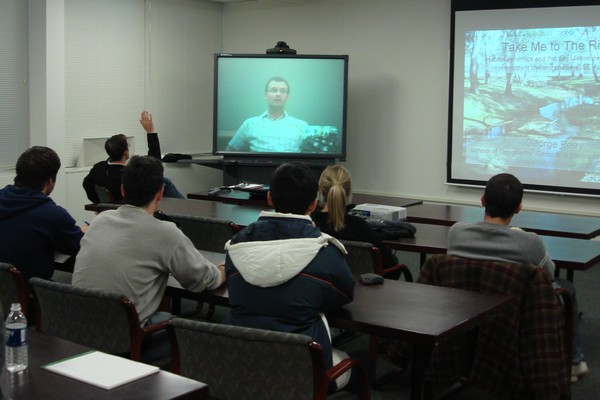
One of the speakers I invited was one of my former PhD advisors, Dr. George Perry. George is at the University of Auckland, New Zealand. Rather than pay for him to fly half way around the world we thought we would save some CO2 (and money!) by doing the lecture via internet video conference. As you can see from the photo below we had a video feed from George up on a large screen (you can also see the video feed he had of our room down in the lower right of his screen) with his presentation projected onto a separate screen (at right).


George spoke about research he has done modelling habitat dynamics and fish population persistence in intermittent lowland streams in SE Australia [I’ll link here to his forthcoming paper on this work soon]. The emphasis was on the ecology of the system and how modeling combined with fieldwork can aid understanding and restoration of systems like this.

Everything went pretty well with only a couple of Max Headroom-type stutters (the stutters were purely technical – George’s presentation and material was much more coherent than the 80’s icon!). With the increasing availability of (free) technologies like this (I often use Skype to make video calls with my folks back home, and Google just released their new Voice and Video Chat) no doubt this sort of communication is here to stay. And it looks unlikely that eLectures will stop here. As highlighted this week, academic conferences and lectures in virtual environments like Second Life are beginning to catch on too.

ABM of Mediterranean LUCC Paper Published in JASSS

Apparently blogging is just soooo 2004 and we should just leave it to the pros. The blog you’re reading may not be dead, but has been anaemic of late. Although this may not be the place to catch breaking news and cutting edge analysis in the 24-hour current affairs news cycle, it is a place where I can highlight some of my recent thoughts and activities. Maybe others will benefit from these notes, maybe they won’t. But in writing things down for public view it forces me to refine my thoughts so that I can express them concisely. Hopefully this blog has some life it yet and I will try to write soon about what has been taking up all my spare time recently – QuadTrees, seed dispersal and fire.

For now I will just let you know that the paper describing the agent-based model of Mediterranean agricultural Land-Use/Cover Change that I began developing as part of my PhD studies has now officially been published in the latest issue of JASSS.

Millington, J.D.A., Romero-Calcerrada, R., Wainwright, J. and Perry, G.L.W. (2008) An Agent-Based Model of Mediterranean Agricultural Land-Use/Cover Change for Examining Wildfire Risk. Journal of Artificial Societies and Social Simulation 11(4)4 http://jasss.soc.surrey.ac.uk/11/4/4.html

Science Fictions

What’s happened to this blog recently? I used to write things like this and this. All I seem to have posted recently are rather vacuous posts about website updates and TV shows I haven’t watched (yet).

Well, one thing that has prevented me from posting recently has been that I’ve spent some of my spare time (i.e., when I’m not at work teaching or having fun with data manipulation and analysis for the UP modelling project) working on a long-overdue manuscript.

Whilst I was visiting at the University of Auckland back in 2005, David O’Sullivan, George Perry and I started talking about the benefits of simulation modelling over less-dynamic forms of modelling (such as statistical modelling). Later that summer I presented a paper at the Royal Geographical Society Annual Conference that arose from these discussions. We saw this as our first step toward writing a manuscript for publication in a peer review journal. Unfortunately, this paper wasn’t at the top of our priorities, and whilst on occasions since I have tried to sit down to write something coherent, it has only been this month [three years later!] that I have managed to finish a first draft.

Our discussions about the ‘added value’ of simulation modelling have focused on the narrative properties of of this scientific tool. The need for narratives in scientific fields that deal with ‘historical systems’ has been recognised by several authors previously (e.g. Frodeman in Geology), and in his 2004 paper on Complexity Science and Human Geography, David suggested that there was room, if not a need, for greater reference to the narrative properties of simulation modelling.

What inspired me to actually sit down and write recently was some thinking and reading I had been doing related to the course I’m teaching on Systems Modelling and Simulation. In particular, I was re-acquainting myself with Epstein’s idea of ‘Generative Social Science‘ to explain the emergence of macroscopic societal regularities (such as norms or price equilibria) arising from the local interaction of heterogeneous, autonomous agents. The key tool for the generative social scientist is agent-based simulation that considers the local interactions of heterogeneous, autonomous agents acting in a spatially-explicit environment and possessing bounded (i.e. imperfect) information and computing power. The aim of the generative social scientist is to ‘grow’ (i.e. generate) the observed macroscopic regularity from the ‘bottom up’. In fact, for Epstein this is the key to explanation – the demonstration of a micro-specification (properties or rules of agent interactions and change) able generate the macroscopic regularity of interest is a necessary condition for explanation. Describing the final aggregate characteristics and effects of these processes without accounting for how they arose due to the interactions of the agents is insufficient in the generativist approach.

As I was reading I was reminded of the recent suggestion of the potential of a Generative Landscape Science. Furthermore, the generative approach really seemed to ring true to the critical realist perspective of investigating the world – understanding that regularity does not imply causation and explanation is achieved by identifying causal mechanisms, how they work, and under what conditions they are activated.

Thus, in the paper (or the first draft I’ve written at least – no doubt it will take on several different forms before we submit for publication!) after discussing the characteristics of the ‘open, middle-numbered’ systems that we study in the ‘historical sciences’, reviewing Epstein’s generative social science and presenting examples of the application of generative simulation modelling (i.e., discrete element or agent-based) to land use/cover change, I go on to dicuss how a narrative approach might complement quantitative analysis of these models. Specifically, I look at how narratives could (and do) aid model explanation and interpretation, and the communication of these findings to others, and how the development of narratives will help to ‘open up’ the process of model construction for increased scrutiny.

In one part of this discussion I touch upon the keynote speech given by William Cronon at the RGS annual meeting in 2006 about the need for ‘sustainable narratives‘ of the current environmental issues we are facing as a global society. I also briefly look at how narrative might act as mediators between models and society (related to calls for ‘extended peer communities‘ and the like), and highlight where some of the potential problems for this narrative approach lie.

Now, as I’ve only just [!] finished this very rough initial draft, I’m going to leave the story of this manuscript here. David and George are going to chew over what I’ve written for a while and then it will be back to me to try to draw it all together again. As we progress on this iterative writing process, and the story becomes clearer, I’ll add another chapter here on the blog.

Forest Fire Cellular Automata


One of the examples I used in class this week when talking about ‘Complex Systems’ and associated modelling approaches was the Forest Fire Cellular Automata model. I’ve produced an implementation of the model in NetLogo, complete with plots to illustrate the frequency-area scaling relationship of the resulting wildfire regime. I’ve updated the wildfire behaviour page on my website to include an applet of the NetLogo model (if that page gets changed in the future, you can view and experiment with the model here).

Systems Modeling and Simulation

No sooner am I back from a fun weekend in Toronto (photos on the photos page soon) than the fall semester starts at MSU (is summer over already?!).

Today was the first day of the graduate-level class I am teaching, FW852 Systems Modeling and Simulation. During the course we will:

  1. Review systems theory and the systems modeling and simulation process
  2. Introduce modeling and simulation methods and tools, specifically the STELLA and NetLogo modeling environments
  3. Apply modeling theory, methods and tools to natural resource management and other areas of research

Term projects are a critical component of the course and students will have opportunities to develop their own models, usually related to their dissertation and thesis research. Students will peer-review others’ work, and present their results in class. Through regular and guest lectures, discussion, and hands-on experience, the course will provide students with a holistic view and integrative tools for their future research, decision-making, and management activities.

As the course progresses I may post some of the examples and topics we look at, and anything interesting that arises out of our discussions in class.

IALE-UK 2008 Conference

The provisional conference programme for the Annual Conference of the UK Regional Association of the International Association for Landscape Ecology (IALE-UK) has been published. The conference will take place between 8th – 11th September 2008 at Cambridge University with sessions to include:

  • Conservation in Farmed Landscapes
  • Dispersal in Fragmented Landscapes
  • Culture and Landscapes
  • Distribution and Fragmented Landscapes
  • Theory Into Practice: Landscape Ecology Being Used to Conserve Habitats and Species

As with all IALE conferences there will be a field trip that attendees can join. This year the IALE-UK trip will visit the Great Fen Project and Wicken Fen, part of the largest wetland restoration in Europe.

The conference programme is now full, but there are still opportunities to submit posters. Registration to attend also remains open. For submissions and registrations, contact Pete Carey, and for more information visit the conference webpage.

‘Mind, the Gap’ Manuscript

Earlier this week I submitted a manuscript to Earth Surface Processes and Landforms with one of my former PhD advisors, John Wainwright. Provisionally entitled Mind, the Gap in Landscape-Evolution Modelling (we’ll see what the reviewers think of that one!), the manuscript argues that agent-based models (ABMs) are a useful tool for overcoming the limitations of existing, highly empirical approaches in geomorphology. This, we suggest, would be useful because despite an increasing recognition that human activity is currently the dominant force modifying landscapes geomorphically, and that this activity has been increasing through time, there has been little integrative work to evaluate human interactions with geomorphic processes.

In the manuscript we present two case studies of models that consider landscape change with the aid of an ABM – SPASIMv1 (developed during my PhD) and CybErosion (a model to simulate the dynamic interaction of prehistoric communities in Mediterranean environments John has developed). We evaluate the advantages and disadvantages of the ABM approach, and consider some of the major challenges to implementation. These challenges include potential process scale mis-matches, differences in perspective between investigators from different disciplines, and issues regarding model evaluation, analysis and interpretation.

I’ll post more here as the review process progresses. Hopefully progress with ESPL will be a little quicker than it has been for the manuscript I submitted to Environmental Modelling and Software detailing the biophysical component of SPASIMv1 (still yet to receive the review after 5 months!)…

US-IALE 2009: Coupling Humans and Complex Ecological Landscapes

Coupling Humans and Complex Ecological Landscapes is the theme of the 2009 annual conference of US-IALE (U.S. Regional Association, International Association for Landscape Ecology). The conference will be held in Snowbird, Utah, from April 12-16, 2009. Proposals for symposia and workshops are due September 15, 2008; and abstracts are due November 17, 2008.

Several types of financial support for attending and presenting at the conference are available:

(1) the “Sponsored Student Travel Awards Program” of local sponsors (USGS, Utah State University, and Utah Department of Natural Resources),

(2) US-IALE’s ‘Foreign Scholar Travel Award‘ Program,

(3) the ‘NASA-MSU Professional Enhancement Awards Program‘ (supported by NASA and Michigan State University), and

(4) the ‘CHANS Fellows Program’ of the new International Network of Research on Coupled Human and Natural Systems (CHANS-Net, supported by NSF, see background papers in Science and Ambio).

US-IALE conferences are particularly students-friendly, with two popular programs — Lunch with Mentors and NASA-MSU dinner, and a new program — We’ll “Pick Up The Tab!”.

More information about the conference is available from the web site.

Effective Modelling for Sustainable Forest Management

In many forest landscapes a desirable management objective is the sustainability of both economic productivity and healthy wildlife populations. Such dual-objective management requires a good understanding of the interactions between the many components and actors at several scales and across large extents. Computer simulation models have been enthusiastically developed by scientists to improve knowledge about the dynamics of forest growth and disturbance (for example by timber harvest or wildfire).

However, Papaik, Sturtevant and Messier write in their recent guest editorial for Ecology and Society that “models are constrained by persistent boundaries between scientific disciplines, and by the scale-specific processes for which they were created”. Consequently, they suggest that:

“A more integrated and flexible modeling framework is required, one that guides the selection of which processes to model, defines the scales at which they are relevant, and carefully integrates them into a cohesive whole”.


This new framework is illustrated by the papers in the Ecology and Society special feature ‘Crossing Scales and Disciplines to Achieve Forest Sustainability: A Framework for Effective Integrated Modeling’.

The papers in the special feature provide case studies that reflect two interacting themes:

  1. interdisciplinary approaches for sustainable forest landscape management, and
  2. the importance of scaling issues when integrating socioeconomic and ecological processes in the modeling of managed forest ecosystems.

These issues are well related to the project I’m currently working on that is developing an integrated ecological-economic model of a managed forest landscape in Michigan’s Upper Peninsula. One paper that caught my eye was by Sturtevant et al., entitled ‘A Toolkit Modeling Approach for Sustainable Forest Management Planning: Achieving Balance between Science and Local Needs’.

Sturtevant et al. suggest that forest managers are generally faced with a “devil’s choice” between using generic ‘off-the-shelf models’ where information flows primarily from researchers and planners down to local communities versus developing case-specific models designed for a specific purpose or locale and based on information from the local actors. To avoid this choice, which Sturtevant et al. believe will seldom result in a satisfactory management result, they outline their proposal for a hybrid ‘toolkit’ approach. Their alternative approach “builds on existing and readily adaptable modeling ‘tools’ that have been developed and applied to previous research and planning initiatives”.

Their toolkit approach is

  1. collaborative – including stakeholders and decision-makers
  2. a ‘meta-modelling’ approach – the model is derived from other models and tools.

They then illustrate their toolkit approach using a case study from Labrador, Canada, highlighting the stages of establishing the issues, developing a conceptual model, implementing the meta-model, and then refining the model iteratively. They conclude:

“A toolkit approach to SFM [Sustainable Forest Management] analytical support is more about perspectives on information flow than on technical details. Certainly expertise and enabling technology are required to allow a team to apply such a framework. However, the essence of this approach is to seek balance between top-down (off the shelf, science-driven) and bottom-up (case-specific, stakeholder-driven) approaches to SFM decision support. We aim to find a pivot point, with adequate information flow from local experts and stakeholders to scientists, while at the same time avoiding “reinventing the wheel” (e.g. Fig. 1) by making full use of the cumulative experience of scientists and tools they have constructed.”

Although this ‘meta-model’ approach may save time on the technical model building side of things, many resources (time, effort and money) will be required to build and maintain relationships and confidence between scientists, managers and local stakeholders. This approach is really a modelling toolkit for management, with very little emphasis on improving scientific understanding. In this case the modelling is the means to the end of integrative/participatory management of the forest landscape.

The authors continue:

“The mixture of local experts and stakeholders who understand how the tools work, scientists who are willing and able to communicate their science to stakeholders, and integrated analytical tools that can simulate complex spatial and temporal problems will provide powerful and efficient decision support for SFM.”

Unfortunately, unless the scientists in question have the explicit remit to offer their services for management purposes, this sort of modelling approach will not be very appealing to them. In a scientific climate of ‘publish or perish’, management outcomes alone are unlikely to be enough to lure the services of scientists. In some cases I’m sure I will be wrong and scientists will happily oblige. But more generally, unless funding bodies become less concerned with tangible outputs at specific points in time, and academic scientists are judged less strictly by their publishing output, this situation may be difficult to overcome.

This situation is one reason the two sides of the “devils’ choice” are more well developed to the expense of the ‘middle-ground’ toolkit approach. ‘Off-the-shelf’ models, such as LANDIS, are appealing to scientists as they allow the investigation of more abstract and basic science questions than asked by forest managers. The development of ‘customized’ models is appealing to scientists because they allow more detailed investigation of underlying processes and provide a framework for the collection of empirical data collection. No doubt the understanding gained from these approaches will eventually help forest managers – but not in the manner of direct decision-support as the toolkit modelling approach proposes.

As a case in point, the ‘customized’ Managed Forest Landscape Model for Michigan I am working on is raising questions about underlying relationships between deer and forest stand structure. I’m off into the field this week to get data collection started for just that purpose.

JASSS Paper Accepted

This week one of the papers I have been working on as a result of my PhD research has been accepted for publication in the Journal of Artificial Societies and Social Simulation (JASSS). The paper, written with Raúl Romero-Calcerrada, John Wainwright and George Perry, describes the agent-based model of agricultural land-use decision-making we constructed to represent SPA 56 in Madrid, Spain. We then present results from our use of the model to examine the importance of land tenure and land use on future land cover and the potential consequences for wildfire risk. The abstract is below, and I’ll post again here when the paper is published and online.

An Agent-Based Model of Mediterranean Agricultural Land-Use/Cover Change for examining Wildfire Risk

James D. A. Millington, Raúl Romero-Calcerrada, John Wainwright, George L.W. Perry
(Forthcoming) Journal of Artificial Societies and Social Simulation

Abstract
Humans have a long history of activity in Mediterranean Basin landscapes. Spatial heterogeneity in these landscapes hinders our understanding about the impacts of changes in human activity on ecological processes, such as wildfire. Use of spatially-explicit models that simulate processes at fine scales should aid the investigation of spatial patterns at the broader, landscape scale. Here, we present an agent-based model of agricultural land-use decision-making to examine the importance of land tenure and land use on future land cover. The model considers two ‘types’ of land-use decision-making agent with differing perspectives; ‘commercial’ agents that are perfectly economically rational, and ‘traditional’ agents that represent part-time or ‘traditional’ farmers that manage their land because of its cultural, rather than economic, value. The structure of the model is described and results are presented for various scenarios of initial landscape configuration. Land use/cover maps produced by the model are used to examine how wildfire risk changes for each scenario. Results indicate land tenure configuration influences trajectories of land use change. However, simulations for various initial land-use configurations and compositions converge to similar states when land-tenure structure is held constant. For the scenarios considered, mean wildfire risk increases relative to the observed landscape. Increases in wildfire risk are not spatially uniform however, varying according to the composition and configuration of land use types. These unexpected spatial variations in wildfire risk highlight the advantages of using a spatially-explicit ABM/LUCC.